In 2022, Tim Needles changed companies without entirely leaving the story he had spent thirty years building. Onix, the technology business he co-founded in 1992, had been acquired by Tailwind Capital. A software operation that had grown inside it, Equidox, became independent. Needles went with Equidox. After a career helping organizations move their work into the cloud, he was taking charge of a problem that could fit inside a single file.
A PDF is an unassuming place for a founder’s next chapter. It has none of the theatrical appeal of a new headquarters or a launch stage. It is where statements, forms, and reports go about their daily business. Yet a file can look finished while remaining difficult to navigate. There is a gap between sending information and making it usable. Equidox had built a business in that gap.
Needles already knew the product. Onix had acquired Capital Technology Partners, the Canadian business behind it, in 2014. Eight years of development preceded the separation. The new CEO role therefore came with a long acquaintance: he was taking an existing piece of the company’s work and giving it a business of its own.
The old brick behind the cloud
Onix began as a networking software and hardware company. Over time, its work expanded into enterprise search and cloud consulting. Those changes required a company comfortable with other companies’ technology: understanding what a platform could do, fitting it to an organization, and helping people use it afterward. A sale was one event in a much longer relationship.
By 2002, Onix was providing enterprise search to corporate and government customers. Google Search Appliance was part of that early work. The partnership later stretched across infrastructure, workplace collaboration, and mapping. In 2018, Onix earned Google Cloud’s Infrastructure Partner Specialization, a recognition of the technical practice it had built around deploying cloud infrastructure.
Some of that history is written in a decidedly earthbound building. In 2011, Onix moved from Westlake to the Georgetown Row portion of the former Bonne Bell headquarters in Lakewood. Needles said the business needed more room. He also liked the culture, nearby amenities, and historic character. For a cloud company, there was considerable interest in the neighborhood.
The address connected with an older part of his life. He had graduated from St. Edward High School in Lakewood. He and his wife, Dianne, had rented their first home together in the city. Moving the business there joined a practical requirement for space to a place the couple already knew. The next stage of growth had a familiar street outside.
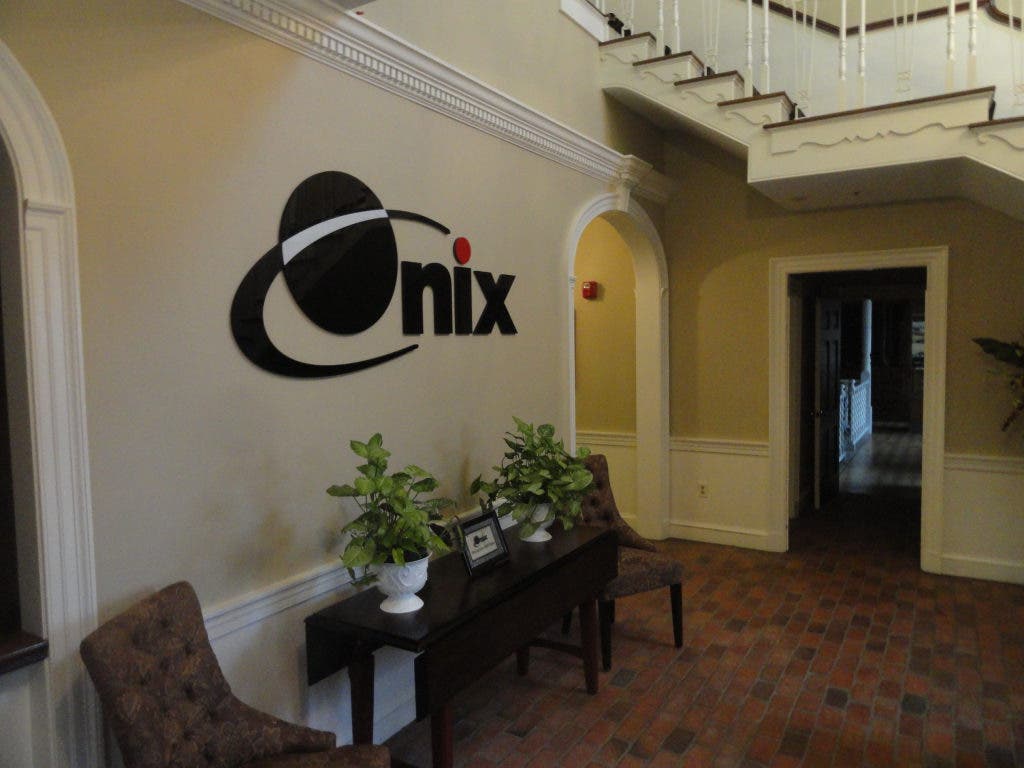
The office eventually acquired its own collection of conversational furniture: meeting spaces called the Barn and the Library, a game room, and an old-fashioned ice cream parlor. A published account of the workplace described staff being encouraged to bring ideas directly to Needles. These were recognizable choices for a growing company trying to preserve ordinary conversation. It is easier to knock on a door when the person behind it expects visitors.
Technology partnerships brought their own changes. In 2016, as the Google Search Appliance faced deprecation, Onix appointed a Google search veteran to lead its enterprise search division. Its offerings also included other search providers. That adjustment is a useful detail in a long company history: experience with one product had to carry over into helping customers choose what came next. The platform could change while the customer’s need to find information remained. Running the business meant making room for that next choice.
The customer still wants a person
Onix’s projects could be much larger than its Ohio surroundings suggested. In 2012, the company was preparing to provide cloud services to 92,000 users at the US Department of the Interior. Local reporting at the time put its workforce at nearly 45, up from about 25 a year earlier. Needles anticipated more hiring, though he declined to put a number on it. The contract was large; the staffing promise remained measured.
That combination of technical reach and personal service runs through the Canadian business, too. In 2017, Onix opened new space in downtown Toronto. Its training room was intended for sessions in which customers could identify an operational problem, try a solution, and carry the process into other parts of their organizations. The office gave the consulting work a place to happen.
Two years later, the company announced plans for a Montreal office, adding to its locations in Toronto and Ottawa. Needles explained the value in terms anyone waiting for a returned call could understand: a physical presence made the relationship more tangible. The city’s cloud modernization work involved an email platform intended for more than 25,000 employees. Behind that scale were customers who still wanted someone available to answer a question.
City employees in the scope of Montreal’s email modernization, described in Onix’s 2019 expansion announcement.
A historical project measure, not a current headcount.The work also carried less photogenic obligations. In January 2021, Onix announced ISO 27001 certification for its information security management system. Teams across the business had helped develop controls, and the audit examined documentation and conformance. Needles described it as the result of an effort begun several years earlier. The interesting detail is the duration: some of the work that supports a customer relationship takes years before it produces an announcement.
A company anniversary, with a side of dinner
Onix’s 25th anniversary celebration in 2017 included clients, partners, employees, and an announcement about a food truck. Its charitable arm, Onix Outreach, was acquiring one to distribute meals. In the midst of a technology company’s milestone, Needles had found room for a practical question about getting dinner to people. The truck was an unusually literal expression of outreach.
Tim and Dianne had established the organization in 2014 to support underserved people and families in Northeast Ohio. Its approach depended on community partners who knew where help was needed. The Cleveland Police Foundation’s account described referrals involving families, community groups, and children’s programs. In 2015, the foundation gave Onix Outreach its Outstanding Community Service Award.
That referral model matters. Giving is easier to announce than to direct well. Working through people already connected to a neighborhood gives an organization somewhere specific to begin. In Needles’s career, the community work sits beside the commercial work with a recognizable concern in common: finding the people close enough to a problem to understand what would help.
There were smaller, less ceremonial occasions, too. At the Fatima Family Center’s summer program in 2019, campers used Chromebooks and Google Jamboards for creative technology activities. Onix had donated the Chromebooks, supported fundraisers, and offered mentoring. At the time, its relationship with the center through Needles was described as stretching back roughly twelve years. A long partnership can show up in the rather cheerful form of children drawing inventions on a screen.
The work inside the file
Equidox’s development followed its own practical progression. In 2017, while it was still part of Onix, the business added document conversion services alongside its software. Customers could work on their files themselves or ask a team to do the work. The distinction acknowledged something familiar to any manager: having a tool and having time to use it are separate resources.
When Equidox became independent in August 2022, it set out plans to expand sales, marketing, and development. Its product work included both software for individual documents and custom solutions for recurring files. Needles framed growth around reaching more organizations and helping them deliver information people could use. His description of the underlying task was unusually compact.
“PDF accessibility is a challenge we can solve.”
Tim Needles, on Equidox’s independence, August 2022
In May 2023, Equidox announced Equidox AI for high volumes of system-generated or templated documents. The recurring nature of that work is important: an organization that produces statements this month will have more statements next month. A successful one-off repair leaves the next batch waiting. Automation was the company’s answer to the repetition, with the product aimed at recognizing and tagging document structures.
documents→Structure &
remediation→Information
people can use
In a February 2024 financial-services webinar, Needles appeared with Paul Campbell and Dan Tuleta to introduce the business and its automation work. The demonstration used bank statements, a suitable example of documents that share a format while changing in their particulars. The business problem was grounded in that ordinary repetition: different names, different line items, another set of pages to process.
There is a continuity here with Onix’s earlier years. Search helped people locate information. Cloud consulting helped organizations change how they worked with it. Equidox concentrates on the document that reaches the reader. Each stage creates another test of whether the technology is useful once someone actually has to do something with it.
Needles’s route to this work includes degrees in business administration and journalism from St. John’s University in New York. His interests away from the office, listed in a 2019 biography, included reading, golf, and time with his family around Marblehead and the Lake Erie Islands. The geography comes around again. A career can span platforms and borders while retaining a distinctly local map.
For now, the most revealing part of his next chapter may be its scale of attention. After decades of building a consultancy, he took on a business concerned with the organization inside an everyday file. A report leaves a company. A reader opens it. There is still work to do between those two events, and Needles has chosen to stay there.
Follow the next page
Explore the companies, conversations, and places in the story.