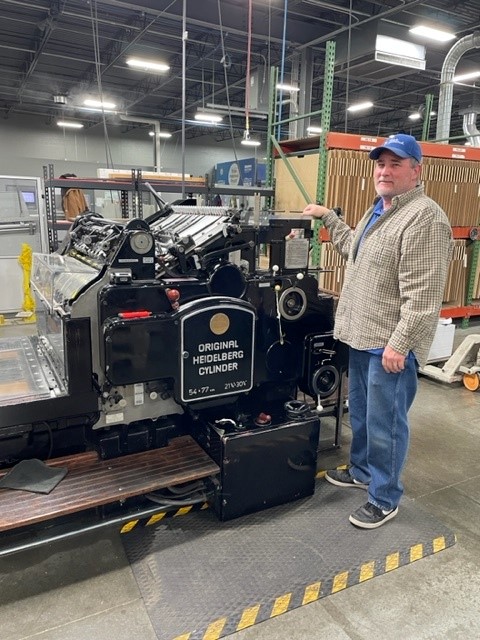
In a photograph published by equipment maker HEIDELBERG, a Think Patented operator named Shawn rests a hand on an Original Cylinder press. The machine is black, mechanical and wonderfully indifferent to marketing fashion. Somewhere else in this same business, customers place orders through branded online storefronts. The distance between those two activities is where Think Patented has found room to grow.
- Print, mail, merchandise and fulfillment, coordinated by one provider.
- Customer portals connect local ordering with corporate brand controls.
- The strongest fit: repeated campaigns with lots of moving parts.
Consider the ordinary brochure. Designing it is one job. Approving it, ordering the right quantity, keeping the current version available and getting copies to a branch office are several more. Add a promotional item and a mailing list, and the brochure becomes a small coordination exercise. Think Patented sells services across that exercise. Its phrase for the business is “marketing execution.” The plain-English translation: helping the thing actually happen.
The name changed before the job was finished
The business began in 1979 as Patented Printing. In April 2006, an investor group that included employees and industry executives bought it. Ken McNerney, already president, joined an ownership team that included former HEIDELBERG North America chief Niels Winther. Patented Printing and Patented Mailing came together under the Think Patented name.
The useful detail is the acquisition strategy. In 2014, Think Patented announced an agreement to buy Chisano Marketing Communications. Chisano brought people and customers, but also proprietary fulfillment software. The announcement specifically emphasized that technology. A printer buying a way to manage literature fulfillment is making a decision about which customer problems belong inside its business.
By its own account, Think Patented generated more than $30 million in revenue in 2024. That figure gives the operation scale without turning it into a software startup story. There are presses, inventory and people assembling things. The business earns its place by doing work customers would otherwise coordinate themselves.
The bottleneck was behind the buy button
Online ordering sounds simple until the storefront needs to speak to everything behind it. Infigo’s 2021 case study describes Think Patented outgrowing earlier web-to-print platforms. When other systems changed, the older storefronts could not integrate. Customer demands had also expanded: customized shops, procurement connections and single sign-on.
“With previous platforms, we had to really stay in the box and we had to sell that box!”
Sean Ferguson, technology and development manager, 2021
That complaint explains the switch to Infigo more clearly than a feature list. Think Patented wanted to accommodate the customer’s operation. A restrictive storefront made that harder. In March 2026, Infigo reported that the company had consolidated legacy systems and grown from approximately 30 to nearly 60 live B2B storefronts, with six more in development.
Live storefronts, not customer count or revenue.
The practical payoff is visibility into orders, budgets and fulfillment. Think Patented’s current Order360 offering describes controlled templates, approval workflows, inventory and reporting. A branch can order what it needs while headquarters sets the rules. The portal is useful because there is a production and distribution operation attached to it.
A campaign has to leave the building
That operation includes offset and digital printing, variable data, display graphics, branded merchandise and packaging. Fulfillment adds barcode inventory control, storage, pick-and-pack and international shipping. Contract packaging includes kit assembly, labeling and shrink wrapping. These are concrete tasks with concrete failure points: the wrong version, the missing item, the shipment that never leaves.
- 01 Approve & order
- 02 Print & personalize
- 03 Assemble & pack
- 04 Mail & track
Its public testimonials name Teradata, Midmark, Forge and Edison Community College. Its markets include healthcare, finance, manufacturing, retail, education and nonprofits. This puts Think Patented between commercial printers, marketing service providers and fulfillment operators. Buyers can also assemble those capabilities from separate vendors. The appeal of combining them rises with the number of handoffs a program requires.
One company-published university case study makes the digital side tangible. For an unnamed Midwestern institution, Think Patented used personalized outreach, automated follow-up and real-time lead delivery. It reports more than 2,000 applications and 636 enrolled students. Those are reported campaign outcomes; they do not isolate how many enrollments the campaign caused.
The price of getting it out the door
A public contract offers a grounded glimpse of the commercial model. Montgomery, Ohio, authorized up to $70,000 for design, production and mailing of its 2024 monthly bulletin and 2025 annual calendar. The amount is a program ceiling, rather than a unit price or proof of actual spending. It shows the shape of a purchase: a continuing communication responsibility, bundled across several services.
For a buyer, the comparison should include coordination time as well as production charges. A one-off leaflet with finished artwork may need little of this machinery. Repeated orders across locations, changing content and assembled kits make the broader offering easier to justify. That is an assessment of fit, not a claim that consolidation always saves money.
More reach, and more to coordinate
In August 2026, Think Patented announced the acquisition of Louisville’s Clark & Riggs. Owner Spring Arbor Group described the deal through Freedom Partners No. 3, identifying Think Patented as that fund’s first portfolio company. Clark & Riggs keeps its name; its capabilities include large-format printing and folding cartons. The platform now spans Dayton, Cincinnati and Louisville.
The older problem remains human. A workforce account published in 2017 described difficulty finding skilled workers and a response built around internships, apprenticeships and scholarships. Software can move an order. Someone still has to know what good production looks like.
The transferable idea is modest: draw the path from an approved idea to a delivered item. Count every handoff. Then decide which ones a customer should still have to manage. Think Patented has spent two decades widening its answer.