In 1998, a software developer stepped into an elevator with his company’s founder and came away with a rather expensive answer. Packy Hyland had asked whether the developers needed anything. Dan Wilson wanted 21-inch flat-screen monitors. Sam Babic, who remembered the encounter years later, put the price at $6,000 apiece. Hyland agreed, and followed through. Today the request sounds almost quaint. A large screen has become office furniture. At the time, it was the sort of purchase that could make an accountant look up from the spreadsheet.
The incident stayed with Babic. It gives us a useful entrance into the career of John Patrick “Packy” Hyland Jr., the founder and first CEO of Hyland Software. A person asks for a better way to work; Hyland takes the request seriously enough to spend something on it. The expense might be money. Earlier in his career, it was the effort of learning to write a program. Later, it would involve a different set of materials altogether.
A bank with a printing bill
The software story began in 1991, in Necedah, Wisconsin. Hyland was doing computer networking consulting for a single-branch bank. The bank needed to keep digital versions of reports and statements it was printing and storing on paper. Existing software struck him as expensive and difficult to use. He had limited programming experience, but learned enough to create a solution the bank bought and used. Other banks heard about it.
It is a modest setting for an enterprise software company: one customer, one recurring task, one bill that kept coming back. The reports had a purpose. Printing every report each evening was a method of keeping them. Optical disks offered another method. Hyland’s opportunity lay in making that alternative usable.
There is something refreshing about the scale of the original question. The bank did not have to imagine the future of an industry. It needed access to its information without the nightly expense of producing so much paper. An entrepreneur can spend years searching for an impressive problem. This one was already waiting at the printer.
A change in how the bank kept information.
The people between an idea and a company
A solution for one bank still needed to become a product for other organizations. Miguel Zubizarreta became central to that work. Hyland’s early software evolved through their collaboration, from ImageBase into OnBase. The name carried two associations: one database for an organization’s content, and the enthusiasm for baseball of Packy’s father, also known as Packy.
The elder Hyland helped raise the money that kept the young business going. His son’s founding story therefore has a family resemblance in more than the company name. Capital came from family, friends and smaller investors, alongside his father’s own contribution. Software needed financing before it could finance the people writing it.
The work also needed people willing to join. In 1997, Sam Babic took a lunch break from NASA’s Lewis Research Center to interview at Hyland. Packy wore a tie. Zubizarreta wore sweatpants and a Cleveland baseball jersey. Babic remembered deciding within 20 minutes that he wanted to work there.
That small wardrobe contrast is better than a slogan about company culture. There was room for the founder’s tie and the technologist’s comfort. Babic wanted a place where he could write software, learn from colleagues and make an impact. He left the interview persuaded that he had found it. He joined the following Monday.
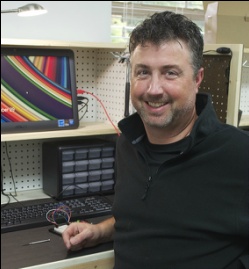
A promise in an elevator
The monitor anecdote belongs here because it describes a relationship after the recruitment was over. Asking employees what they need is easy. The question becomes consequential when the answer costs real money. In Babic’s telling, Hyland kept the promise he made to the developers.
There is no need to turn an equipment purchase into a management religion. Screens do not write software. They do, however, sit between a developer and the work for hours each day. A decision about them can say something about whether the people doing that work have been heard.
Babic remembered the price because the technology was unusual then. The purchase has become less remarkable as monitors have become cheaper. The follow-through has survived that change. This is one reason a colleague’s recollection can tell us something a product release date cannot: it preserves the moment when a founder’s question became an action.
Hyland’s relationships with partners had a similarly personal side. Travis Smith, who worked in the company’s partner training program, recalled sessions that combined classes with time spent alongside the leadership team. Packy would host the class and employees for a backyard cookout. People learning how to sell and support the software could meet the people responsible for it.
The backyard was an extension of the classroom. A reseller needed product knowledge, but also a working relationship with the vendor. Dinner created another place for that relationship to develop. The arrangements sound informal because they were; they also served a business that depended on other companies helping customers use its software.
The company grows past its first CEO
Hyland’s own chronology records a leadership change in 2002: A.J. Hyland took over as president and CEO from his brother. Packy’s send-off included a roast. A company named after a family had found a suitably affectionate way to make its founder the evening’s target.
The business continued expanding under later leaders. That distinction matters in a personal biography. Founding a company and running every later chapter are separate achievements. Packy gave the enterprise its start and its first period of leadership. Other people carried it through the years that followed.
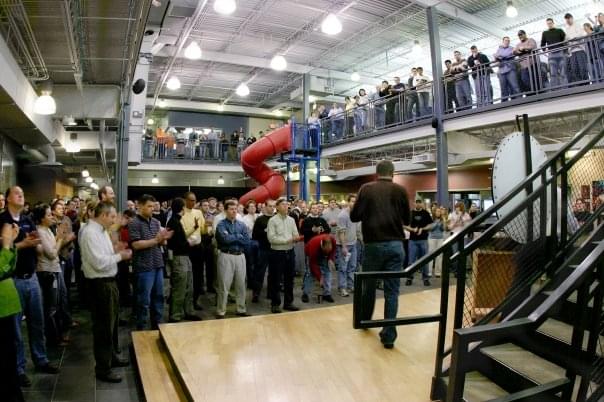
By 2005, the Westlake workplace featured a slide, a diner and space for employees to gather. A.J. described the importance of giving people a place to enjoy themselves alongside the demands of their jobs. A software business could take its customers seriously and still make room for a little architectural mischief. Slides are seldom required by the specification.
In a later conversation with his former colleagues, Packy offered a more demanding idea of employee loyalty. He wanted people to become skilled enough to attract offers elsewhere and still choose to come to Hyland. That puts a recurring obligation on the employer. The organization has to keep being a place people want to select.
“You are the president of You, Inc.”
Packy Hyland Jr.
A different sort of operating cost
Hyland’s later interests moved into solar energy and construction. His public business biography identifies him as the founder of PadSmart. His professional profile lists photovoltaic systems certificates from Solar Energy International, issued in December 2015, covering residential and commercial work as well as battery-based systems.
Those credentials belong in the story because a house makes different demands from a software application. Solar generation, construction and insulation require knowledge of physical systems. A founder’s earlier success does not make a roof install itself. Training offers a concrete detail about how he approached the change.
PadSmart describes homes designed to produce more energy than they consume over a year. Its approach combines integrated solar, insulation, airtight construction and factory-assembled wall panels. The company also describes steel framing and layouts with zero-step entries and wider doorways. These are choices about the making and everyday use of a home.
The annual energy balance is the useful measure here. Energy-positive design asks whether generation exceeds consumption across the year. A sunny afternoon alone cannot answer that question. The ambition connects the equipment on the roof with the decisions made in the walls, rather than treating the solar panels as an accessory.
Keep reports digitally.
Reduce repeated printing.
Combine efficient construction with solar.
Target an annual energy surplus.
The next plan has a roof
The housing work appears in Cleveland’s planning record. A December 2023 Northeast Design Review agenda named Packy Hyland as the representative of KiloSolar LLC, doing business as PadSmart, for a project with LMM. A February 2024 presentation again listed him as representative for the 4-Efficiency new-construction project.
A planning presentation is a particular kind of entrepreneurial document. It brings an idea into contact with a location, a proposed building and a public review process. The questions become specific: what will go here, how will it look, and how will it fit? A home has neighbors in a way a software disk does not.
The distance from Necedah’s bank reports to Cleveland’s housing plans is considerable. Yet both episodes reward attention to the unglamorous parts of daily life. A report has to be kept. A room has to stay comfortable. An expense comes around again. Someone decides to reconsider the system behind it.
Packy Hyland’s career is most interesting at that level of detail. The optical disk. The developer’s screen. The factory-made wall panel. Each belongs to a larger business, but each also belongs to someone trying to get through an ordinary day. Start with the task they have to repeat, and a better idea has somewhere to go.