During a five-hour layover in Houston in May 2023, Ale Gicqueau bought a car. A 2012 Honda CR-V, to be precise. He completed the purchase, took an Uber back to the airport, and continued to Costa Rica. The car stayed in Texas. Getting the two of them into the same country would require another journey, a traveling companion, a succession of border offices, and considerably more patience than the purchase itself.
Gicqueau eventually wrote the trip up in chapters. Then he published the accounts: fuel, hotels, fees, the price of the vehicle, the cost of getting it registered. Many travelers return with photographs. He returned with photographs and an explanation of whether the transaction made financial sense. The engineer had brought a calculator on holiday, even if it only came out afterward.
There are several ways into his working life. He is the founder associated with Clinovo and ClinCapture, a French-trained engineer who worked at IBM, and a former honorary vice-consul of Monaco in San Francisco. He also writes as Vaillant. These days, his business demonstrations include an AI assistant named Pat. The Honda offers a less formal introduction: here is a person willing to investigate an idea all the way to its administrative conclusion.
Before the road, the systems
His education took him through École Centrale Paris and the University of California, Davis. He holds engineering master’s degrees from both. His professional profile lists the Paris studies from 1993 to 1996 and Davis from 1995 to 1996. The French and American chapters overlapped early; they would continue to share space in his career.
He began as a software engineer at IBM. Later came startup work and the move into running businesses. In 2003, he founded Clinovo. The business grew out of SAS consulting under the name The Business Bridge. That starting point matters: consulting puts someone close to the awkward details of a customer’s work, where a technically sound answer still has to fit an existing organization.
Another 2003 appearance places him in a different kind of network. A French expatriate election slate identified him as an entrepreneur and the founder and CEO of InterFrench, a French-speaking mutual-support network with members in Silicon Valley. Alongside the engineering credentials was an interest in connecting people who had crossed the Atlantic and now needed to find one another.
That year, a technical presentation also listed him as a business development manager at HiT Software. Its subject was integrating a database with XML-based processes. The material concerned information moving between applications and businesses. It is a suitably practical early artifact: databases, compatibility, a demonstration. The glamorous part was presumably scheduled for another room.
*Date given in ClinCapture’s historical company profile.
ClinCapture’s historical company description dates its founding to 2010 and names Gicqueau as president and chairman. It describes a cost-conscious cloud platform and tools that customers could use themselves. Those choices suggest the commercial problem he was addressing: complicated software becomes more useful when a smaller organization can afford it and operate it.
The work also had an educational side. Clinovo released CDISC Express as an open-source tool in 2011. The company subsequently offered recorded webinars, including a joint presentation by Gicqueau and Comprehend Systems founder Rick Morrison. Demonstrating the machinery was part of the business. A customer needed to understand what could be done with it.
By August 2016, ClinCapture had appointed Scott Weidley chief executive, effective the first of that month. Gicqueau appeared in the announcement as the founder, endorsing the incoming executive’s leadership and customer focus. It is a useful dated scene in a career that otherwise risks becoming a stack of overlapping titles: a founder welcoming another person into the chief executive’s chair.
A second set of credentials
While the software business developed, Gicqueau acquired a title from a different institution. On December 9, 2009, Monaco appointed him honorary vice-consul in San Francisco. The appointment placed him in the principality’s American consular network, alongside Thomas Horn, the honorary consul in the same city. His French-American professional life now included a formal international role.
A visit to Las Vegas in 2011 supplies the human scale. Gicqueau and Alina Gicqueau came for Valentine’s Day weekend. Their hosts included Monaco’s consul Jonathan Warren and Chile’s consul Paulina Biggs Sparkuhl. There was an operatic event, dinner at the Wynn, and seats at Le Rêve, arranged with help from the Polish consulate. Diplomacy had acquired a theater booking.

The photograph preserves something a title cannot: four people posing under an exuberantly colored ceiling, on an evening their hosts thought worth recording. It belongs beside the business history without needing to explain every business decision. Gicqueau had a technical career and a social world that extended well beyond technical meetings.
The journey acquires a balance sheet
In July 2023, he returned to Houston with his friend Niek to collect the Honda. A friend there had helped receive the paperwork and prepare for their arrival. Gicqueau’s opening chapter describes a last-minute scramble over Niek’s entry authorization before their flight from Costa Rica. The road trip had developed a paperwork problem before either traveler reached the road.
They made it to Texas, collected the vehicle, and headed south. The essays follow them through Mexico and Central America, with meals, overnight stops, and excursions interrupting the business of covering distance. Gicqueau had chosen a car he expected would be straightforward to repair in Costa Rica. He had also chosen a route with plenty to stop for.
In Guatemala, he and Niek climbed San Pedro volcano. In Nicaragua, they went to Cerro Negro and slid down the volcanic slope. The writing makes room for those experiences alongside the logistics. He describes the sliding as a highlight. Even a journey organized around acquiring a useful vehicle can justify an afternoon spent traveling downhill in an entirely less useful fashion.
“Because sharing is the stuff that life is made of…”
The line beneath the title of Gicqueau’s personal blog
The follow-up, published in January 2024, changed the unit of measurement. He reported 2,672 miles of driving and a total outlay of about $18,000 once the vehicle, journey, and registration were included. He estimated the car’s local value at about $22,000. These were his figures and his valuation, an account of one purchase rather than a promise about anyone else’s economics.
He also described months of registration work. The trip’s attractive scenery had a bureaucratic afterlife. The temporary permit, customs process, fees, and final plates received their own narrative attention. His conclusion depended on the particular circumstances of the purchase and import arrangements. He was prepared to tell readers when the arithmetic would have pointed toward buying locally instead.
The 2023 drive, in his accounting
Personal figures published in January 2024. Total includes the vehicle, travel, and registration.
By March 2026, he had a sequel. This time the vehicle was a 2005 Toyota Sequoia with 250,000 miles. A friend, Jeremy, had initially tried to drive it south to attend Gicqueau’s wedding in Costa Rica. The attempt stalled, the car ended up in Houston, and Gicqueau eventually joined the effort to bring it down. The opening admits that he had already said he would never repeat the journey.
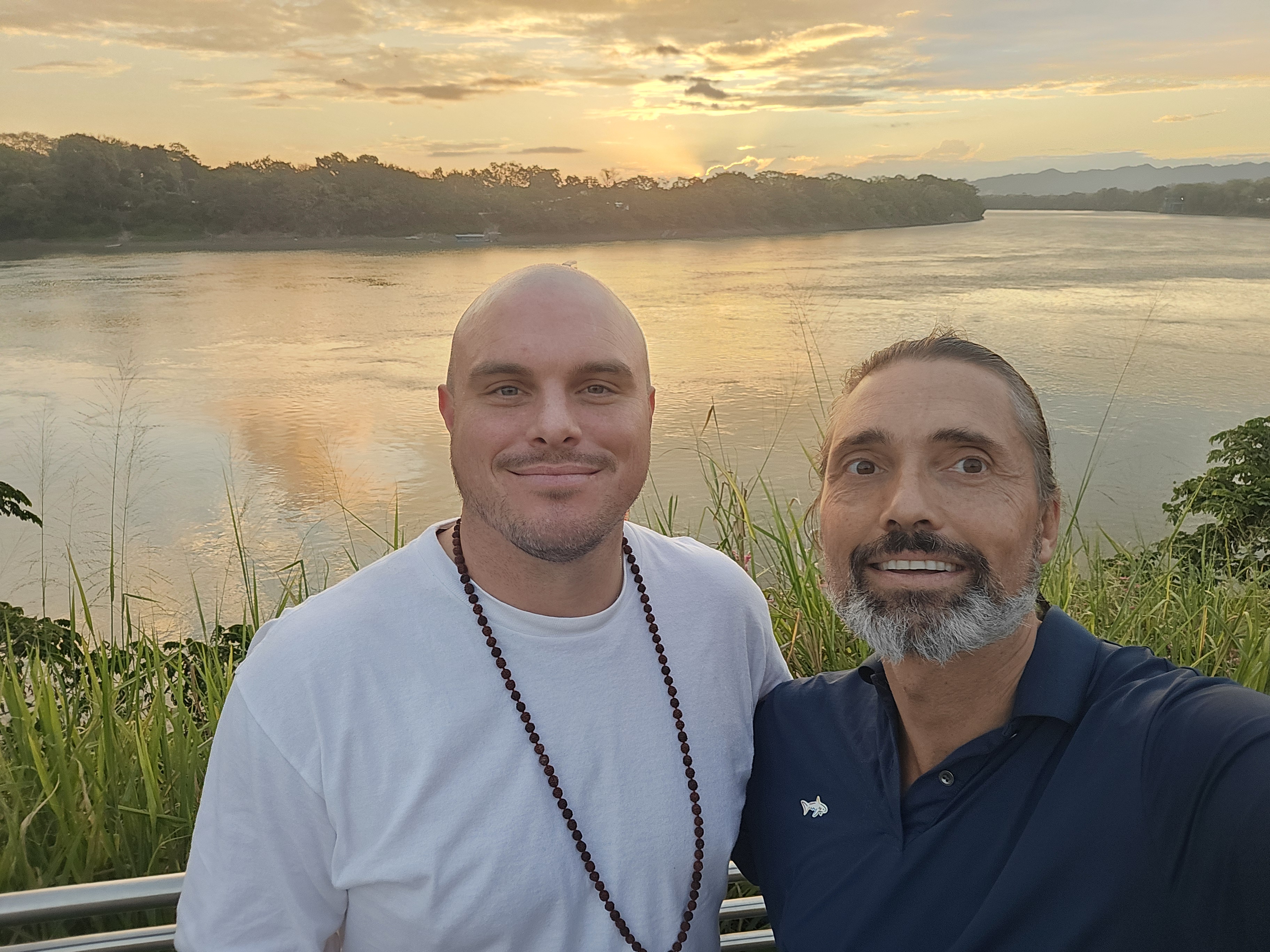
An assistant named Pat
His current business, UshAIA, brings the attention back to everyday work. He presents himself there as an entrepreneur offering AI advice and implementation to small-business owners. The examples involve properties, bookings, documents, and customer messages. They draw on operations he says he manages across the United States and Costa Rica, including a boutique hotel.
Pat, short for Personal Assistant Technology, is the assistant at the center of his demonstrations. His video catalog includes synchronizing booking calendars, answering guests in their own language, and adjusting hotel room prices. These are his published demonstrations of the system. Their appeal is easy to understand: anyone who has maintained two calendars knows how quickly the smaller administrative tasks multiply.
The catalog has continued into October 2026. One episode describes an assistant spotting a pricing configuration that made busy Christmas nights cheaper. Another concerns building an iPhone app when Gicqueau himself uses Android. He is still making demonstrations out of practical complications, now with a different set of tools and a camera close enough to show the work.
His stated ambition is to give business owners more room for creative activity and human contact by reducing routine overhead. “Work by passion, not obligation,” is how he puts it. That sentence sits comfortably beside the older webinars and the travel accounts. He enjoys showing how an undertaking works, especially when the smooth outline has met an inconvenient detail.
For all the software in this story, the old Sequoia provides a fitting last image. A plan had left a car waiting in Houston. Someone still had to go and collect it. Gicqueau went, then wrote about the trip. The promise to avoid doing it again may require a third installment.
Follow the next chapter
Work, writing, and demonstrations from Gicqueau’s public record.