Tim Hamilton went to the County Clerk’s office in downtown Houston in the summer of 2000 to register a business. He was 16. His commercial credentials included one customer, a $75 poster and parents generous enough to give him a copy of Photoshop. It was a modest inventory for a future software company. It was quite enough to begin.
The name on the paperwork was Astonish Designs. More than two decades later, the business is called Praxent, and Hamilton still runs it. The continuity is appealing, particularly in an industry fond of announcing a fresh beginning every Thursday. Yet the interesting part of his career is how much he has had to revise while keeping the same job.
He learnt to build what customers requested. Later came the less comfortable work: choosing which customers to serve, inviting other people into decisions and accepting that a good idea can arrive with a dreadful first invoice. His move into financial services would test all three.
01Before the paperwork, a screen full of stars
The first attraction was the pleasure of making something happen. In the late 1980s, his father gave him a Sinclair ZX Spectrum. Hamilton copied six pages of code from its manual, corrected his typing and watched stars appear on the television. Before computers, there had been treehouses and cardboard forts. The materials changed; the urge to assemble a world remained.
“What else could I create?”
Tim Hamilton, remembering his first program
That question is a better introduction to him than a job title. The small drama of a program finally running has a particular charm: the machine offers no encouragement, then suddenly rewards every correction. For a child inclined to make things, even a black and white screen can look like an invitation.
Hamilton was born in Johannesburg, grew up in Durban and moved with his family to Houston at 11. American sports references required translation. He later recalled that colleagues still had to explain the metaphors. A business meeting is apparently one more place where knowing cricket does not entirely prepare you for the ball game.
His early design client was a tennis coach. Hamilton remembers a poster abundant in lens flares and flaming lettering, followed by a request for a website. He bought a teach-yourself HTML book and learnt as he went. The typography may have lacked restraint. The willingness to figure things out was already in working order.
02Astonish Designs acquires some grown-up problems
Hamilton continued building the company while studying at the University of Texas at Austin. His education covered management information systems and economics, an appropriate combination for someone discovering that making software and making a business behave are separate disciplines. The client list widened beyond straightforward websites into portals and custom applications.
The early projects ranged across industries. There was work for NRG, Cost Plus World Market and McCoy’s Building Supply. That variety gave the company room to learn, but it also meant the founder’s curiosity had plenty of places to wander. A capable generalist can always find another interesting problem. Paying for all that interesting work requires a little more organisation.
One answer arrived in 2016, when Kevin Hurwitz joined as managing partner. Hamilton had been reading Rocket Fuel, with its distinction between the person generating possibilities and the person bringing operational discipline. Recognising the need for that partnership meant admitting that an expanding business could ask for abilities its founder did not supply alone.
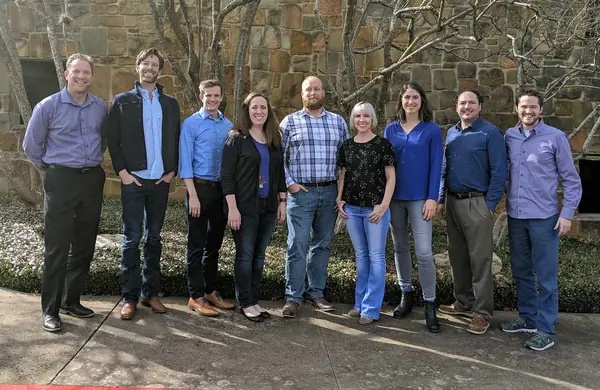
By January 2019, the executive team numbered nine. Product strategy, design, engineering and project management had their own leaders. The group photograph is a useful interruption to the solitary-founder legend. A business that began with one teenager and a design program now needed people whose expertise could complicate, challenge and improve his plans.
03The expensive business of choosing
Praxent’s sales rose from $3 million in 2016 to $11.5 million in 2019. Hamilton and Hurwitz had worked on bringing in business through a repeatable marketing process, reducing dependence on referrals and individual hustle. Growth had become something the organisation could work on deliberately. Then Hamilton chose to change the kind of organisation it would be.
In 2020, Praxent committed to specialising in financial services. The transition initially halved both its team and revenue, a setback Hamilton later made the subject of an Austin Chamber business-owner talk. Narrowing a company’s focus sounds admirably clean when drawn on a presentation slide. In practice, it can involve an alarming amount of erasing.
There is no need to varnish that contraction into a cheerful milestone. It gives the decision its weight. A general software firm can pursue many kinds of work; a specialist has to earn the right to be chosen for a smaller set. Hamilton was exchanging the comfort of breadth for the possibility of understanding particular problems more deeply.
For someone whose business began by accepting a request and then finding a book, that is a substantial change of habit. The useful question becomes which problems deserve the company’s accumulated attention. A founder can remain curious while learning to close a few doors. The doors, naturally, seldom thank him.
04What a bank actually needs
The financial-services focus becomes easier to understand through the work itself. In December 2023, Locality Bank described its partnership with Praxent to build a data warehouse and business intelligence systems. Customer information sat across different systems, limiting reporting and the bank’s view of its relationships. The task was to bring that information together.
A data warehouse has none of the glamour of a new app launch. Its usefulness is rather more durable than glamour: people can ask better questions when the relevant information is available in one place. For a bank serving local businesses, that can shape how it understands a customer and decides which services might help.
Hamilton’s public discussions of modernisation return to such practical constraints. Community financial institutions need to respond to digital competitors while working around existing technology. His interest in focused customer propositions fits his own company’s experience. The same temptation visits both banker and software consultant: offer everything, then wonder why the offer is difficult to explain.
05A company scattered across the map
Building the team brought another design problem. Praxent operates across the United States and Latin America. In a distributed company, proximity cannot be counted on to deliver introductions, notice good work or explain how a career advances. Those experiences need someone to think about them, much as someone thinks about the steps in a customer’s application.
Hamilton has described a weekly, half-hour Huddle featuring shared wins, music and celebration. The idea is to give colleagues a rhythm they can recognise wherever they work. His approach also includes deliberate attention to onboarding, promotion and access to feedback across locations. An office has walls by default. A dispersed company has to decide what will hold it together.
“We’ve got to have a budget for mistakes.”
Tim Hamilton on developing people’s judgment
That allowance matters in a company selling expertise. People need room to develop judgment, which is awkwardly difficult to acquire without occasionally exercising poor judgment. Hamilton’s emphasis on coaching gives his fondness for learning an organisational consequence. A founder who taught himself HTML can appreciate that competence often begins with being conspicuously new at something.
He also draws on The Progress Principle, by Teresa Amabile and Steven Kramer: people respond to a felt sense of forward movement. Clear career paths make that idea concrete. Recognition and advancement become things employees can understand and work toward. A vague promise of opportunity is considerably less useful than knowing what the next step requires.
06The programmer who keeps asking questions
Hamilton has spent time on both sides of the interview. His Commanding Business podcast brought him into conversation with business authors and operators, including sales specialist Jack Daly. In the Financial Services Innovators series, he interviewed Argyle founder Shmulik Fishman about employment data, asking how people encounter the technology and where it sits inside a financial product.
Those questions reveal a consistent interest in the junction between systems and people. He wants to know what a product does, how it feels to use and how the organisation delivering it works. He also serves as program committee chair on the Association for Financial Technology’s board, extending that habit of convening conversations beyond Praxent.
07Another new machine, the same old question
By 2026, artificial intelligence had become a central subject in Hamilton’s work. In a March essay, he described an ambition for AI embedded in financial platforms with governance, auditability and measurable returns. His argument rests on understanding the business rules inside financial systems. A persuasive demonstration still has to survive the less theatrical business of operating reliably.
Praxent now describes a team of 200 specialists and an AI transformation focus. The scale is far removed from Astonish Designs, although the underlying invitation is familiar: here is a difficult problem, and here are tools that might help. The intervening years have added colleagues, constraints and a more exacting definition of useful.
Hamilton’s career has room for both the child delighted by a screen of stars and the executive willing to discuss a painful contraction. One supplied the appetite to begin. The other learnt that keeping a company alive involves revising the work, the team and sometimes the offer itself. He still has things to build. These days, choosing them is part of the craft.