Four desks fitted into the room behind his father’s metalworking business. Mariano Di Maggio returned there years later, before Crombie’s twentieth anniversary, and showed the place where the enterprise had begun in May 2005. The first customers were small local businesses. The first colleagues had agreed to join a venture whose premises did very little of the persuading.
It is a pleasingly inconvenient beginning for a software company. Technology likes to imagine itself freed from physical limits; furniture is less philosophical. Before international clients, before conference stands, there was the elementary question of where everybody would sit.
Today Di Maggio is the founder and CEO of Crombie, the Argentine company previously called 4R Soluciones. Its work reaches fintech and retail businesses beyond Argentina. His account of that first office supplies something a list of markets cannot: the people who trusted him when the proposition was still small enough to fit behind a workshop.
A growing company needs a longer conversation
A larger team changes the questions a founder must ask. In 2023, Crombie reached 100 collaborators. That year, its Campus gathering included Melina Jajamovich, whose contribution considered the demands of growth: keeping an organization effective, making room for learning and deciding what should survive as the business changes.
Di Maggio welcomed the experience as material for the company’s continuing development. Jajamovich’s account of the session credited him with opening the conversation across the organization. The subject was how to create a culture capable of growing, including the patience to let people adapt and the willingness to make decisions with evidence.
There is a familiar comedy in organizational expansion. More people arrive to help with the work, and suddenly part of the work consists of helping everybody work together. Crombie’s gathering gave that problem a place on the agenda. The founder was participating in a discussion about how the company should change, with colleagues whose daily experience would shape the answer.
By the following anniversary, Di Maggio was describing a longer horizon. He brought together more than 100 Crombie colleagues and their families for a celebration in 2024. Away from everyday obligations, they had an opportunity to know one another better. He wrote about the responsibility attached to affecting so many people’s lives.
He also mentioned a ten-year plan for the business, one to which he wanted each member to contribute. An anniversary generally encourages the safe occupation of looking backwards. He used this one to invite people into what came next. A celebration and a planning conversation could share the same occasion.
- 2005The first office opens behind the family workshop.
- 2023Crombie reaches 100 collaborators; Campus examines growth.
- 2024A Germany summit and a ten-year planning ambition.
- 2026AI conversations and software for Santa Fe’s municipality.
The airport is part of the job
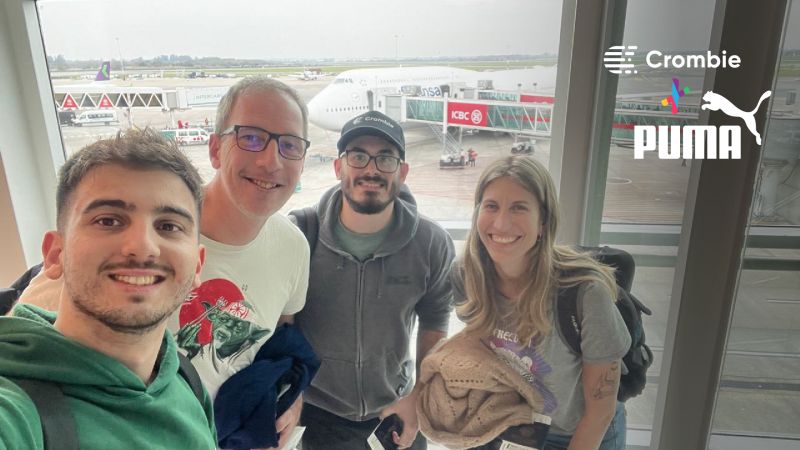
In May 2024, a photograph put Di Maggio alongside three Crombie colleagues at an airport. An aircraft waited beyond the windows. The team was heading to PUMA’s eCom Engineering Summit in Herzogenaurach, Germany, on May 23 and 24. The accompanying announcement named the CEO, CTO Francisco G., project manager Laura Mó and technical leader Lautaro Gonzalez Scholtus.
Crombie said its PUMA work supported ecommerce in Canada, the United States, the United Kingdom, Japan and India. A team of 22 worked across time zones. The scope included payments, interface improvements and site performance. The invitation brought the people doing that work into a gathering of internal and external engineering teams.
Di Maggio described the trip as a chance to learn from other professionals and cultures, and expressed pleasure in travelling with his colleagues. The photograph has the ordinary charm of a group setting out together. International business, viewed from an airport window, still involves bags, boarding times and making sure everybody is in the picture.
Barcelona offered another setting for the same outward-looking work. For Mobile World Congress 2025, Crombie announced its own stand at 4YFN after attending previous editions. Di Maggio and senior account manager Milton Nieves were to represent the business, introducing its approach to understanding customers and connecting technology with commercial needs.
The stand included plans for short Crombie Talks about business efficiency and examples from fintech and retail. The stated purpose of the visit included meeting businesses, understanding their challenges and exploring opportunities face to face. For a company whose product can cross a border electronically, the itinerary gave personal contact a deliberate place.
His later reflection on Skylight Lending’s annual summit in Houston made the reasoning explicit. In-person visits, he argued, reveal how decisions are made, where operations encounter friction and what pressures leadership teams are managing. They also create space for candid feedback and discussing mistakes together.
“Technology can be built remotely. But truly understanding a business rarely happens that way.”
Mariano Di Maggio, reflecting on a client summit in Houston
That observation gives the travel a purpose beyond collecting destinations. A software partner needs to understand the organization in which a platform will operate. Who decides, who depends on whom and where a process becomes difficult are consequential details. Di Maggio’s argument is that sharing a room can help make them visible.
Empathy, with a job to do
Di Maggio set out his customer-centered thinking in an August 2024 opinion article. He argued that understanding clients matters in business-to-business work as much as it does when selling directly to consumers. Corporate buying brings its own complicated decisions, specific constraints and expectations. Listening is part of the technical assignment.
His explanation reached beyond satisfying an immediate request. He wrote about anticipating challenges and treating a relationship as something with room for both parties to develop. In his account, the useful combination is technical ability and a detailed understanding of human needs. The application or website has a purpose in somebody else’s life and work.
This gives Crombie’s recurring language of empathy a practical obligation. Understanding must affect what gets built. A courteous conversation is pleasant; software still has to handle the task for which someone commissioned it. His argument asks the engineering business to keep those two responsibilities connected.
Back to the city that gave him a start
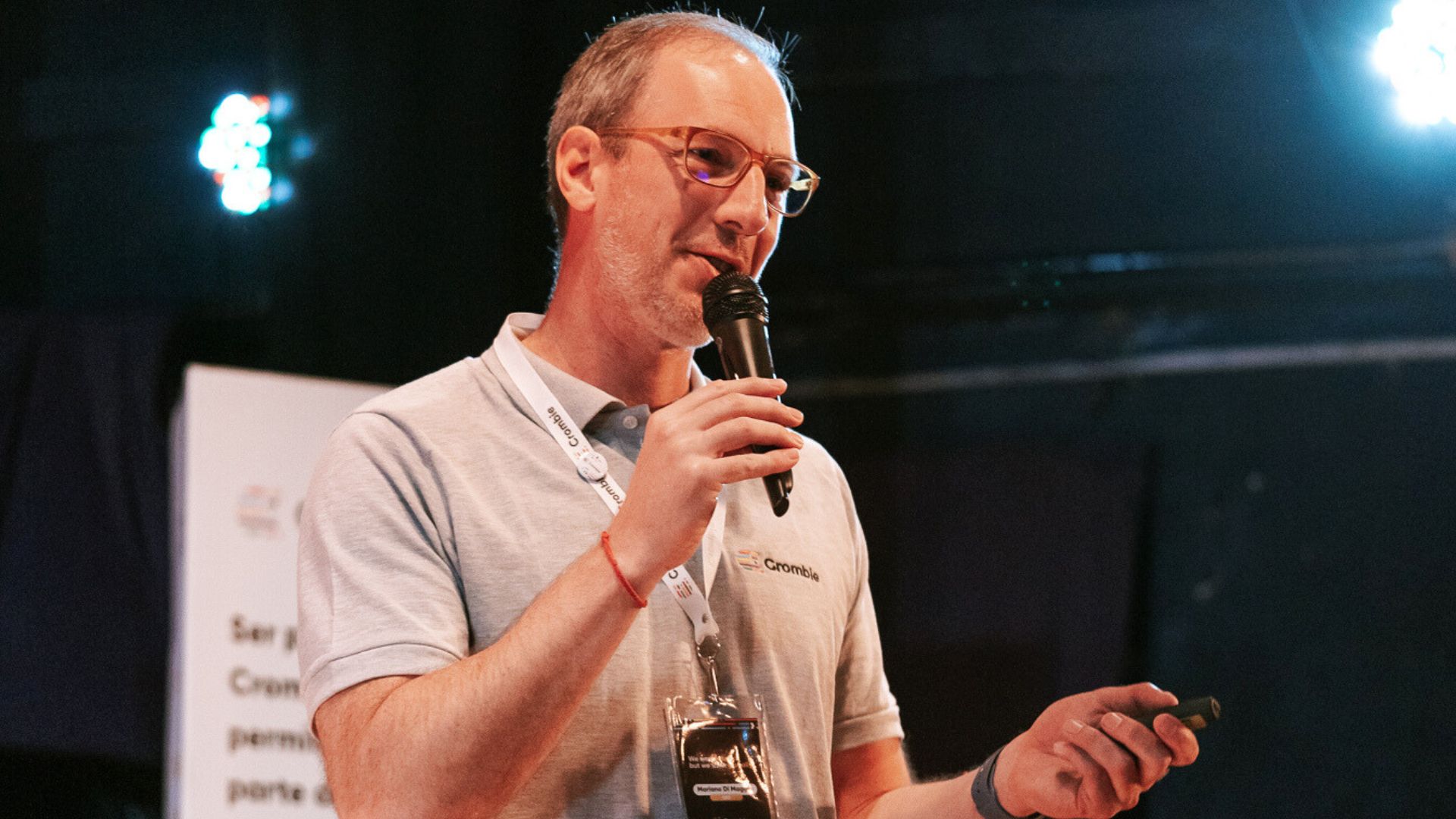
In September 2026, that language acquired a distinctly local setting. Crombie worked with Santa Fe’s municipal technical teams on La Muni en tu Celu, an application intended to help residents manage services, receive information and participate from their phones. Di Maggio spoke at its presentation about the pleasure of working for the city.
He described technology as a way of connecting people and resolving problems, an idea he said the company had been advancing for 21 years. The municipality emphasized the local professionals involved and its ability to keep developing the application. The city was acquiring something it could continue to expand.
For a founder whose company works internationally, the project adds another direction to the map. Expertise developed in Santa Fe could serve distant ecommerce operations and return to the practical business of residents dealing with their municipality. A blocked street and an online checkout have different audiences. Each makes the quality of software an everyday experience.
Di Maggio’s connection to the local industry also appears in his participation in Cluster TIC Santa Fe. He has described himself as a founding member since 2010. In August 2026, his public activity included the ConECtar event at UTN Facultad Regional Santa Fe, discussing technology and knowledge alongside other companies from the city.
Faster software still needs clear thinking
Artificial intelligence has given him another subject to take into public conversation. On July 23, 2026, the Código Abierto series at DEMOS in Santa Fe scheduled him to discuss AI’s effect on the software industry. The event addressed production, quality, development time and the changing skills of programmers. An interview from DEMOS also brought his views to YouTube.
His public comments place method beside speed. Crombie has been developing an approach that combines AI agents with human judgment and specification-driven development. Di Maggio points to problems that arise before programming: unclear requirements, assumptions left unchecked, decisions without a record and knowledge concentrated in one person.
The concern follows the same line as his writing about clients. Understanding the task takes work, even when producing code becomes faster. Teams need a way to make their reasoning traceable and keep delivery connected to the business. A tool that moves quickly gives the person choosing the direction more to consider.
A schematic of the priorities in Di Maggio’s public comments on software delivery.
Room for the next person
At the end of 2025, Di Maggio looked back on travel, talks, teams and companies reconsidering how to use technology. He described stronger international relationships and new AI work. What he most valued, he said, was the movement inside Crombie: people taking on roles, bringing ideas and finding different ways to work.
That is a revealing choice of emphasis for an anniversary-era founder. The public account includes customers abroad and changes in the technology, yet he repeatedly returns to colleagues developing alongside the business. The ten-year plan, the Campus discussion and the family gathering all give that interest a concrete setting.
There are smaller details alongside the corporate plans. He identifies himself as a father of three. His X biography describes a preference for reading on paper, curiosity and an intensity that extends to making coffee. His professional projects include an online football prediction game listed in 2011. These details give the executive biography a little domestic clutter: books, family, a cup prepared with conviction and the occasional competition over who knows more about football.
The four-desk office belongs to the past. The question of how people join an uncertain venture, learn together and help decide its future remains present. Di Maggio has given it more room, more participants and a considerably more complicated travel schedule.