Tianwei Liu wanted to do his friends a favour. He was working at Amazon in Silicon Valley, where a staff discount made a Kindle an appealing purchase. Friends in Singapore wanted one. Getting the devices across the Pacific was manageable. Getting paid back was the part that refused to behave.
In his retelling, ten Kindles produced eight bank transfers. One payment was twice the expected amount. Names were missing. A small act of friendship had acquired a reconciliation department, staffed by one increasingly puzzled software engineer. The collecting stretched from Christmas towards Chinese New Year.
There is something pleasingly unglamorous about this beginning. Before the stablecoins, the investors and the conference stages, there was a man trying to establish which friend still owed him money. The parcel could travel. The information that should have accompanied the payment could not keep up.
Liu would go on to co-found Xfers and lead StraitsX, the payments business within Fazz that issues the Singapore dollar stablecoin XSGD and its US dollar counterpart, XUSD. The distance between a box of e-readers and digital financial infrastructure looks considerable. Follow the inconvenience, however, and the route becomes easier to see.
A useful education in leaving
Liu’s working life began around the devices people hold, wear and tap. His background includes computer engineering at the National University of Singapore, a Silicon Valley placement through NUS Overseas Colleges, and study at Stanford during that programme. He worked on developer tools at WIMM Labs, an early Android smartwatch company, before joining Amazon Lab126 in 2012.
These jobs put him close to the engineering behind consumer electronics. A device looks self-contained when it reaches the customer. Behind it sit software tools, data systems and teams whose work is largely invisible. His later interest in payments would involve a comparable arrangement: a simple action supported by a great deal of machinery.
The return to Southeast Asia brought him to a different set of constraints. An elegant consumer payment app would still need a dependable way to receive money, identify it and send it onward. Building the screen was only part of the job. Someone had to make the underlying bank transfers usable by software.
Xfers pursued that work. An API, in this context, gives another business a way to make payment functions part of its own product. A merchant should be able to identify an incoming payment without undertaking the detective work Liu had performed for his friends. The engineering problem had become a business proposition.
Buy a Kindle → collect a bank transfer → identify the payer → make the process repeatable.
The recurring problem in Liu’s career: a payment is useful only when the people around it can act on it.
The work beneath the app
Xfers joined Y Combinator’s summer 2015 batch. The programme placed a Singapore payments company inside a network of founders building across markets. It also supplied a connection that would matter later: Payfazz, the Indonesian fintech co-founded by Hendra Kwik, was another YC company.
The two businesses approached access to finance from different directions. Xfers supplied payment infrastructure. Payfazz developed an agent network serving Indonesian communities, including places where a familiar local shop could act as a point of access to financial services. Put together, they offered both the machinery and a route to the customer.
In March 2021, Payfazz invested US$30 million in Xfers, leading to the formation of Fazz Financial Group. Liu became the group’s deputy CEO. The combined group subsequently announced a US$100 million Series C in September 2022. The combination gave the businesses a shared structure for their regional plans.
For an engineer, distribution is an education of its own. Software may work exactly as intended and still struggle to find a place in someone’s day. An agent who already serves a neighbourhood has something an API cannot supply by itself: a relationship. Fazz brought those two forms of usefulness into the same organisation.
“Real world utility trumps everything.”
Tianwei Liu
That short observation is a helpful way into his career. The question keeps returning to what somebody can actually do. Can a business collect a payment? Can a traveller buy lunch? Can the merchant receive the right currency? These are fairly stern examinations for a technology with an enthusiastic vocabulary.
A Singapore dollar takes another form
StraitsX publicly launched XSGD on 5 October 2020. The design linked a blockchain token to Singapore dollars held in reserve, with one XSGD backed by one Singapore dollar. It gave developers a locally denominated asset they could move through blockchain applications.
The local currency matters. A merchant pricing goods in Singapore dollars has obligations expressed in the same currency. A digital token tied to another unit of account introduces another consideration into an already busy working day. XSGD made the Singapore dollar itself available within this different technical environment.
The product’s development included practical, incremental changes. In April 2021, StraitsX expanded the number of verified blockchain addresses users could connect and improved automatic crediting for certain deposits and withdrawals. Such changes rarely supply a stirring keynote. They do help explain whether people will return to a product tomorrow.
Transparency became another part of the work. In 2022, StraitsX announced monthly public reserve attestations by a certified public accountant. A stablecoin’s promise depends on what stands behind it. Publishing information about those reserves makes that promise available for scrutiny beyond a founder’s assurances.
Regulatory language calls for the same care. In November 2023, StraitsX announced in-principle approvals for its Singapore dollar and US dollar issuance entities. As of 2026, XSGD and XUSD are acknowledged by the Monetary Authority of Singapore to be substantively compliant with the upcoming stablecoin framework. Those words carry a more precise meaning than a loose claim of official endorsement.
The customer orders coffee
The public experience can be much simpler than the institutional arrangements. StraitsX’s work with Grab and Alipay+ connects familiar wallet payments to settlement using XSGD. A visitor can use a home wallet while a Singapore merchant receives local currency. The blockchain occupies the middle of the transaction.
A payment flow can therefore contain a substantial technical change without demanding a new ritual at the counter. This is central to Liu’s approach. The customer has arrived to purchase something. A satisfactory payment system allows that person to finish the purchase and get on with the day.
Simplified illustration of the wallet-to-merchant model, not a timing guarantee.
In Hong Kong in 2026, Liu demonstrated a payment ring during an interview. The wearable let him tap to pay with his hand. There is a quiet circularity here: someone who worked on early smartwatch tools now runs infrastructure that can sit behind another small object worn on the body.
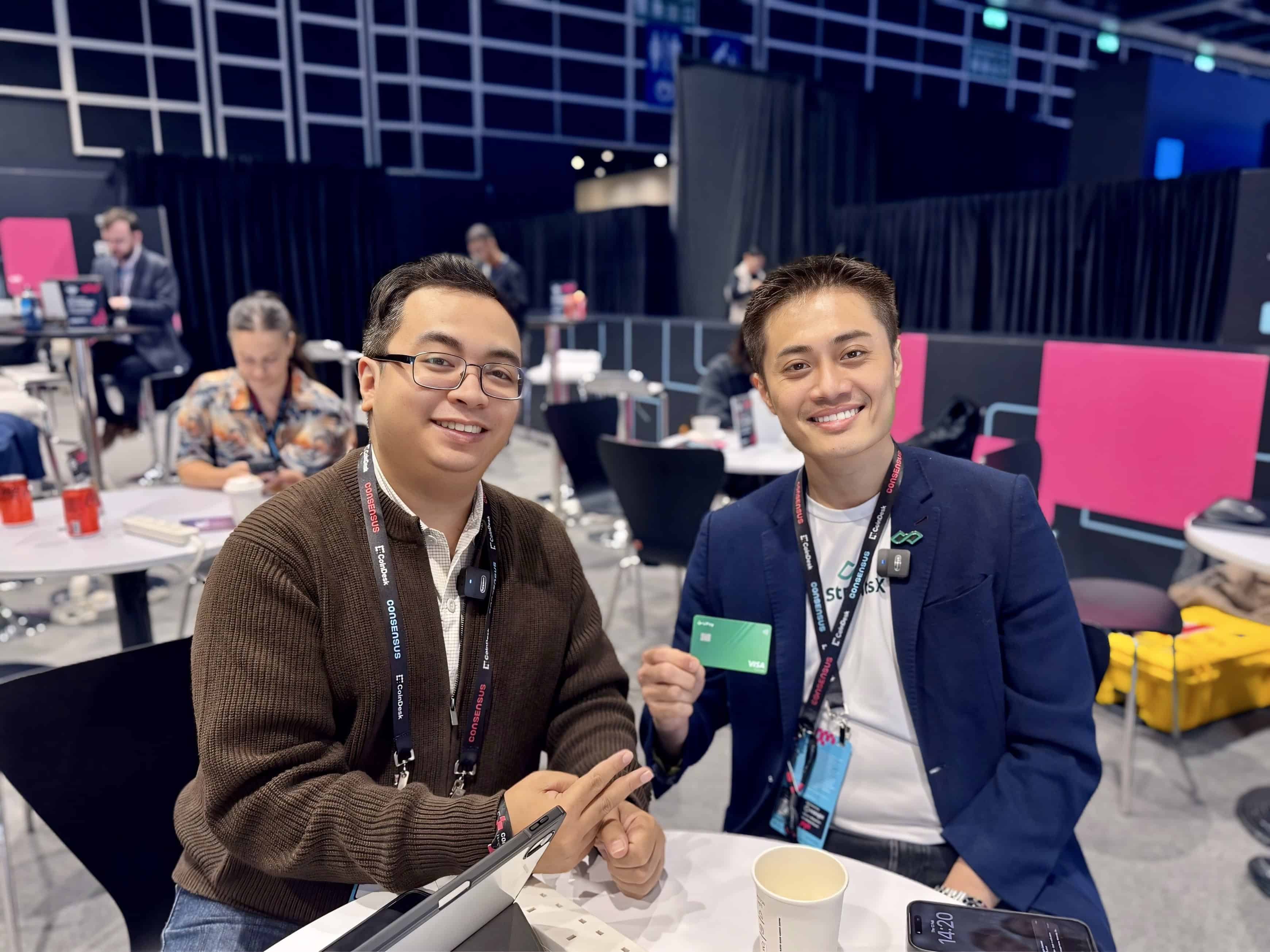
The demonstration also gives the technology a useful scale. Much of the language around digital assets concerns enormous markets. Here the action is a knuckle approaching a reader. Liu’s ambition becomes intelligible in that small movement: let the system do its complicated work while the person does something ordinary.
An engineer’s case for letting go
There is a danger in building a technically interesting answer: eventually, the answer can become more attractive to its makers than the problem that prompted it. Liu has addressed that temptation directly. In a 2024 essay, he described shelving ideas the team liked because they did not match customer needs.
That admission adds texture to the founder story. Engineering rewards the satisfaction of making something work. Running a business adds a less comfortable test: whether the thing deserved to be built in the first place. Attachment to a clever solution can make that question surprisingly difficult to hear.
His stated ambition is to build financial infrastructure that endures across generations. Such an aspiration requires a willingness to change individual products along the way. The durable part is the purpose: helping people and businesses move value. A particular interface, device or protocol can have a shorter working life.
More countries, and a new kind of customer
On 15 October 2026, StraitsX announced a Visa partnership expanding its card issuing capabilities to more than 100 markets, subject to applicable regulatory, compliance and Visa requirements. The company reported annualised card gross transaction volume above US$6 billion across its stablecoin-backed programmes. Annualised volume describes the pace of activity; it is distinct from revenue.
The announcement extends a familiar argument. Businesses can connect stablecoin funding and settlement to card credentials people already know how to use. Acceptance matters as much as invention. A customer paying through an established card network gives the underlying technology a practical way into everyday commerce.
Liu’s next set of questions also includes software acting as a customer. StraitsX’s AgentiX Playground brought developers together in August 2026 to experiment with AI agents and payments. Identity, permissions and accountability sit alongside settlement in the initiative’s concerns. If software can initiate a purchase, the permission to spend becomes part of the product.
It is a new participant in an old problem. Somebody wants to buy something. Somebody else needs to receive the right amount, with enough information to understand what happened. Years after those Kindles crossed the Pacific, Liu is still working on the awkward space between the two.