There are two versions of Washington. One is printed in the civics book: a bill, a committee, a vote, a signature. The other runs on calendars, staff expertise, jurisdictional boundaries and the stubborn fact that a persuasive idea can still die in the wrong inbox. The McKeon Group works in that second Washington. Its job is to make a client's request legible to government - and to put it in front of the people who can move it.
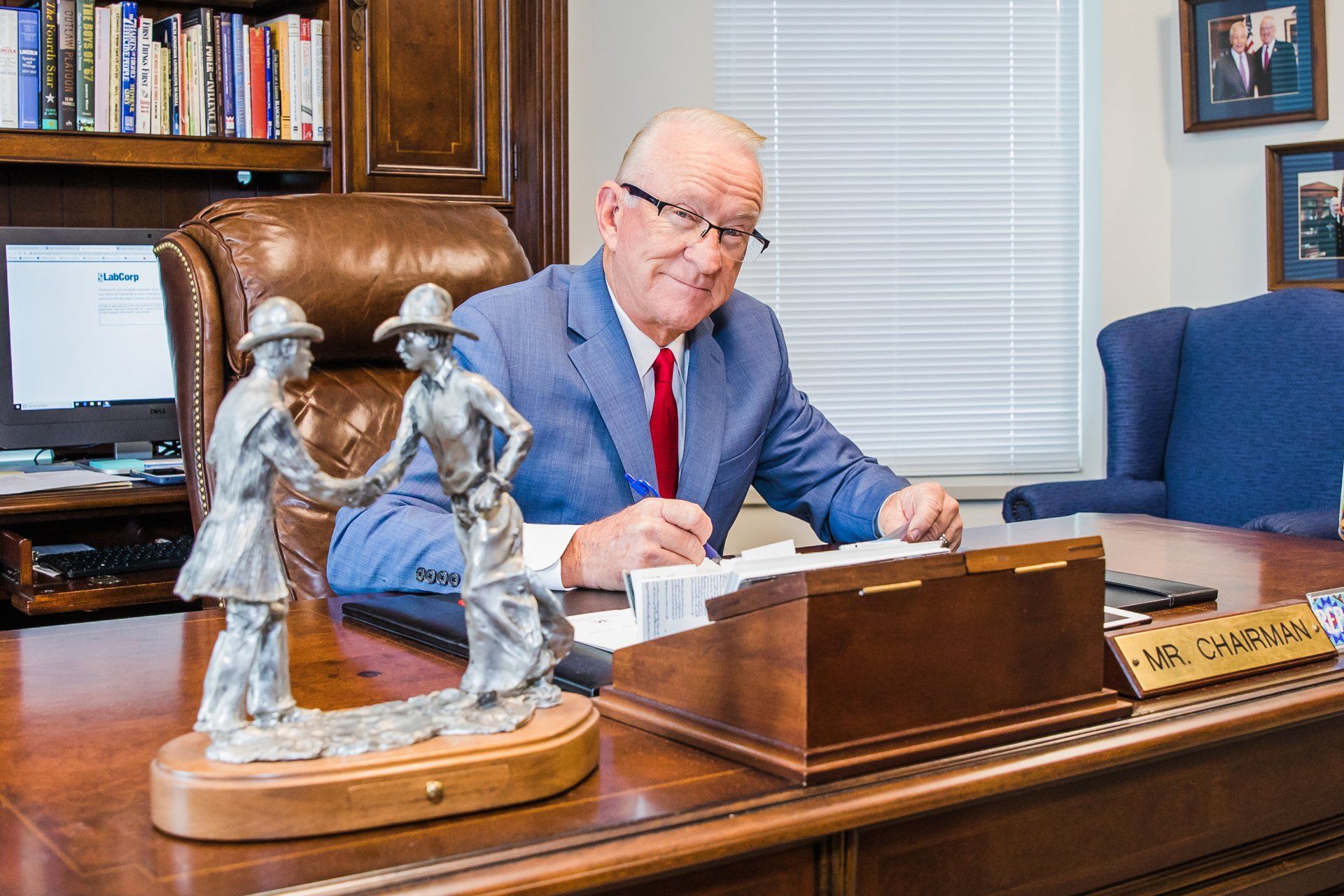
The firm sits in Alexandria, just across the Potomac, and describes itself plainly as a consulting and lobbying shop. Its origin is less ordinary. Howard P. “Buck” McKeon spent 22 years in the U.S. House, chairing both the Education and Workforce Committee and the Armed Services Committee. After retiring in 2015, he formed the business with his son, Howard D. McKeon, now its president. A congressional career became a private operating system.
The map is the product
The McKeon Group does not sell a single deliverable. It sells choreography. For a defense manufacturer, that might mean refining an argument, identifying the right authorization and appropriations channels, arranging meetings on Capitol Hill and tracking the ask through a budget cycle. For a city, it might mean navigating transportation credit programs. For a critical-minerals venture, the cast expands to the Department of Energy, the Pentagon, the Export-Import Bank, the Development Finance Corporation and congressional committees with overlapping claims on the subject.
This is why “access” is both an accurate description and an incomplete one. A meeting is only useful if the client has a specific request, evidence that survives staff scrutiny and a follow-up plan timed to the legislative calendar. The firm's education practice describes its method as a sequence: establish actionable priorities, build targeted initiatives, execute, measure, then recalibrate. Strip away the Washington nouns and it looks like competent enterprise sales conducted against public law.
Make the ask finite
A bill provision, budget line, rule change or agency decision.
Find jurisdiction
Committee, subcommittee, staff, agency and calendar.
Speak government
Turn a company claim into policy language and public value.
Track and adjust
Follow the process through drafts, objections and deadlines.
That sequence is the useful bit another adviser can copy. The chairmanship cannot be copied. Neither can a colleague's half-century of congressional experience. But anyone can insist on a measurable ask before booking meetings, map authority before writing a pitch, integrate communications with policy and define the next move after every conversation. Without those habits, a famous contact list is merely an expensive address book.
“We know who to work with and how to accomplish objectives by eliminating barriers and opening doors.”The McKeon Group's description of its advantage
Six doors, one hallway
The practice is organized into six lanes. Defense is the obvious anchor: platforms, aircraft, ships, tactical vehicles, protective gear and medical technology, with work touching acquisition, authorization and funding. Education reaches from early learning and special education to student loans and career training. International government affairs serves companies, foreign governments and nonprofits seeking audiences across Congress and the executive branch.
Critical minerals may be the most revealing expansion. The policy problem touches industrial strategy, renewable energy and national security at once. The firm's pitch follows the overlap: help clients navigate grants, loans, permitting and legislation while introducing private capital to public money. It is a good example of where the firm fits in the market - narrower than a giant law firm, broader than a one-issue boutique, and designed for clients whose commercial plans depend on federal action.
The client ledger makes that range concrete. Public lobbying records have included Lockheed Martin, Cubic Defense Applications, Kyocera, the Antelope Valley Transit Authority, the City of Lancaster and the National Association of State Agencies for Surplus Property. More recent filings add private-equity, telecommunications, manufacturing and Ukrainian defense-industry interests. These buyers could hire a large law firm's public-policy practice or staff an in-house team. McKeon's alternative is a smaller bench whose senior people are the pitch: former lawmakers, chiefs of staff, policy specialists and operators working across a limited set of federal problems.
What influence costs
Lobbying is one of the rare advisory businesses whose invoices sometimes become public evidence. Aggregated federal disclosure records show approximately $19.9 million in reported lobbying income for the firm from 2015 through 2026. A separate aggregation reports $2 million for 2025. Bloomberg Government put its 2024 number at $1.6 million. These are lobbying figures, not a complete company income statement, but they show the scale: a compact specialist, not a K Street factory.
Reported lobbying income
USD millions · annual LDA aggregationThe chart uses one public-data aggregation for consistency. Bloomberg Government separately reported $1.6 million for 2024, illustrating how totals can differ by database method and filing treatment.
Individual contracts offer a sharper view. A disclosed 2018 engagement for the Saudi embassy specified $50,000 a month, plus pre-approved expenses, for a government-relations program supported by the full firm. In 2025, press coverage of foreign-agent filings described a six-month Myanmar-related engagement at $60,000 a month. The work can be lucrative because the stakes are large, the process is specialized and the number of people who have chaired the relevant committee is very small.
The first obstacle was a statute
The firm's founding also reveals the limit built into its advantage. Federal law gives former House members a one-year cooling-off period during which they may not seek official action from current members or congressional employees for someone else. McKeon could open a consultancy in 2015, but the most direct congressional advocacy attached to his résumé had to wait. That constraint did not kill the model. It shaped it: a team can research, plan, work with permitted audiences and assign contacts to colleagues while the former member observes the restriction.
The larger tension never cools off. The firm openly markets the relationships and institutional knowledge created by public service. Clients see efficiency. Critics see the revolving door. Both descriptions point to the same asset. Foreign-government work intensifies the scrutiny because registration records expose not just fees but whose interests are being carried into Washington. The Saudi engagement drew sustained criticism; the Myanmar engagement did too. Disclosure is not a side issue in this business. It is part of the product's public cost.
For a prospective client, the model is most useful under specific conditions: the objective has a real federal nexus, the ask can be made concrete, internal experts can defend it and leadership is prepared for a long calendar. It is a poor substitute for product-market fit, evidence or regulatory compliance. A lobbyist can improve the route to a decision-maker. No lobbyist can make a vague request precise without cooperation, or make an unconvincing technology convincing by introducing it to better people.
A business built between the lines
The McKeon Group's team explains why the company can stretch beyond its founder. President Howard D. McKeon brought 25 years of telecom and Fortune 100 operating experience. Chief operating officer David Keysor came from strategy, marketing and business development. Executive vice president John Chwat began on Capitol Hill in 1971, served Democrats and Republicans, worked at the Congressional Research Service and later taught lobbying and American government. The combination is deliberate: elected-office credibility, staff-level mechanics and private-sector translation.
The enduring lesson is almost comically unglamorous. Influence is not a single conversation. It is preparation arranged in the right order. The McKeon Group has made a business from that order - priority, jurisdiction, language, meeting, follow-up - and from the reputation of the man whose name is on the door. Washington may love a grand speech. It still runs on the person who knows where the sentence belongs.