There is something almost suspiciously tidy about the origin of Alpine Group Partners. In 1996, before the firm had an office, a client list or a three-decade anniversary to celebrate, its first planning sessions happened at the Alpine Restaurant. The restaurant supplied the name. The table supplied the management theory: put smart people together, keep the hierarchy light, and let the problem decide who should sit where.
That theory became a Washington business. Alpine is a bipartisan, bicameral government-affairs consultancy headquartered on North Capitol Street, close enough to Congress that “proximity” is less metaphor than walking direction. It represents companies, trade associations, nonprofits, coalitions, startups and public-sector organizations. The work ranges from lobbying and regulatory strategy to appropriations, coalition management and media-narrative analysis.
The easy description is that Alpine sells access. The more accurate one is that it sells sequence. A meeting is only useful if the right person takes it, at the right moment, with a request that can survive contact with a committee calendar, an agency rulemaking and the other party’s politics. Alpine’s own formulation is wonderfully blunt: “In Washington, access is abundant. Impact is not.”
The meeting before the meeting
Consider what a client actually brings to a lobbying firm. Usually it is not a neat policy question. It is a business problem wearing government clothes: a new regulation, a budget deadline, a market that cannot open, a technology lawmakers do not yet understand. The firm first translates that problem into Washington’s grammar. Then it maps the people who can move it, the people who can stop it and the people who have not decided which group they belong to.
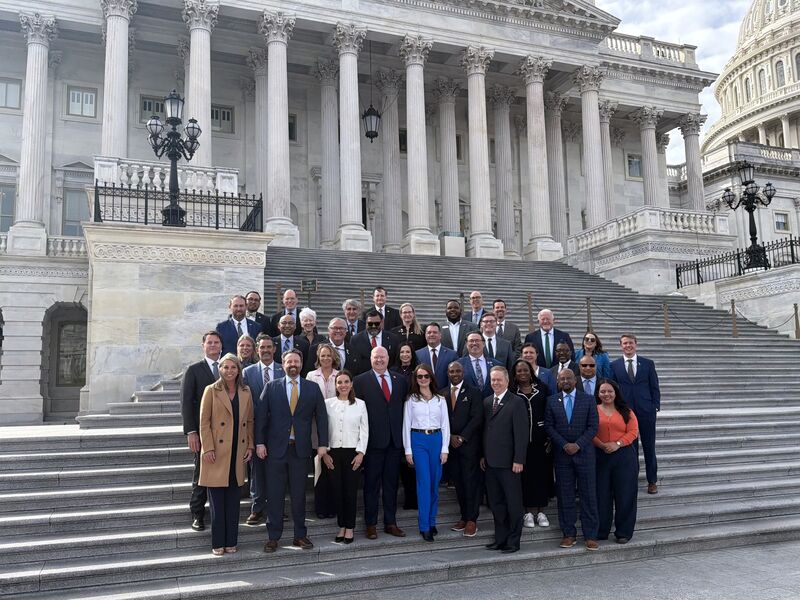
This is why Alpine’s roster reads less like a single specialty than a miniature legislature. Team biographies include former congressional chiefs of staff, appropriations professionals, agency officials, campaign strategists and specialists in energy, health, transportation, defense, tax, technology and trade. The pitch is not that one rainmaker knows everybody. It is that each client gets a lead team and can draw on the wider firm when the issue mutates, which policy issues reliably do.
“We assemble the right team for today’s fight, while giving you reach across the firm as new challenges emerge.”Alpine Group’s description of its operating model
The phrase “shoe leather” appears in Alpine’s public description of itself. It sounds charmingly analog beside “narrative intelligence,” another service the firm now sells. But the two belong together. Media analysis can tell you that a story is gathering force. Shoe leather tells you whether a senator’s staff considers it real, whether an agency is already drafting around it, and whether showing up today would be helpful or merely noisy.
A people business puts a price on memory
In January 2020, Alpine joined Public Policy Holding Company, a group of government-relations and communications firms. The transaction is revealing. No cash changed hands. Alpine contributed its assets for an ownership interest. The accounting placed about $32.2 million on the identifiable net assets: $20.46 million of goodwill, $10.36 million of customer relationships and $1.38 million of trade name, with lease assets and liabilities offsetting each other.
That is what a professional-services acquisition looks like when the inventory is memory. Customer relationships and goodwill dwarf the furniture because the thing being purchased is accumulated trust: who returns the call, who can explain a provision, who remembers why a compromise collapsed six years ago. PPHC disclosed that Alpine produced $13.748 million in revenue in 2020 with an average workforce of roughly 22. It was a compact operation with unusually valuable context.
The deal also answered a classic consulting-firm problem. How do you add scale without sanding away the judgment clients came for? PPHC’s model lets its operating firms retain their identities while sharing infrastructure and adjacent capabilities. Alpine gained a wider platform; Alpine’s partners gained ownership rather than a cash exit. It was less a sale of the restaurant than an invitation to a larger dining room.
From North Capitol Street to Southlake
The widening continued. Alpine connected to FIPRA, a network of independent public-affairs consultancies in more than 50 countries, with coordination from Brussels. It formed a structural alliance with Capitol Funding Solutions for competitive federal grants. In 2025 it opened in the Dallas-Fort Worth area, adding a Texas state-policy base to the Washington practice.
The customer mix explains the map. A manufacturer may face a federal tax question, a Texas permitting issue and a European regulatory concern at the same time. A startup may need Congress to understand a technology before a larger incumbent defines it first. A nonprofit may possess a compelling mission but lack the coalition, appropriations fluency or timing to make it legible to government. Alpine’s named clients have spanned AWS, Siemens, Solugen, Shell, Walmart, Twilio, Equinor, GSK and the Recording Industry Association of America. The common product is not industry knowledge alone. It is translation across institutions.
The leadership transition followed the same widening logic. Keenan Austin Reed joined Alpine in 2021, became executive vice president in 2022, principal in 2023 and CEO at the start of 2025. Her background crosses congressional offices, campaigns, corporate strategy and civic organizations. Les Spivey moved from CEO to president, concentrating on business development and existing client relationships. Succession here was staged as continuity with a new center of gravity, not a purge.
Access gets the first meeting. Usefulness earns the second.
What another advisory firm can borrow
Very little about Alpine’s work can be copied by downloading a template. Relationships accumulated over 30 years remain stubbornly non-exportable. But the design of the practice is portable. Start with the client’s decision, not your service menu. Staff the changing problem rather than preserving a fixed account team. Treat restraint as a billable form of judgment. Give specialists a way to enter without forcing the client to renegotiate the whole relationship.
A small operating system for complicated advice
- Map the decision, the veto points and the calendar before proposing activity.
- Make the client useful to the audience before asking the audience for help.
- Change the team when the problem changes, but keep one accountable lead.
- Pair data that spots movement with people who can interpret what it means.
- Measure the outcome, not the number of introductions or meetings.
The model depends on conditions that are easy to overlook. The issue must be legitimate enough to survive scrutiny. The client must be willing to hear “not yet” and sometimes “no.” Senior practitioners must share relationships instead of hoarding them. And the firm must manage conflicts carefully, because a broad client list creates collisions as readily as opportunities. Without those conditions, flexible staffing becomes confusion and access becomes theater.
Alpine’s oldest idea is still its most useful one. A team is not simply a collection of impressive résumés. It is an arrangement: who sits at the table, what they know, what they are willing to tell one another and whether they can recognize the moment to act. The restaurant is now a footnote. The seating plan became the business.
Revenue and transaction figures above refer to historical public-company disclosures and should not be read as current valuation or financial guidance.
Go deeper
Explore the firm’s current work, people and public filings.