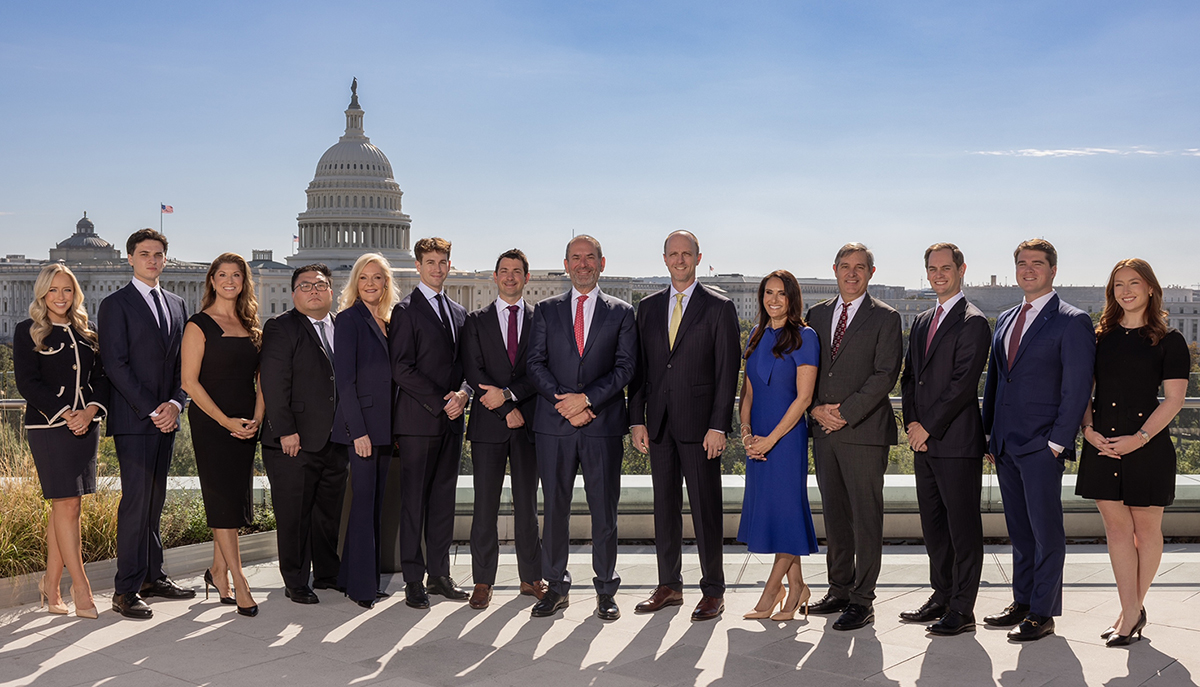
There is a peculiar kind of office address that tells you almost everything. Miller Strategies sits at 801 Pennsylvania Avenue NW. Walk one way and you reach the White House. Walk the other and you reach the Capitol. The location is a piece of accidental infographics: the firm makes its living in the territory between the executive branch and Congress, carrying the problems of companies and institutions toward the people who write rules, enforce them and fund them.
Jeff Miller founded the firm in 2017, just after serving as vice chair of President Donald Trump's first inaugural committee. He had already spent years in Republican politics, including running Rick Perry's presidential operation and advising figures such as Arnold Schwarzenegger and Kevin McCarthy. In Washington terms, he arrived with a fully charged phone book.
A phone book, however, is a wasting asset. Officials leave. Majorities flip. Yesterday's indispensable chief of staff becomes tomorrow's person with a podcast. The enduring product is not the introduction. It is knowing which introduction matters, what argument can survive the room and what must happen the morning after.
The first thing to fail was the weather
The firm's disclosed federal lobbying income rose from roughly $4.7 million in 2018 to $13.9 million in 2020. Then the administration changed. In 2021, the number fell to $6.8 million. Nothing mysterious happened: a firm whose founder was deeply wired into Republican politics encountered a Democratic White House and Congress. Political access had been repriced.
The rebound is the more instructive part. Revenue returned to about $12.1 million in 2023, when McCarthy briefly held the speakership. His removal could have exposed the firm as a single-relationship machine. Instead, business held up. Miller's explanation was blunt: sound strategy, good information and work rate should beat a mere entrée.
“I truly believe sound strategy paired with good information should always win and nobody can outwork us.”Jeff Miller
This was not a public conversion so much as a stress test. The firm kept adding people who had worked inside institutions: congressional policy staff, White House officials, campaign operators, lawyers and corporate government-affairs executives. The network became less like one impressive contact and more like a switchboard.
What the client actually buys
Miller Strategies names three services. Policy advocacy promotes a client's interests. Regulatory-risk work interprets and attempts to shape agency rules. Legislative strategy works the congressional machinery. Those labels are accurate, but they sound tidier than the work. A real engagement can include monitoring a proposal, deciding whether to oppose it publicly, finding sympathetic offices, preparing an executive, assembling a coalition and keeping a technical amendment alive while everyone else is watching the headline fight.
Turn a business concern into a policy argument a decision-maker can use.
Read the rule, identify the risk and find the moment when engagement matters.
Build support across offices, agencies and stakeholders until language changes.
The customer list makes the product easier to see. The firm's own testimonials feature Broadcom, GE Aerospace, Dow, Southern Company, Fresenius Medical Care, GRAIL, the National Fisheries Institute and the prediction-market company Kalshi. Federal records add technology companies, energy producers, financial firms, health-care businesses, universities and trade groups. These organizations do not share a product. They share exposure to federal decisions.
In 2025, that exposure became unusually expensive. A year-end industry analysis put Miller Strategies' disclosed lobbying revenue at $51.29 million, up 298.96 percent from 2024. Zoom Communications reportedly spent $800,000 through the firm that year; Centene spent $420,000; Cornell paid $140,000 in one quarter. These are not prices on a menu. They are useful markers for what sustained representation can cost when the stakes include drug pricing, federal research money, trade or technology regulation.
The advantage is concentration
Miller Strategies fits between the solo lobbyist and the enormous law-and-policy platform. Large firms can sell breadth, bipartisan benches and subject-matter departments. A focused shop sells senior attention, speed and a concentrated political network. Miller's firm leans openly Republican. In a Republican administration, that is not a decorative brand choice. It is operating leverage.
The 2025 alliance with Checkmate Government Relations extended the model. Miller brought federal reach; Checkmate brought state, local and public-affairs capacity. Miller also became a founding partner of Watchtower Strategy, a separate public-affairs and crisis-communications business, and serves as a principal at tax-services firm Ryan. The pattern is clear: rather than pretending every client problem stops at the edge of federal lobbying, surround the core service with adjacent capabilities.
There is a lesson here for any expert-services company. Start with the scarce asset, but do not confuse it with the whole product. Access may open a door. The renewable work is diagnosis, preparation and execution.
- 1Move before the emergency. Miller has argued that hiring only after the immediate problem appears is already late. Early monitoring creates options.
- 2Pair generalists with institutional specialists. A broad strategist sees the board; a former committee or agency hand knows which square can move.
- 3Sell a sequence, not a meeting. Briefing, coalition work, regulatory comments and follow-up make the introduction useful.
- 4Build around the client's risk. Apple and Cornell may enter through different doors, but both need federal uncertainty translated into action.
Where the leverage thins out
The same chart that demonstrates the firm's growth also reveals its constraint. Relationship capital is not equally valuable under every administration, in every chamber or at every agency. A concentrated partisan network works best when the relevant decision-makers are in that network. It works less well when a problem demands deep Democratic access, a durable bipartisan coalition, state-by-state coverage or technical expertise the shop does not possess.
The method is portable. The contacts are not.
Companies can copy the early-warning system, the issue discipline and the habit of following through. They cannot copy thirty years of personal trust, and they should not mistake a lobbyist's access for a guaranteed policy result.
Nor can lobbying outcomes be read neatly from fees. A rule may change for many reasons. A bill may stall because the calendar ran out. A meeting may prevent a bad provision without producing a public victory. The business sells informed influence under uncertainty, not a vending machine for laws.
That is why the most revealing line on Miller Strategies' website is not “connected.” It is the quieter insistence on strategy. Washington turns over. The distance between the Capitol and the White House remains almost exactly the same, but the people inside both buildings keep changing. The durable firm is the one that knows the route even after the door has a new name on it.