Consider the screw. It is cheap, small, and capable of making an otherwise competent adult spend twenty minutes staring into a drawer. A screw almost fits. Another looks right but has the wrong thread. The project waits. In that irritating gap between something nearly right and something useful sits much of The Hillman Group’s business.
- Hillman supplies the hardware and helps retailers keep it organized and available.
- Its field-service network makes small, complicated product categories easier to run.
- Key-copying and sharpening services put another reason to visit inside the store.
In 2025, Hillman recorded $1.55 billion in sales. That is a substantial business built around purchases people rarely celebrate. Nobody invites friends over to admire a correctly specified washer. Yet somebody has to source it, package it, deliver it, and make sure its bin contains washers when the next customer arrives.
01 / The aisle is the invention
Max Hillman started the company in Cincinnati in 1964, supplying fasteners to independent hardware stores. His sons Mick and Rick joined in 1969. The pivotal development came in the early 1990s, when Hillman established its National Field Service Group to manage the assortment sitting on customers’ shelves.
This is where the story gets interesting. A retailer can buy screws from several suppliers. Running a department full of sizes, finishes, and quantities is a different task. Hillman combined the merchandise with the work: displays, replenishment, and people visiting stores. Its current investor overview describes more than 1,200 field sales associates.
The little item comes with a much bigger system.
Think of the distinction as the difference between delivering groceries and keeping a kitchen ready to cook. Hillman operates in the space between those jobs. Its expertise includes global sourcing, distribution, product development, and the unglamorous judgment involved in deciding what belongs where. For a store manager, fewer loose ends can be worth buying.
The audience is broader than the weekend repairer. Contractors buy fastening products and work gear. Pet owners buy engraved identification tags. Retail customers include Home Depot, Lowe’s, Walmart, Tractor Supply, and pet-store chains, alongside independent hardware stores. The company’s market position comes from making that assortment practical to sell.
The product names make the range easier to recognize: OOK for picture hanging, Power Pro for fastening, Firm Grip for work gloves. In 2025, Power Pro Joist Tape won a Pro Tool Innovation Award. Product engineering gives Hillman something to put on the shelf; distribution and service give that product a chance to be bought.
Its stated culture puts customer commitment alongside accountability and integrity. The practical test is fairly concrete: the display needs attention after the original sale. Hillman also encourages employee volunteering in the communities where its people work. Both commitments depend on employees doing things that a product catalog cannot do.
02 / A robot beside the shopping cart
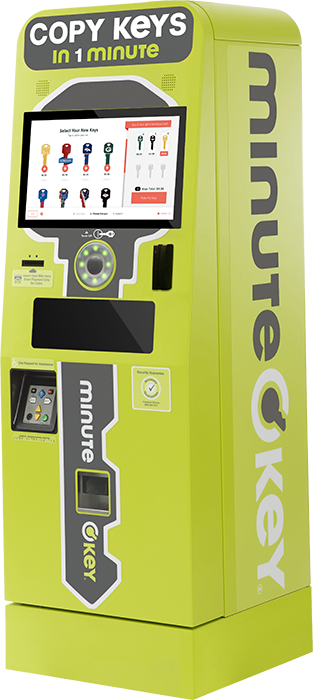
Then there are the machines. Minute Key offers self-service key copying; other Hillman systems engrave tags. These services borrow something the retailer already has: a place customers visit. A spare key becomes another errand completed during a shopping trip. The machine turns a small patch of floor into a service counter.
A spare key.
A saved trip.
Hillman retains ownership of key and engraving equipment and sells the associated keys and tags. That arrangement helps explain why machinery belongs inside a hardware supplier’s portfolio. The equipment creates a continuing place to sell consumables, while service technicians keep the transaction possible. A broken kiosk occupies exactly as much floor space as a working one.
Resharp extends the idea to knives. At participating Ace Hardware locations, a trained associate uses a machine that scans, sharpens, and polishes a compatible blade. The advertised suggested price is $6.99 per knife, with sharpening taking 90 seconds or less. Serrated, scalloped, and wavy edges are excluded. Convenience has a specification sheet.

03 / Small transactions, substantial bills
None of this runs on charm. Hillman spent $70.1 million on capital expenditures in 2025, including key-duplicating equipment and merchandising racks. That is company-wide capital spending, rather than a price tag for one rollout. The shelf and the robot require money before the next small purchase happens.
Nor does every category move upward. In its 2024 annual filing, Hillman reported that lower key and engraving volumes reduced robotics and digital sales by $15.1 million. The lesson is narrower than a turnaround legend: placing a machine in a store does not guarantee growing demand. Customers still have to use it.
The subsequent response is visible in the spending. Hillman invested in MinuteKey 3.5, expanding what its installed machines could do. By the second quarter of 2026, management attributed low-double-digit growth in robotics and digital solutions to that rollout. More useful transactions at an existing location offer a plausible route to better economics.
Revenue shows the scale. Profit shows what remained after the bills.
The broader results improved too: 2025 net income reached $40.3 million. In the second quarter of 2026, sales rose 9.8% to $442.3 million. Those figures describe a functioning business, but not an effortless one. Freight, imported-product costs, retailer negotiations, and consumer spending all travel through the same system.
04 / Beyond the weekend project
In 2026, Hillman widened its route to customers. It acquired Campbell Chain and Fittings and door-hardware supplier Delaney. Then came Kanebridge, an industrial fastener master distributor, for approximately $315 million. The transaction added access to distributors seeking commercial and military-grade fasteners, extending Hillman beyond the familiar home-improvement aisle.
“Kanebridge diversifies our customer base”
Jon Michael Adinolfi, president and CEO / September 2026
That diversification matters. Home Depot and Lowe’s together accounted for roughly 43% of 2025 revenue. Large customers bring reach and purchasing power, including power over their suppliers. Alternatives include Midwest Fastener, PrimeSource, and retailers importing directly. Hillman has to keep making its service worth the cost.
There is a useful idea here for other businesses: study the work surrounding a purchase. Which small irritation makes the whole transaction harder? Could the supplier take responsibility for it? Hillman’s answer depends on enough store traffic, enough replenishment volume, and dependable equipment. A quiet location or an incompatible knife will defeat the convenience pitch. The missing screw remains a good place to begin.