A key is almost offensively ordinary until the moment it is missing. Then a sliver of metal becomes an appointment, a bill, a stranger at the door and a small referendum on whether modern life is actually modern. James Moorhead has built the latest chapter of his career around that gap - the vast emotional distance between a mundane product and the inconvenience it can cause.
He is the chief executive and a board member of KeyMe Locksmiths, the company whose yellow kiosks sit inside grocery, convenience and big-box stores. The machines scan a key with computer vision, interpret wear, and use robotics to cut a copy. Around them sits a wider operation: online orders, vehicle-key services, mobile vans and a network for lockouts and repairs. By March 2026, KeyMe said it had installed more than 8,000 kiosks and duplicated 47.2 million keys.
It sounds like an industrial story, and it is. It is also a consumer story about reducing the number of things that can go wrong between “I need a spare” and “I have one.” Moorhead's résumé suggests he is drawn to precisely this sort of puzzle. His industries have changed repeatedly. His subject has not. He studies the instant when a person hesitates, tunes out or feels trapped, then tries to redesign the experience around that person.
Before the robots, there was a towel
Moorhead's public career begins at Williams College, where he graduated in 2001. He played defense on the men's lacrosse team, made the All-NESCAC team as a senior, and served on College Council and the Residential Life Committee. His older brother John played attack. The arrangement is almost too tidy: one brother trying to create a shot, the other trained to prevent one. Moorhead later said their competition “goes to my core personality.”
He joined Procter & Gamble and stayed for 11 years, working across household brands including Vicks, Prilosec, Gillette and Old Spice. By 2008 he was managing Old Spice and explaining why humor worked with younger men. The brand carried decades of history and the faint aura of a medicine cabinet inherited from somebody's grandfather. The assignment was not to erase that history. It was to make the history wink.
The result reached its purest form in 2010 with “The Man Your Man Could Smell Like.” Isaiah Mustafa moved from bathroom to boat to horseback in a single, deliriously controlled take. The commercial was concise, ridiculous and confident. More important, it gave the brand a voice flexible enough to survive outside television.
“Digital is perfect because you can quickly gauge the reaction.”James Moorhead, on the Old Spice campaign
Then came the response campaign. Over just more than two and a half days, a compact operation selected comments from social platforms, wrote scripts, moved them to a teleprompter, filmed Mustafa and published 186 personalized videos. Some went from idea to finished response in 10 or 15 minutes. By the third day, the videos had passed 20 million views. The speed looked reckless from the outside. Inside, it relied on something steadier: agreed guardrails and trust.
Moorhead's account of the process is revealing. The client did not attempt to approve every line. Instead, the brand and agency established the boundaries, then let the writers and production team operate. “We trusted the team at W+K to be true brand stewards,” he said. It is a lesson disguised as a funny-ad anecdote. Fast work is often the residue of slow preparation. Autonomy becomes useful when everyone knows the edges of the field.
Everyday products
Household media
Usage-based insurance
Consumer finance
Robots in retail
The marketer becomes an operator
Awards followed the Old Spice work: Grand Marketer of the Year, a place on Advertising Age's Creativity 50, an Emmy for the commercial, and major Cannes Lions and Effie honors for the wider campaign. Moorhead did not remain the keeper of one famous brand. In 2012, DISH recruited him as senior vice president and chief marketing officer. His brief included marketing, advertising, public relations and market research - a leap from a portfolio of packaged goods into a subscription business fighting over the American living room.
In 2015 he joined Metromile, the pay-per-mile car insurer, as chief marketing officer. The proposition was another exercise in reframing an old category: if someone drove less, why should that person pay as if every car lived the same life? Moorhead later held marketing leadership at AI lender Upstart, then became chief marketing officer of Acorns, the saving and investing app.
At Acorns, his language paired art with science. Brand created meaning; acquisition supplied the measurable engine. In a 2021 presentation, he described the people behind the metrics as everyday Americans managing jobs, families and bills. The practical task was to reach them, keep them engaged and help a financial habit endure. Education, segmentation and well-timed nudges mattered because the product asked for a long relationship rather than a single clever conversion.
The portable idea: meet the customer inside an existing behavior. Old Spice answered comments where people were already talking. KeyMe puts key copying inside stores where people already shop.
This sequence marks the gradual widening of Moorhead's remit. At P&G, the visible output was a campaign. At DISH and Metromile, it was growth across channels and products. At KeyMe, the operating canvas includes hardware reliability, software, manufacturing, retailer relationships, service partners and customer care. The marketer's question - what does the customer need? - now collides daily with the operator's question - can the entire system deliver it?
A robot should make the errand disappear
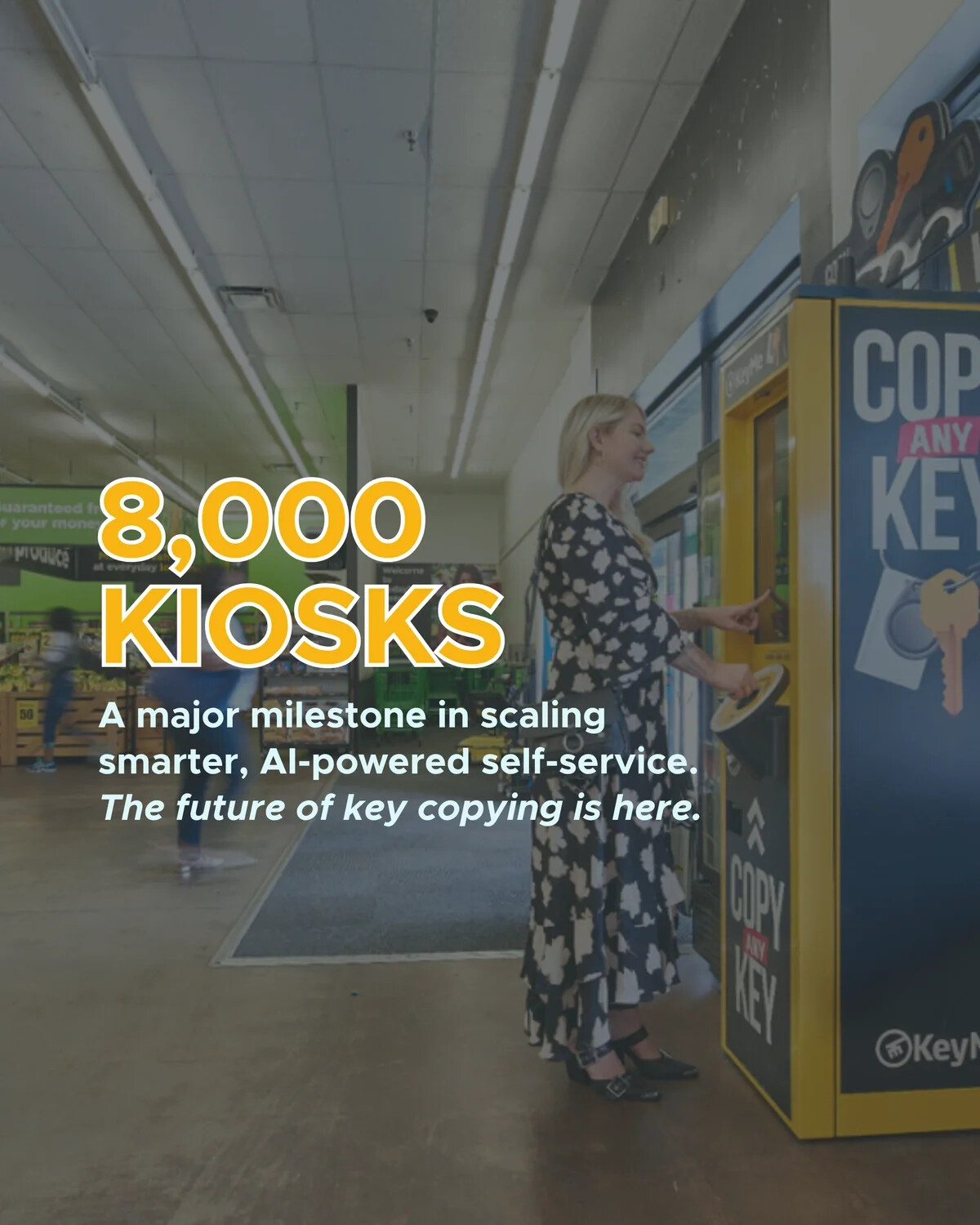
KeyMe's technology is sophisticated, but its success depends on not making sophistication the customer's burden. A person presents a key. The machine scans its geometry, accounts for wear and cuts a duplicate to the original specification. Vehicle keys introduce chips, remotes and programming. Locksmith calls add dispatch, credentials and the pressure of someone waiting beside a locked door. Each capability increases what the system can do and creates another seam that must hold.
Moorhead describes the 8,000th-kiosk milestone as AI moving “beyond the cloud and into the physical world.” That phrase earns its keep here. These are not abstract models offering suggestions in a browser. The output has teeth, grooves and a blunt pass-fail test at someone's front door. Physical AI cannot shrug and call its answer provisional.
Scale changes the meaning of convenience. One kiosk is a novelty. Thousands of them become infrastructure, distributed among Walmart, Kroger, Meijer, 7-Eleven and other retailers. KeyMe's 2026 Sam's Club agreement added more than 600 Tire & Battery Center locations to that footprint. The company has also pushed beyond the kiosk: photo-based ordering through CopyKeys.com, on-site vehicle-key vans and a partnership with roadside-assistance provider Agero.
A boring category is often an important human problem wearing work clothes.
The expansion follows a simple map of customer circumstances. Planning ahead? Copy a key while shopping or order one online. Need a programmed vehicle key? Visit a mobile unit. Locked out now? Call for help. The channels differ because urgency differs. Treating them as one identical customer journey would be tidy on a slide and clumsy in a parking lot.
The competitive instinct, redirected
Moorhead's brotherly lacrosse story offers a useful image for his career. Competition may sit at his core, but his public work is less about flamboyant attack than about spotting openings and closing gaps. Old Spice had a relevance gap. Metromile found a gap between driving behavior and insurance pricing. Acorns addressed the gap between wanting to save and making saving habitual. KeyMe works on the gap between a small need and a notoriously uncertain service experience.
There is wit in moving from the most quoted shower in advertising to a machine that can reproduce a house key. Yet both jobs demand respect for attention. A body-wash commercial gets seconds before the viewer leaves. A retail kiosk gets minutes before the customer wonders whether this was a mistake. In each case, confidence must arrive before doubt.
The larger lesson is not to chase unfashionable industries for sport. It is to notice where emotional stakes are larger than the object involved. A key weighs almost nothing. The home, car or office behind it does not. A tiny purchase can carry safety, access, schedule and peace of mind. That mismatch creates room for a better experience and little patience for a worse one.
Moorhead's most famous work made an ordinary product spectacular. His current work aims for a different kind of success: making a stressful task pleasantly forgettable. The first requires theatre. The second requires machinery, distribution and trust. His career has room for both, which may be why it hangs together so neatly despite crossing soap, television, insurance, lending, investing and locksmithing.
The yellow kiosk waits under retail lighting, neither horse nor towel in sight. A customer inserts a key. Cameras measure, software interprets, metal turns. The duplicate drops. The show is over before anyone thinks to applaud.