Before there was another CEO appointment, there was a choice. FrontRange could be sold, or it could be rebuilt. Michael McCloskey, already on its board, had been asked to consider what to do with a software business that was losing money. He described the second option with a phrase that would sound equally at home at a card table: “roll the dice and try to build something.” The board chose to build.
That episode offers a useful entrance to a career usually compressed into a list of executive titles. McCloskey has worked in finance, operations and company leadership. He has helped management teams bring three technology businesses through initial public offerings. Yet his story also contains the less ceremonial work that happens between announcements: repairing a business, adding a sales organization, meeting with developers and deciding which former colleagues to work with again.
A choice before the comeback
McCloskey became FrontRange’s interim chief executive in 2003. The assignment followed the departure of Patrick Bultema, and arrived with the ordinary uncertainty of an interim appointment. A board member was moving into the operating seat. Advice would now have to survive a working day.
By 2007, he was describing a company that had needed attention across product development, management and sales. Those are three short labels for a considerable amount of work. A product can disappoint its salespeople; sales can disappoint the engineers; everyone can develop an elaborate theory about everyone else. Getting a company moving again requires those departments to share something more useful than a grievance.
In early 2008, FrontRange was approaching $130 million in annual revenue, compared with roughly $65 million at the earlier stage of its recovery. Its workforce had grown from 375 to more than 700. Those numbers describe the company during his tenure, rather than a result any one executive could claim alone. They give scale to the decision the board had taken.

The interesting part is the sequence. First came a choice made while the outcome was uncertain. Later came the figures that made it look sensible. Turnaround stories are often polished until the risk disappears. In McCloskey’s account, the dice remained on the table.
Finance first, then the whole company
His earlier career had placed him close to the machinery of technology businesses. In June 1995, Network Appliance named him vice president and chief financial officer. He came from Digital Microwave Corporation, where he had been executive vice president and CFO. These were roles concerned with what a business could support as well as what it hoped to sell.
The scope broadened. Genesys and Kana became part of his executive history; he served as president of both companies. His experience eventually covered international sales and operations alongside finance and the chief executive’s job. A career like that offers several views of the same company, each with its own preferred explanation of why things cost so much.
He was part of management teams involved in the IPOs of Network Appliance, Genesys and Kana. The team distinction matters. An IPO carries the names of bankers, lawyers, employees, customers and executives into one event. McCloskey’s experience places him among people who had already watched a technology company prepare for that scrutiny before he arrived at Bright Pattern.
VP & CFO
Interim CEO
Named CEO
There is a temptation to treat that history as a passport: enough familiar company names and the next appointment explains itself. Bright Pattern adds a more personal detail. McCloskey knew the people there.
The colleagues who came around again
Konstantin Kishinsky, Bright Pattern’s founder and chief technology officer, had worked with McCloskey at Genesys and FrontRange. By 2018, the two described a working relationship stretching beyond twenty years. McCloskey also knew much of the development team from earlier companies. The new job came with a substantial cast of familiar characters.
Bright Pattern had been established in 2010. McCloskey joined in 2016. The company announced his appointment as CEO on January 23, 2018, after he had served on its board. The distinction gives the story its proper shape. He was moving deeper into a business he already knew.
“the people and the market”
Michael McCloskey, describing what brought him to Bright Pattern, 2018
That was the compact explanation he gave for taking the job. Both halves mattered. The team offered shared experience; the contact center market offered a problem they believed a newer platform could address. His argument was that older systems could be difficult to adapt, particularly when capabilities acquired from different businesses had to be made to work together.
A long working relationship cannot do the engineering or close a sale. It can change the starting point. Colleagues have already seen one another make decisions under pressure. They arrive with some knowledge of how a disagreement will go and whether a promise tends to survive the following week. In this story, that accumulated experience is as consequential as the new title.
A product needs a route to market
Bright Pattern’s earlier years had concentrated on developing its software. Its commercial reach included partners and a white-label arrangement, under which another business sold the technology under its own name. A product could therefore be working for customers while the company behind it remained less visible.
The next stage required a larger commercial effort. The company expanded sales and marketing, with Ted Hunting joining in 2018 after a long tenure at Genesys. Enterprise customers included Sun Country Airlines and Randstad. The business was developing both direct sales and partner relationships, giving its technology more than one way to reach a customer.
This is a different kind of construction from writing software, although the two are closely related. Salespeople need to understand what can be delivered. Customers need someone to hear what happens after installation. Developers need usable feedback rather than an inbox full of requests marked urgent. An organization has to carry the product beyond the demonstration.
Hunting later described McCloskey participating in development meetings multiple times a week. It is an unusually practical detail in an executive profile. The person responsible for the business was regularly in the discussion about what the product should do. A calendar entry can sometimes tell you more than a job description.
The customer gets a vote
One thread reaches back further than Bright Pattern. In 2004, while running FrontRange, McCloskey discussed plans for a hosted version of GoldMine alongside the continued option of software licenses. Customers would be able to move between deployment models. The vocabulary was different, but the underlying question was already familiar: where should the software run?
Twenty years later, deployment choice was again a subject of his interviews. With Bright Pattern, he discussed public cloud, private cloud and on-premises options. A company buying contact center software might want modern capabilities while retaining control over its infrastructure. Its decision could also involve data requirements and the systems already in place.
cloudPrivate
cloudOn
premises
McCloskey’s recurring argument: let the organization choose where its contact center runs.
There is a pleasingly stubborn continuity here. Technology companies enjoy announcing the future in the singular. Customers tend to arrive with several versions of the present. An executive who has discussed this question across two decades has at least had repeated opportunities to encounter the gap. McCloskey’s public position makes room for the buyer’s circumstances.
After the AI demonstration
By 2024, his interview schedule included AI agent assist, practical implementation and the risks and opportunities of contact center AI. He also discussed how regional service providers could combine unified communications with contact center technology. The subjects were changing, while the question of how a system fits into a working organization remained.
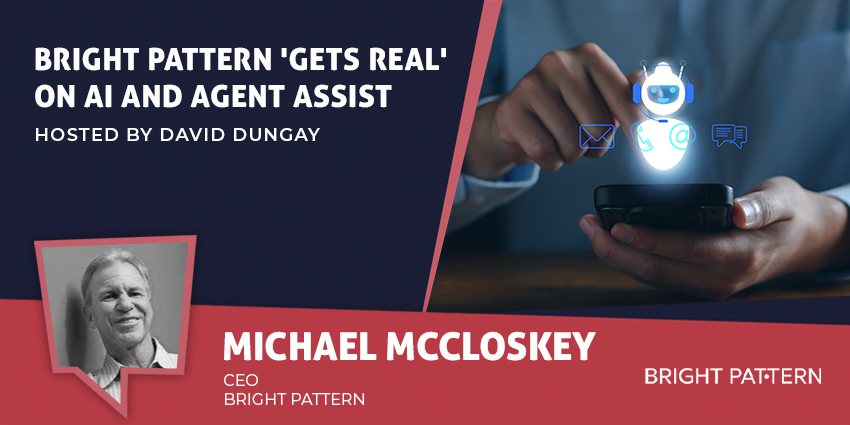
Bright Pattern announced the general availability of its next-generation AI Agent Assist in December 2025. Its description included suggestions during live interactions, teleprompter guidance and recommendations about the next action. These are specific places to put software: beside an employee who is trying to answer a question while another person waits.
In February 2026, Castles Technology selected Bright Pattern for global customer support, with integration into its Matrix42 service management platform. The example makes the practical challenge visible. A conversation is one part of a service process. The information and the work may live elsewhere. Connecting them is part of what the buyer is paying for.
McCloskey opened Bright Pattern’s customer and partner conference in San Francisco on September 30, 2026. Kishinsky followed with product strategy. The two-day event focused on autonomous customer experience, including software intended to complete tasks such as returns and bookings. Customers and partners came from six continents. The old colleagues were still dividing the work between the business and the technology, with a wider audience in the room.
A board of a different kind
There is also a life beyond the product agenda. Asked in 2018 what people might not know about him, McCloskey named wakeboarding and snowboarding among his interests. It is a welcome piece of ordinary specificity in a career full of software acronyms. Sometimes a board is something you stand on.
The detail need not become a theory of leadership. What carries through the career is visible enough: a finance executive taking on wider responsibility, a board member accepting a troubled operating business, a familiar colleague returning for another chapter. At Bright Pattern, the work now includes AI, global partners and the distance between a conversation and a completed task. The choice to build keeps acquiring another day’s work.