A receptionist in Ghana had been learning data science. Then her boss noticed her projects. In Celestine Tetteh’s account, published by Women Techsters, that discovery led to a promotion to data analyst in 2023. The course mattered. So did having something to show someone who could change her job.
That small workplace turn captures the proposition behind Tech4Dev. The nonprofit teaches digital skills, then tries to connect those skills to a livelihood. Software development, cybersecurity and product design are among its subjects. Mentorship, practical experience and help finding work belong in the same sentence. For someone trying to enter technology, knowing the vocabulary is useful; getting a first opportunity is the harder assignment.
Women Techsters is its best-known program, aimed at girls and women across Africa. But the wider organization also works on basic digital education, developer training and public-sector skills. Its place in the market is somewhere between a training provider, a community organizer and a workforce development partner. The learner is central, while much of the money and institutional access comes from elsewhere.
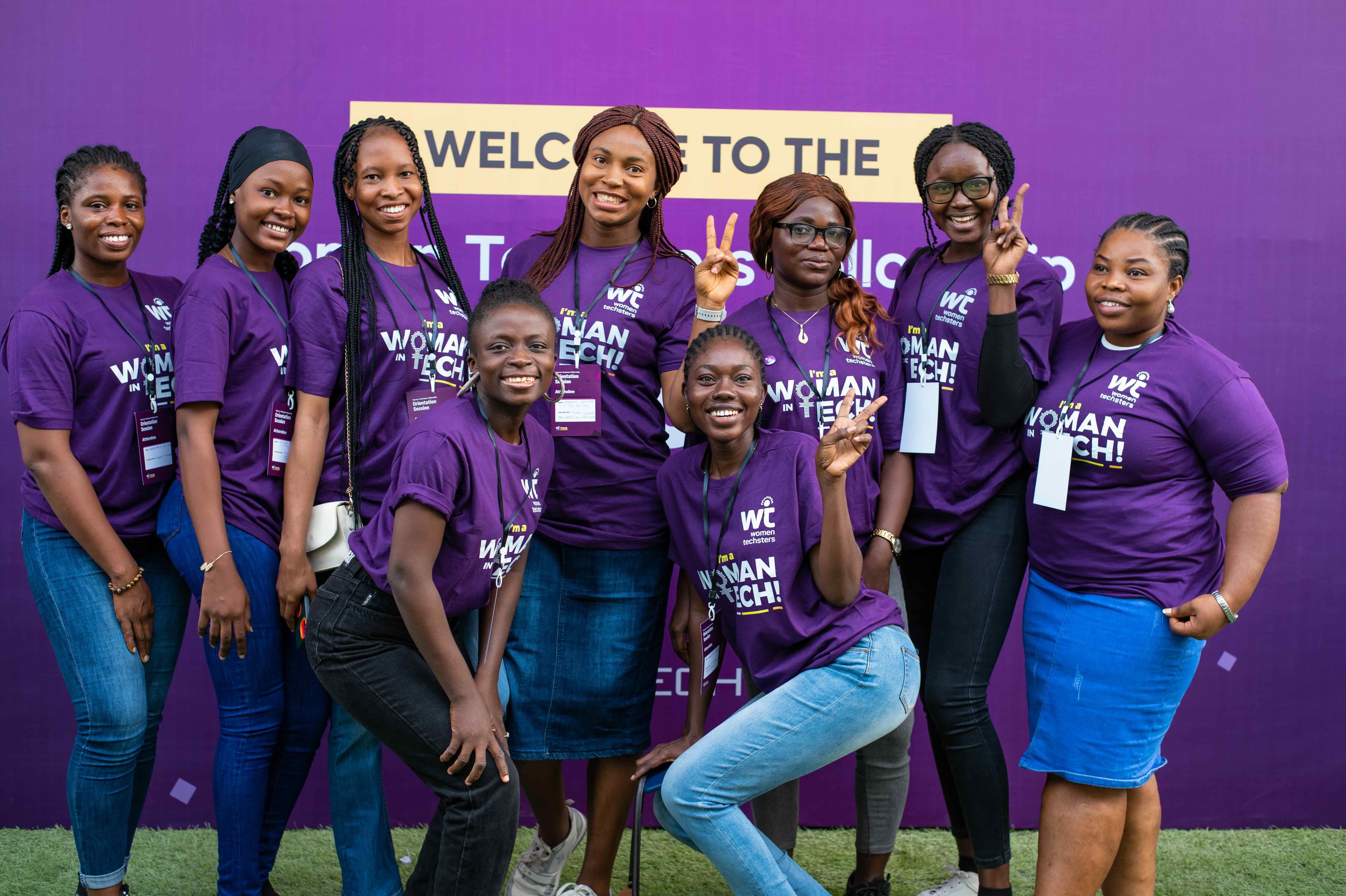
Seventy learners, then a narrower bet
Founded in 2016 by Joel Ogunsola and Oladiwura Oladepo, Tech4Dev initially took on education, civic engagement and public health. By 2019, it had concentrated on education. In a Global Citizen interview, Oladepo traced the training effort through Code for Impact, which equipped 70 girls and women in tertiary institutions with coding and analytical skills.
That work involved Hacey Health Initiative, Access Bank and the U.S. consulate in Nigeria. Microsoft subsequently supported Nigerian Women Techsters. The organization’s account describes an expansion driven by the results of earlier programs: try a focused intervention, observe what participants do with it, then widen the geography.
The Nigerian pilot was more varied than the phrase “coding class” suggests. Its tracks included web and mobile applications, games development and embedded systems. The published outcome was 2,475 women across 12 states. Games and embedded systems put a different picture in front of an aspiring technologist: software could mean an interactive experience or something connected to physical hardware, as well as a website.
In March 2020, Microsoft reported that more than 2,400 women had learned to code through the program, with roughly 70 percent starting technology careers. It also confirmed the initiative’s appearance at the 2019 UN Solutions Summit. Those were early-program results, not a promise about every later cohort. They help explain why a Nigerian experiment became an African ambition.
A year with a second half
The Women Techsters Fellowship gives its employment ambition a timetable. The Class of 2026 announcement described six months of intensive technical learning followed by six months of practical opportunities through internships, volunteering, freelancing, entrepreneurship and mentorship. It named seven tracks, including DevOps, cybersecurity, mobile development and product management.
The same announcement reported more than 14,540 applications and 1,530 selected fellows. Those figures suggest roughly one place for every ten applications. Selection is part of the model: a free program with sustained teaching and support still has finite capacity.
Technical learning
Experience & support
One year. Two connected assignments.
Not everyone needs to begin with that commitment. Women Techsters also offers three-week bootcamps, expert-led masterclasses and monthly Open Days where participants meet women working in technology. Tech Girls Drive takes career advocacy to younger audiences. An advocacy book, Tech Girls Squad, uses storytelling to make technical careers more imaginable.
These formats answer different questions. An Open Day helps someone decide whether a career sounds interesting. A bootcamp offers an initial period of practical learning. A fellowship asks for a much longer investment. Treating all three as interchangeable would miss the point of having them.
For prospective participants, the practical decision is therefore about fit: subject, entry level, available time and the opportunity currently accepting applications. The main program page describes Women Techsters as free and includes mentorship, job matching and business support. Someone exploring design should look at the design pathway; someone already committed to software development needs the details of that particular track.
The first leak was attendance
Tech4Dev’s April 2026 reflection describes a problem familiar to anyone who has abandoned an online course: learners arrived enthusiastically, then disappeared. Data difficulties, falling confidence and a lack of check-ins could interrupt participation. The team responded with more structured support and smaller affinity groups.
Expansion exposed another weakness. Learners in the same track could have different experiences depending on instructor or location. Tech4Dev describes clearer curriculum expectations, aligned assessments and stronger instructor onboarding as responses. The lesson is operational: a good course outline still needs consistent delivery.
“For most learners, the instructor is the program.”Olabisi Etuk, Tech4Dev programs lead
For other training organizations, the transferable practice is concrete. Check on people before they vanish. Give instructors shared standards. Build small peer groups inside large cohorts. These are useful design choices, although the reflection does not establish how much each intervention independently improved completion. The same account makes the conditions plain: enthusiasm struggles when connectivity and ongoing support give way.
Free at the point of learning
Tech4Dev describes its programs as free. That shifts the business-model question from “What will a student pay?” to “Who will support delivery?” Its public partnership structure separates funders, government bodies, companies and social-impact organizations. Microsoft, Mastercard Foundation, the Internet Society Foundation and the UK’s Foreign, Commonwealth & Development Office appear among its listed funders and partners.
The organization also accepts donations in naira and dollars and invites volunteers to contribute time and skills. Its donation page makes that mix explicit. In practice, a free classroom still requires instructors, coordination and relationships with people who can provide resources. Tuition can be zero while the work of delivering the course remains substantial.
One disclosed contribution came through Oladepo’s 2022 Waislitz Global Citizens’ Choice Award, carrying $50,000 to support her work. That was an award to a founder, not a venture funding round or a measure of Tech4Dev’s annual budget.
Another visible monetary figure belongs to Digital for All Challenge 2.0: an advertised ₦150 million prize pool. That figure describes competition rewards, not the total cost of instruction. It is a useful distinction for anyone tempted to divide a headline amount by a participant count and call the result a training cost.
For learners, a further cost is time. A year-long fellowship has to fit around work, family and other obligations. The reported connectivity difficulties also show why removing tuition does not remove every expense. A prospective fellow should plan for regular access and sustained participation before treating admission as the whole solution.
Beyond the future software engineer
Tech4Dev’s portfolio reaches people who may never apply for a developer job. Its Basic Digital Education Initiative addresses essential digital literacy in underserved communities. Developers Foundry sits at a different point, offering a practical fellowship with industry mentorship for technology talent. Their coexistence is a useful reminder that “digital skills” covers very different starting positions.

Digital for All broadens the audience again. Its competition website lists young learners aged 12 to 18, youths aged 19 to 45 and civil servants, with basic and intermediate categories. Prize money supplies an incentive to participate, while the category structure accommodates people at different stages of education and working life.
Government partnerships create another route into the classroom. In 2022, Tech4Dev, Microsoft and Delta State announced a plan to train 5,000 youths and civil servants in intermediate technology proficiency over 12 months. That was an announced training commitment, not evidence that every intended participant completed it. It illustrates the organization’s role as a delivery partner for institutions with their own workforce needs.
Count the class, not just the crowd
Tech4Dev’s current website reports 316,630 direct participants and a presence reaching 58 countries. Those figures describe organizational scale. They should not be read as 316,630 new technology employees. A person learning basic computer skills, a fellowship participant and someone securing a job represent different outcomes.
The distinction becomes particularly important around advocacy. A campaign can introduce many people to a possibility without putting them through sustained technical instruction. A fellowship can train a smaller group intensively. Both may be worthwhile, but adding their audiences together does not produce a graduation rate.
Audience size, completed learning and paid work answer different questions. Keep the denominators attached.
The research program offers a more specific lens. Tech4Dev’s resources page describes an alumni jobs and AI-adoption survey covering 1,054 people across 30 African countries, including employed professionals, freelancers, entrepreneurs and job seekers. A defined survey population is a more useful starting point for interpreting work outcomes than a broad publicity total.
The next seat belongs to an employer
Tech4Dev operates in a crowded learning market. ALX offers technology training through an access-fee model, currently advertised at $5 monthly or $49 annually. SheCodes Foundation provides free coding workshops to eligible women in developing countries. Neither mentorship nor free learning is unique to Tech4Dev.
Its particular combination matters: women-focused technical training, community advocacy, basic literacy and institutional delivery, with employment support built into the longer programs. For learners, the sensible comparison concerns what happens after the lesson: practical assignments, feedback, peer support and access to experience. Price alone cannot answer those questions.
In July 2026, a Women Techsters Sprint announcement in Ghana pointed toward that next step. The program targeted women with foundational digital skills and followed a Ghana Week featuring an AI masterclass, an employers’ roundtable and an industry mixer. Bringing employers into that sequence puts the hiring conversation close to the learning conversation.
The model depends on both sides showing up. Learners need the time and access to finish; employers need reasons to recognize the work they produce. Tetteh’s published story supplies one modest, memorable example of that connection. She had projects. Her boss saw them. The next assignment came with a different job title.