Zach Maurides arrived at Duke in 2003 to play football and found himself surrounded by help. Fifteen professionals, he later recalled, supported different parts of his life. The trouble was that they worked in separate departments, with separate schedules and separate ways of reaching him. Their coordination problem became his punctuality problem. Sometimes, he wrote, the consequence was running stadium stairs at four in the morning.
- The job: connect the staff, workflows, and data around athletes.
- The wedge: shared schedules and communication that people use every day.
- The bet: turn acquired specialist tools into a connected platform.
There is something wonderfully unglamorous about this origin story. An offensive lineman did not need a better motivational speech. He needed the adults helping him to consult the same calendar. Teamworks grew out of that gap between an organization’s intentions and an athlete’s actual Tuesday. Its early product, Hub, launched with Duke football in 2006. The first useful innovation was getting everyone to look in the same place.
The calendar was the opening
Today, Teamworks sells software across personnel, performance, coaching, and operations. A recruiter can organize prospects. A dietitian can build meal plans. A coach can review game video. An administrator can manage athlete contracts. These are different jobs, but they keep returning to the same people and the same changing roster. That shared subject gives the company its organizing principle.
Hub remains the everyday doorway: calendars, messages, files, travel plans, and rosters. Its original shared-calendar approach used SMS to make information accessible. The current mobile product gives athletes and staff a place to find updates and tasks. The less effort it takes to find tomorrow’s appointment, the more plausible it becomes to put another piece of work there.
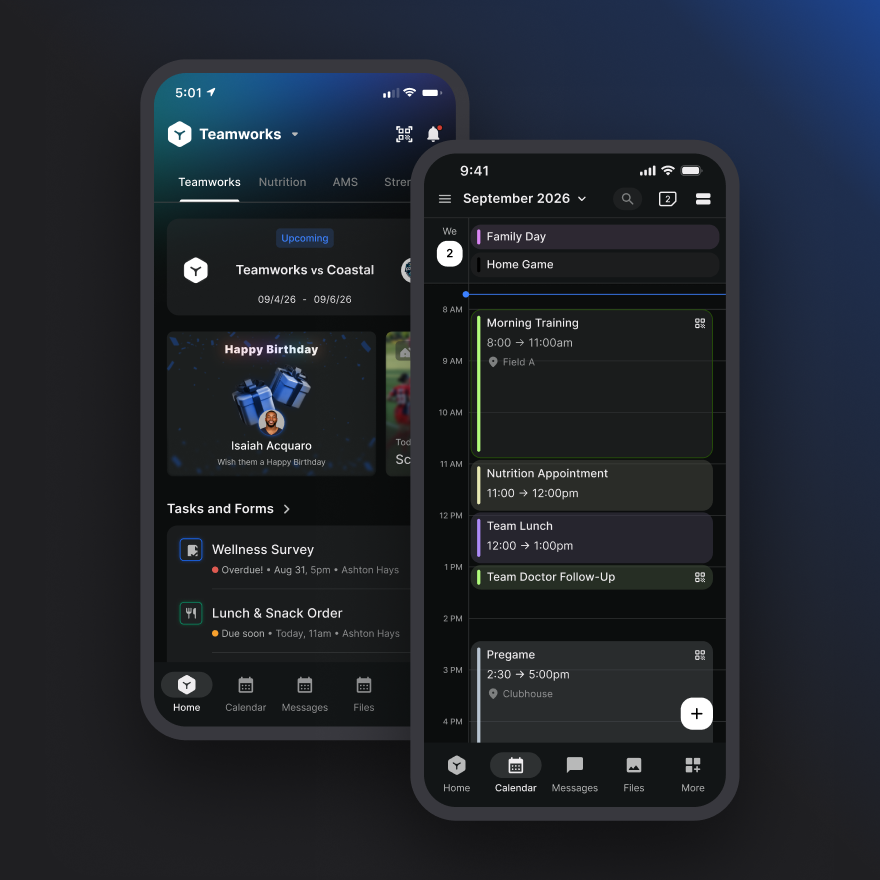
Teamworks’ distinction is its breadth around that routine. Kitman Labs also connects performance and medical information; Hudl supplies video and analysis; Catapult offers monitoring and video tools. The categories overlap. Teamworks’ argument is that recruiting, nutrition, administration, and preparation become more useful when information can move between them. A long feature list alone cannot deliver that benefit.
Nutrition makes that argument tangible. Teamworks provides meal planning, food logging, and tools for dietitians to work with performance kitchens. An athlete’s plan has to survive the journey from a professional’s recommendation to the food actually available. Connecting those jobs gives the software a purpose beyond collecting another set of numbers. The kitchen is part of the performance workflow, too, with its own deadlines and practical constraints.
There is also a less visible job: keeping an athlete’s identity consistent across systems. Teamworks describes shared profiles, roster updates, and access controls as platform foundations. If the same recruit becomes a rostered player, that change should travel to the people supporting them. Otherwise, staff spend their time copying yesterday’s information into tomorrow’s application, one department at a time.
The spreadsheet reaches its limit
Consider Memphis. In a January 2026 customer account, university athletics staff described preparing athlete revenue-sharing operations through spreadsheets, shared documents, and manual updates. Version confusion mattered because the work involved budgets and agreements. A document that was merely two edits old could leave people working from different numbers.
Memphis adopted Teamworks General Manager and Wallet to connect budgeting, contracting, and payments. Football served as the initial program, giving other sports a working example. Staff reported reliable payment timing and less administrative burden. This is a company-published account, rather than an independent measurement of savings, but its mechanism is concrete: carry an agreement through to payment without reconstructing the process at each step.
“We don’t buy products, we buy people”
Kathy Sulentic / University of Memphis
Sulentic’s remark helps explain the sale. An institution changing how it pays athletes is purchasing implementation help as well as software. Teamworks sells to organizations through an enterprise model, with multiple products available in its Elite bundles. The buying decision includes the people who answer questions when the workflow changes. That makes customer support part of the product’s practical value.
For a buyer, the useful starting point is a specific bottleneck. Map who approves a contract, who changes the roster, and who releases the money. Then ask a demonstration to follow that whole sequence. A polished screen is easy to admire; a missing handoff is easier to notice when the next person has to use the result.
Buying the next layer
The company’s expansion followed a second coordination problem. In his 2022 strategy letter, Maurides described teams accumulating twenty, thirty, sometimes more than forty specialized technology products. The helpers had become applications. Teamworks responded by buying specialists, including INFLCR in 2019 and nutrition company Notemeal in 2021, and working toward a common platform.
Later purchases moved deeper into sporting decisions. Zelus Analytics, acquired in September 2024, brought a data warehouse, predictive models, and more than seventy data scientists and engineers. Telemetry Sports added coaching and video capabilities. In January 2026, Sportlogiq brought computer vision and hockey analytics, extending the chain from footage to tracking data to evaluation.
In March 2026, Teamworks acquired PFF’s enterprise business, adding football event data and analytics used by professional and collegiate programs. The boundary matters: PFF’s consumer business remained independent. Teamworks was buying infrastructure for organizations making football decisions, rather than taking over every product familiar to football fans.
Announced financing amounts. Series F included primary and secondary capital; these figures are not acquisition prices.
The money is substantial. Teamworks announced a $235 million Series F in June 2025, led by Dragoneer. An April 2026 investment led by Hg pushed the reported valuation above $1.5 billion. Hg’s cumulative investment reached $200 million; that figure describes its total backing, not the size of the latest round. These are financing milestones, not evidence that software improves a team’s win percentage.

The useful lesson lives in the handoff
By April 2026, Teamworks reported serving more than 7,000 organizations, with technology relationships across every NFL, NHL, and Premier League team. Those figures describe portfolio reach. They do not mean every club has purchased every module, or that every workflow already runs through one application.
The lesson travels beyond sport: start with a frequent, irritating handoff, make it dependable, and expand into the work beside it. The condition is equally practical. Departments must maintain usable records and agree who owns each update. If a club needs only a calendar, a broad platform can add unnecessary work. If staff keep competing spreadsheets, integration has little to connect. Teamworks’ opportunity still turns on the original question: can the people helping an athlete act on the same information?