Alan Clarke went away and priced the equipment. That is the small, useful detail in the STATSports origin story. He had been standing beside a football pitch when a conversation turned to testing players. Sean O’Connor thought more teams should use the technology. Clarke joined in. The next day, O’Connor’s phone rang. Clarke had done some homework. A business partnership was beginning to take shape, with the distinctly unglamorous advantage of knowing what something might cost.
O’Connor later recalled that Clarke had been managing a local team. The two knew each other a little. A discussion on a sideline was an ordinary enough occurrence; the follow-up gave it consequences. There is something reassuringly physical about this beginning. Before the software dashboards, international clients and acquisition announcement, there was equipment to source and a person to call.
By October 2025, Sony was announcing a majority acquisition of STATSports. Its announcement described a business serving more than 800 professional teams and federations. Clarke, identified as CEO and co-founder, had travelled a considerable distance from that touchline. Yet the earlier episode remains a useful way into his career: a conversation became a practical enquiry, then a working relationship.
The drummer beside the pitch
Clarke’s route into sports technology had included mechanical engineering at Dundalk Institute of Technology and work in the music industry. He had played rock drums. An engineering qualification and a drum kit make an appealing pair of biographical props, though neither needs to be forced into a theory of entrepreneurship. They establish that his professional life had already crossed different worlds before STATSports.
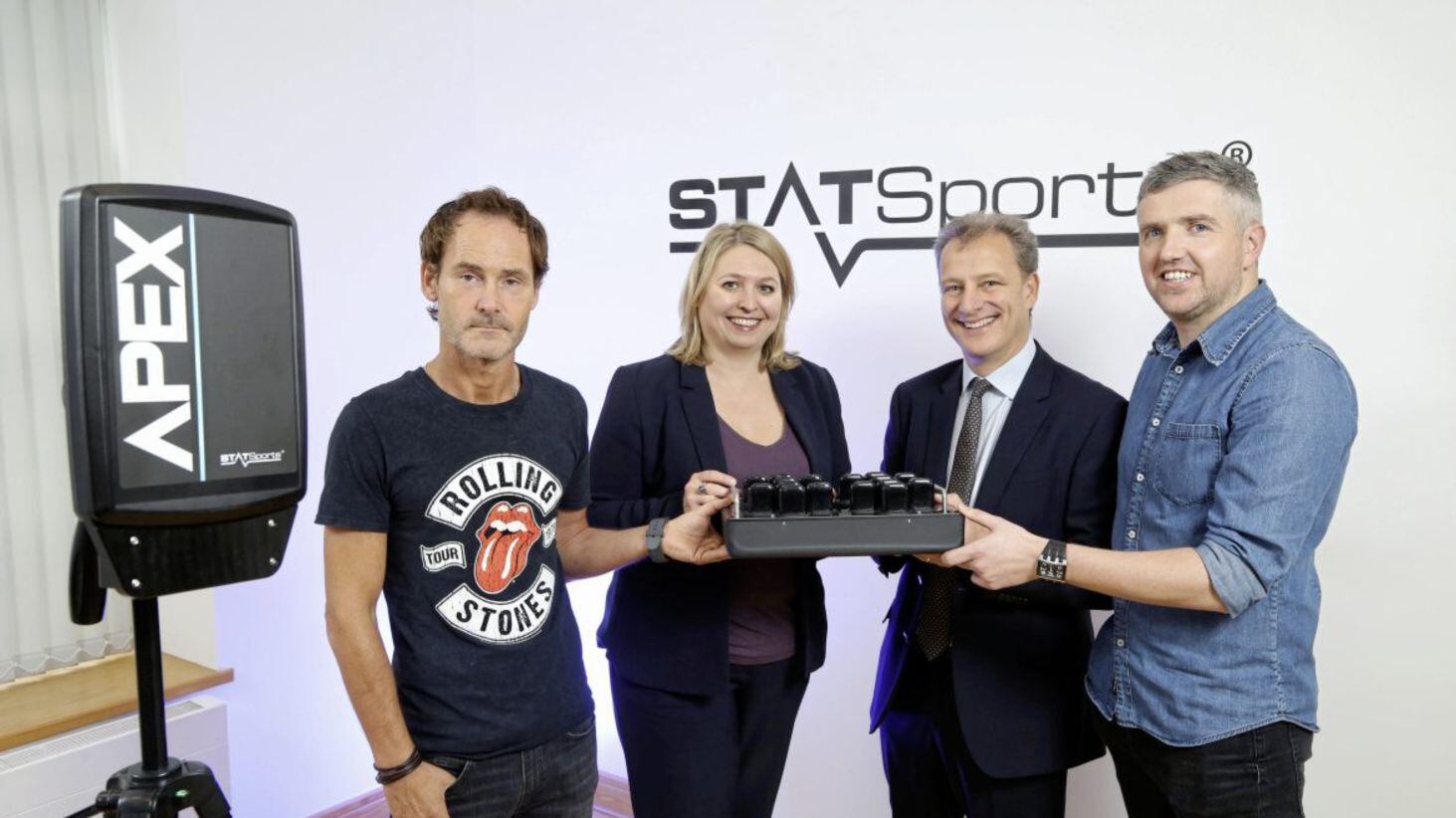
The music connection occasionally appeared in the business photographs. At the company’s 2018 expansion announcement, Clarke stood beside public officials wearing a Rolling Stones T-shirt. Everyone had arrived for a serious occasion. One participant had brought a tour shirt. It is a pleasing detail because it requires so little explanation: the executive in the photograph still had a wardrobe from outside the executive costume department.
Sport was already part of his life too. He had played for Dundalk in his youth. His eventual work with O’Connor therefore grew from an existing connection to teams and pitches. The business was based in Newry; Dundalk supplied educational and football connections. The company’s later international reach did not erase those places from the story.
A customer before a product of their own
STATSports dates its founding to 2008. Early work involved taking third-party equipment and services to teams. The founders could offer technology without yet manufacturing every component themselves. That distinction matters. They were learning what practitioners wanted while doing business with them, rather than waiting for a finished proprietary system to introduce them to the market.
The early demonstrations were hardly guaranteed a reverent audience. When Clarke and O’Connor brought sensors to Glenmuir United in Dundalk in 2008, they encountered amusement. O’Connor would later remember people laughing at the pair. A sensor can look very persuasive on a presentation slide. Beside a local football pitch, it still has to justify the fuss.
Rugby gave the young company visibility. Work with Irish teams led towards English rugby and, in turn, football. The significance of a recognised team was practical as well as promotional: another coach or analyst could see that colleagues were using the equipment. The company’s progress followed people who could make an introduction, ask a question or recommend a system.
“No matter what industry, there is always room for innovation.”Alan Clarke, 2015
By 2012, STATSports had introduced its own Viper hardware and software. The move changed what Clarke and O’Connor were building. They could develop the tools around the requirements of their customers. A relationship that began with supplying equipment now extended into creating it, with the extra demands that hardware and software development bring.
The college stayed in the picture
Dundalk Institute of Technology had more than a graduate’s connection to the company. STATSports established a presence at its Regional Development Centre early in its life. In November 2018, the institute and company signed a memorandum of understanding covering possible collaboration in sports performance and sports data analytics. The agreement set out a three-year framework for research and course provision.
For Clarke, it was a return with a different purpose. Students would be able to encounter the performance monitoring equipment during their education. The company would have a closer relationship with a place developing relevant skills. An institute that had helped accommodate an early business was now discussing how to work with an expanding one.
Clarke also credited the centre’s network and facilities with helping STATSports meet the demands of its growing customer base. The acknowledgment adds useful people and buildings to a story easily reduced to two founders. A company selling abroad still needs somewhere to work, people to recruit and others who can help solve a problem.
The expansion announcement that year came with a plan to create 237 jobs over three years. Invest Northern Ireland offered almost £4 million towards recruitment, research and development, and training. Those were announced commitments, rather than a headcount to borrow for every later year. They indicate the scale of the organisation Clarke was trying to build around its sporting relationships.
Letting the individual player in
Professional teams were only one audience for the technology. Clarke was discussing a consumer direction in 2016, describing the opportunity for amateurs to track their progress and compare it with professional athletes. The appeal is easy to understand. A player watching a training session on television might also want a more precise account of their own Saturday afternoon.
STATSports entered the consumer market with its Apex Athlete Series in 2019. That widened the conversation beyond the analyst employed by a club. Individual players could buy their own tracker. Distance, speed and sprint information became things a player could inspect after a session, rather than numbers reserved for a professional organisation’s staff.
The Arsenal edition, introduced in 2021, made the comparison especially concrete. Users could compare performance with Arsenal’s men’s, women’s and academy teams, while the club gained an additional route for identifying talent through performance data. The same shirt badge that attracts a supporter could give a young player a familiar reference point for the numbers.
It is an intriguing extension of Clarke’s early pitch-side enquiry. The first business depended on taking equipment to teams. The consumer business asked how the individual could use it. That changes the explanation required alongside the device. A number has to mean something to the person reading it, whether that person works at a training ground or is checking a phone after their own match.
Buying into the home team
In November 2021, Clarke’s relationship with local football became an ownership commitment. He joined O’Connor and businessman Andy Connolly in taking over Dundalk FC from Peak6. Clarke explained that he and O’Connor had discussed such an opportunity before. Its arrival forced a decision on a timetable they could not choose.
The ambition included restoring a community emphasis and using connections in professional football to help the club. For someone whose company worked with famous teams abroad, there was a particular significance to becoming involved at Oriel Park. A local club comes with neighbours, memories and supporters who have their own detailed opinions about how things should be done.
That chapter ended in November 2023, when the ownership changed. Accounts for 2023 subsequently recorded a loss of about €1.47 million, following roughly €498,000 the previous year. The football venture belongs in Clarke’s biography alongside the technology company’s expansion. Local attachment could motivate a purchase; it could not settle the arithmetic of running a club.
A bigger collection of instruments
On 8 October 2025, the Sony announcement put STATSports inside a wider collection of sports technology businesses. Sony already had optical tracking through Hawk-Eye Innovations and KinaTrax, along with Beyond Sports’ visualisation technology. STATSports brought wearable tracking. The proposed combination offered different ways of observing the same sporting action.
Clarke described the deal as a way to accelerate the company’s mission and combine its technology with Sony’s. His stated ambitions included performance analysis, athlete development and new ways for audiences to engage with teams. These were plans for what the partnership could enable. The announcement marked a change of ownership and an opening for further work.
The company’s footprint by then stretched across several sports, from football and rugby to American football and baseball. A business that had needed to explain tracking equipment to prospective users was joining an organisation already selling other ways of collecting and presenting sports data. Clarke’s work would be part of that larger arrangement.
Return, though, to the phone call. It contains neither a promised valuation nor a prophecy about the future of sport. It contains a price enquiry and a reason to speak again. After the music industry, after engineering, beside a local pitch, Clarke had found something worth investigating. The next day he called back. There is enough business in that small action to make the rest of the story possible.