01 / The missing connection
The basement has no signal. Somewhere else, an enterprise system holds the information a service engineer needs. Between the two sits a problem that can make an expensive software installation feel remarkably distant from the job it is supposed to help someone finish.
Navdeep Singla used that example in 2018 when explaining myJobCard, the mobile application developed by On Device Solutions. He also described someone working on a remote gas pipeline. His question was plain: “How do they get access to the information they need to do their jobs?”
That question gives his career a useful scale. Enterprise software deals in organisations, systems and projects. Singla keeps returning to the person standing in front of a piece of equipment. The distance between those two viewpoints might be only a few feet. Crossing it has given him a business to build.
Based in Solihull, he is the co-founder and chief executive of On Device Solutions, the SAP consultancy and product company established in 2011. His work concerns the awkward meeting between a large organisation’s information and an individual’s working day. The basement is an unforgiving product reviewer. It has no interest in a polished demonstration.
- 01SAP recordThe enterprise holds the information.
- 02Mobile accessWork continues when the signal stops.
- 03Return & syncThe completed record travels back.
Conceptual workflow for offline mobile work, rather than a system architecture diagram.
Before the company, the architecture
Singla’s route into that problem ran through SAP consulting. From July 2004 to March 2007, he worked as a senior SAP consultant at CSC. He then held the same title at Atos Origin, from April 2007 until October 2009. His next role, at Syclo International, was SAP integration and mobility architect.
Those titles describe a progression towards the connection itself: how business systems talk to applications, and how those applications reach a mobile worker. By February 2011, he was a director of his own company. The UK incorporation record dates his appointment to 10 February.
He founded On Device Solutions with Murali Yeddula and Anup Rathi, fellow SAP mobile architects. The business began in consulting. Its subsequent products grew out of a field the founders already knew, with all the practical obligations that come with connecting new interfaces to existing enterprise systems.
Their present responsibilities show how the partnership developed. Singla leads as CEO; Yeddula is CTO; Rathi oversees products and the Indian operation. The company’s leadership description places more than 100 colleagues behind the team. There is room in this origin story for three architects, rather than a solitary founder having every good idea.
- CSCSenior SAP Consultant
- Atos OriginSenior SAP Consultant
- Syclo InternationalIntegration / Mobility Architect
- On Device SolutionsCo-founder and director
The software you already bought deserves a hearing
In August 2016, Singla wrote an unusually revealing argument for someone whose business sells technology: organisations should do a better job of using software they already have. A new purchase can win because people have forgotten the existing application, or because nobody has kept it current.
He proposed giving product owners responsibility for explaining those existing tools internally. Keep a record of applications and the capabilities they serve. Upgrade sensibly. Consider commercial arrangements that give vendors a continuing reason to care whether the software gets used.
It is a small reversal of the usual sales choreography. The shiny newcomer gets the presentation; the incumbent gets the complaints. Singla wanted the incumbent to have a representative in the room.
Read alongside his mobile work, that position makes sense. Much of the value he describes depends on giving people better access to an existing system. The purchase has already happened. The interesting question is how much useful work it now permits.
Growth needed more than another screen
On Device Solutions moved its UK office to Innovation Birmingham Campus in October 2017 and joined the Barclays Eagle Labs incubator programme. Near the end of that year, it launched myJobCard 2.0 with SAP S/4HANA integration. Consulting expertise was becoming a product customers could evaluate.
In September 2018 came its first private investment, from a single investor. The amount was undisclosed. The announcement set out an ambition to expand from 32 staff to 100 across Britain and India, alongside more investment in product development and sales.
Singla credited the Barclays relationship with improving investor confidence and the way the business operated. Customers already extended across the UK, the UAE and the Nordic region. The money offered the company more room to plan beyond the next engagement.
The distinction between an ambition and a completed result matters. In July 2019, a separate milestone supplied a more tangible picture: the Hyderabad team had grown from six people to 80, with more than 95 staff worldwide. Its new office had capacity for over 120.
The opening included employees’ families, a traditional lamp-lighting ceremony, games, dancing and food. There was also a Metro station opposite. Expansion has its grand vocabulary, but a workable commute and enough chairs belong in the story too. Singla said he was “so proud of the work the team in India have already achieved”.
India team growth reported in July 2019. More than 95 colleagues worldwide at that point.
A cheaper day can become an expensive project
By 2022, Singla was publicly questioning another familiar enterprise habit: choosing IT suppliers by their daily rate. His objection concerned incentives. A supplier paid for the days it delivers has a financial interest in how many days the work takes.
In his argument, that arrangement can leave ready-made products unexplored, encourage custom development and make organisations increasingly dependent on the delivery partner. Smaller specialist suppliers can also disappear from consideration when procurement frameworks bundle requirements too broadly.
He advocated stronger architecture oversight, attention to code quality and documentation, and agreements tied to defined outcomes or milestones. Buyers, he argued, should make room for specialist firms when designing procurement.
This is an interested argument from the head of a specialist consultancy. It is also consistent with his earlier enthusiasm for reuse. Both ask buyers to look past the immediately visible number: the attraction of a new application in one case, the price of a consultant’s day in the other. A low daily rate remains perfectly capable of producing a long calendar.
A low daily rate remains perfectly capable of producing a long calendar.
On the incentives behind IT procurement
The worker comes back into the picture
In April 2024, Singla made the case for directing more enterprise technology investment towards frontline employees. His recommendations included involving workers in designing the tools, providing training suited to their tasks and appointing people who could help colleagues adopt them.
That attention to adoption adds a human requirement to the engineering problem. An application has to fit the task, and the people expected to use it need a voice in how it works. Installing a tool leaves plenty of work still to do.
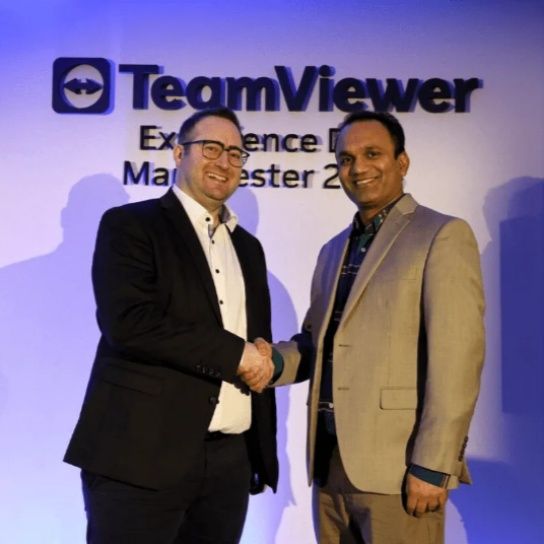
The company’s partnerships that year widened the equipment available for that effort. A TeamViewer agreement brought wearable software into the offering. A RealWear partnership added specialist wearable hardware. Tarento Technologies brought SAP integration expertise.
The company also opened an office in Colombo during 2024. Rathi visited the Sri Lankan team for workshops and team activities. As the organisation spread, the original division between enterprise knowledge, product development and delivery acquired more locations and more collaborators.
Smart glasses still have to remember the reading
The appeal of wearables is easy to photograph. A technician can receive instructions while keeping both hands available. The harder work takes place behind that picture: selecting the right instructions, recording what happened and returning the record to the enterprise system.
Singla described that work in April 2025 when discussing TeamViewer Frontline’s integration with SAP Service and Asset Manager. An initial version had a single fixed workflow and lacked integration with the SAP backend. Customer feedback informed the next iteration.
The newer version could present different workflows according to the equipment on a work order. Inspecting an electricity pole and inspecting a transformer could call up different instructions. Reference limits could come from SAP, while new measurements travelled back. Notes and photographs were stored there too.
These are modest-sounding details with considerable consequences for whether the workflow is useful. A display can show a number; an integrated process knows which equipment the number belongs to and where the reading should be saved. Across Singla’s work, that last connection keeps attracting attention.
A founder’s next question: what is the AI working with?
Singla is an alumnus of the Goldman Sachs 10,000 Small Businesses programme. In March 2026, he attended its AI for Growth event in Birmingham, where he met Rishi Sunak. His reflections returned to data quality and the conditions required for enterprise AI to be useful.
He predicted opportunities for specialist consultancies, wider use of standard software for back-office functions and more speech-driven wearable interfaces. Those are his expectations for the market. They extend his existing interests in standardisation and the way workers reach information.
Meanwhile, the company continued working on the underlying systems. In April 2026, its ODS ABAP Integration Suite V5.0.0 achieved SAP Clean Core integration certification for S/4HANA Cloud Private Edition, release 2025. In June, On Device Solutions announced SAP PE Sell Partner status, bringing software licensing and services into a closer commercial relationship.
Singla’s explanation emphasised shorter projects, responsibility across the customer journey and business results. The company announced Cyber Essentials certification in September. These developments belong to the organisation he helps lead, with its wider team doing the work behind each milestone.
The recurring question remains refreshingly concrete. What can the worker actually do with the information? First came consulting and mobile applications; then more configurable workflows, wearable devices and the prospect of AI-assisted interaction. Each introduces a different way to reach the same essential material. Somewhere, an engineer still needs the right record at the right moment. The basement continues to set the terms.