At an airfield in Yorkshire in June 2013, Paul Drayson had a problem familiar to anyone who has ever tried to prove a point. He had done the thing. The equipment had failed to notice. His electric racing car had passed 200mph on the team's telemetry, but the official timing beacons had malfunctioned. So the former science minister had to go back and do it again.
There were rules. Two runs, opposite directions, within an hour. There was a runway with an end to it. There was a car that needed to accelerate, hold its speed through a measured mile and stop before the available tarmac disappeared. A speech about the promise of electric vehicles would have been considerably easier to arrange.
Drayson completed the runs. The two-way average was 204.185mph, beating the long-standing record in the lightweight electric category. Stepping out of the cockpit, he offered a compact verdict: “This is the future.” For once, a prediction about transport came with a timing slip.
A minister takes the racing line
Six years earlier, Drayson had made an unusual career decision. In November 2007, he resigned as minister for defence equipment and support to pursue racing in the American Le Mans Series. He had finished second overall in the British GT championship in a bio-ethanol-fuelled car. America offered the next step towards the endurance race he wanted to enter.
He called it his “eventual dream of success” at Le Mans. Plenty of people have a dream involving a sports car. Fewer reorganise their ministerial careers around the qualifying requirements. The decision was concrete enough to disappoint people who thought he still had unfinished business in government.
Defence procurement had given him responsibility for the slow, expensive business of acquiring military equipment. He had pressed for faster acquisition and helped drive the December 2005 Defence Industrial Strategy. Then he chose a working environment in which delays were measured with rather less diplomatic patience. His interest in speed crossed the boundary between policy and personal appetite.
The departure did not become a permanent farewell to Whitehall. In 2008, he returned as minister for science and innovation, serving until 2010. The sequence refuses a tidy account of a politician abandoning public life for a hobby. Engineering, business, government and racing kept taking turns at the wheel.
“This is the future.”
Paul Drayson, after the June 2013 electric speed-record runs
The education beneath the helmet
Drayson's interest in motorsport preceded the titles. Cars helped draw him towards physics and engineering. He became the first person in his family to attend university, studying production engineering at Aston before pursuing a doctorate in robotics. The attraction had acquired a technical vocabulary, and the vocabulary would give him ways to earn a living.
His early work included development engineering at BL Technology and the Trebor Group. Those names put the first part of his career close to factories and manufactured objects. Production engineering asks how something can be made repeatedly, economically and reliably. Robotics adds the question of how a machine can perform the work. Both disciplines are useful correctives to a splendid idea that refuses to function on Monday morning.
His first entrepreneurial chapter involved the Lambourn Food Company and manufacturing technology. A management buyout in 1989 was followed by a sale in 1991. That year he established Genisys Development, a consultancy for developing and managing new products. Long before the racing team carried his name, he was working on the passage from technical possibility to a business someone would buy.
Oxford became another recurring setting. He held a science entrepreneur-in-residence role at the Saïd Business School from 2003 to 2005, and later became a supernumerary fellow at St John's College. His experience could be carried back into a university as well as out of one. By 2011, he had been elected a fellow of the Royal Academy of Engineering.
British racing green, taken literally
Drayson Racing Technologies was co-founded in 2007. The race programme connected his appetite for competition with an interest in alternative propulsion. The early cars used biofuel; electric power followed. The same sport that had helped send him towards science now offered somewhere to test it in public.
The 2010 season required considerable travelling. Drayson Racing competed across three continents and five countries in twelve races, including Le Mans and the American Le Mans Series. Its Lola coupe used a Judd engine running on biofuel. The green paint could be read in two ways, which was presumably more useful than having to explain the entire proposition every time the car passed.
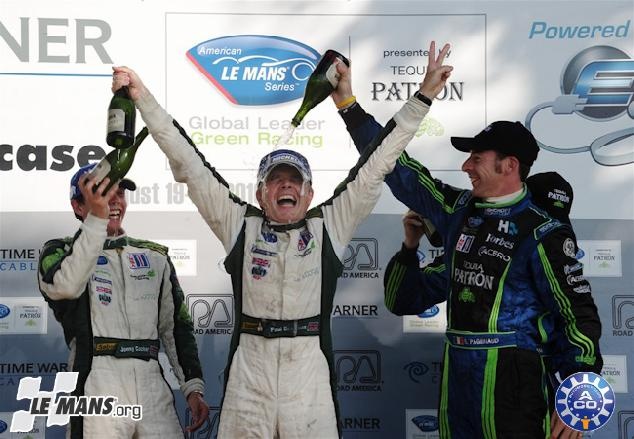
At Road America in Wisconsin that August, Drayson and Jonny Cocker delivered the team's first victory. In the podium photograph, Drayson stands in the middle, arms raised, with an expression that requires no engineering qualification to interpret. For all the talk of research and development, somebody still wanted to win the race.
Le Mans itself supplied no equivalent happy ending. His 2009 entry did not finish; the 2010 entry was not classified. Endurance racing has a useful way of separating an ambition from its result. Entering the race fulfilled an important part of the journey, while the results retained their own stubborn independence.
The electric programme brought another kind of test. At the 2012 Goodwood Festival of Speed, the B12/69EV recorded a 53.91-second run, finishing eleventh overall and setting an electric-car record at the event. A hillclimb gave the technology a short, visible examination. The following year's airfield runs would ask a different question.
The runway does not negotiate
A speed record is a wonderfully severe form of editing. Everything unnecessary has to justify its weight. The Drayson B12/69EV came from a Lola endurance-racing platform, with the combustion powertrain replaced by batteries and electric motors. For the lightweight record attempt, the team had to work within the category's weight limit as well as the length of the runway.
Elvington offered roughly three kilometres of tarmac. The engineering task included the acceleration before the measured section and the braking after it. Opposite-direction runs reduced the advantage of the wind, while the one-hour limit made the turnaround part of the attempt. The headline number was only the most easily printed part of the job.
Two-way flying-mile record in the FIA electric category for vehicles over 500kg and up to 1,000kg.
June's 204.185mph was followed by an October return. On 9 October 2013, Drayson raised the flying-mile figure to 205.139mph. The flying kilometre came in at 207.084mph, and the standing quarter-mile took 9.742 seconds. These were records within a defined electric-vehicle category. Keeping the qualification attached makes the engineering achievement easier to understand.
The distinction between a momentary maximum and a measured average matters too. A fast flash on a display would not settle the record. The car had to deliver over the specified distance, and do so in both directions. Even a driver travelling at 200mph had to return for the second part of the paperwork.
His connections extended beyond the pit lane. Google's Eric Schmidt visited the June attempt, an encounter between a technology executive and a technology argument on wheels. Yet the practical verdict remained with the car, the driver and the timing system. A distinguished spectator could appreciate the experiment; he could not make the beacons work.
Another generation enters the workshop
Drayson's business career continued after the record runs. He established Drayson Technologies in 2014. He also founded Sensyne Health and served as its chief executive until April 2022. The career has included board work at Airbus, alongside the parliamentary role he has held since becoming a life peer in June 2004.
His more recent chapter brings the family into view. He chairs Locai Labs, whose founders include his sons James and George Drayson, alongside Sujith Aleshwaram. The company is based in London and works on artificial intelligence that organisations can run on their own premises. There is hardware in this story again, along with the software.
Locai's stated ambition is ownership: models and computing that a customer can keep and operate locally. Its work includes model compression and continual learning, with an appliance designed to sit within an organisation's network. These are the company's aims and product propositions. Whether customers find them persuasive is the commercial test that follows the technical one.
By September 2026, Drayson was among the speakers at Civo Navigate London, an event concerned with cloud computing, AI and data sovereignty. The setting suited a career spent moving between the machinery itself and the conditions under which a country might build a business around it. His ministerial experience has become part of the conversation rather than a closed chapter.
Homework, followed by the practical
In a 2025 conversation with patent attorney Andrew White, Drayson returned to the importance of intellectual property and the difficulty of keeping growing technology businesses in Britain. He discussed his involvement in developing the Patent Box policy, which uses tax incentives around qualifying patented inventions. The point was to connect research, ownership and manufacturing decisions.
For a younger audience, his advice was less elaborate: “Do your science homework. Do your maths homework.” It is an amusingly ordinary instruction from someone who once rearranged his working life to race at Le Mans. The homework, in his telling, helps make the interesting parts possible.
That thought takes the story back to Elvington. A childhood interest in cars had led through engineering, factories, companies and government to an electric prototype on a finite strip of tarmac. The ambition was large; the conditions were exact. When the timing failed, the answer was to turn around, prepare the car and make another run.