science-policy
(4)
Paul Drayson and the problem of running out of runway
Paul Drayson left a ministerial job to pursue Le Mans, then drove an electric prototype past 200mph. His route through engineering, government and company building keeps bringing him back to the practical test: will the thing work?

Donghoon Lee and the cell that needs a language
An experimental biologist became a co-developer of L++. Now Donghoon Lee is teaching researchers to build biological models while keeping scientific judgment firmly in human hands.

The New York Academy of Sciences
The New York Academy of Sciences is one of the oldest scientific organizations in the United States, founded in 1817. A nonprofit professional society with more than 20,000 members across 100 countries, it convenes scientists, students, policymakers and the public to advance research, education and expertise. Its work spans flagship recognition programs like the Blavatnik Awards for Young Scientists and the Tata Transformation Prize, global STEM education through the Junior Academy and Global STEM Alliance, crisis-response coordination via the International Science Reserve, and the long-running peer-reviewed journal Annals of the New York Academy of Sciences.
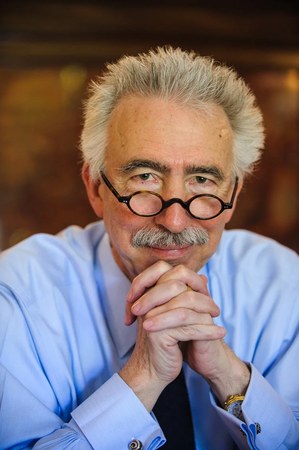
Nicholas Dirks
Nicholas B. Dirks runs the New York Academy of Sciences, one of the oldest scientific organizations in the United States. A historian and anthropologist by training, he led UC Berkeley as its 10th chancellor, chaired anthropology at Columbia, and writes books about empire, caste, and the future of the university.