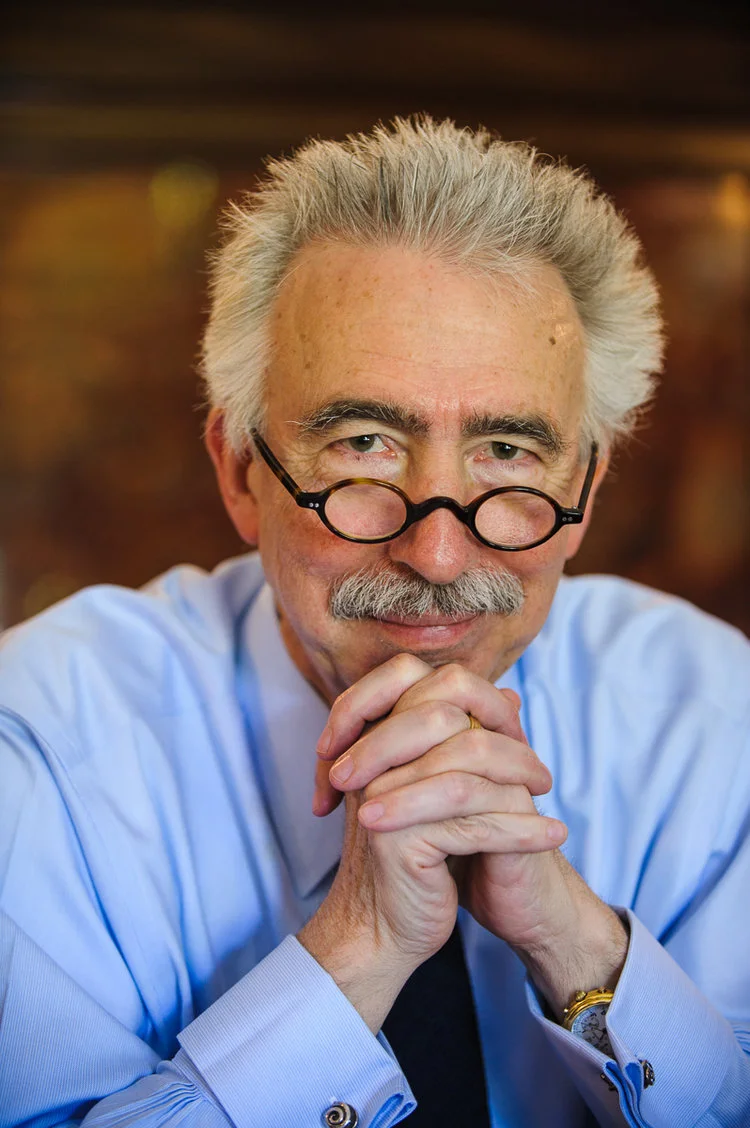
The historian who ended up running the room.
On a weekday morning at 115 Broadway, a hundred floors of lower-Manhattan glass blink awake while a 209-year-old institution opens its email. The New York Academy of Sciences has outlived steam, gaslight, and most of the corporations on its block. Its president is a Tamil-country historian who reads colonial revenue records for fun.
Nicholas B. Dirks took the job in June 2020 - a date that sentence-by-sentence implies he arrived by Zoom, and he did. The Academy was founded in 1817, eight years before anybody had figured out how to make a photograph. He spent his first months as CEO on a screen, learning who 1,100 employees were one rectangle at a time.
The Academy convenes scientists. That is the verb that matters. Where universities credential and corporations productize, the Academy convenes - workshops in Vienna, fellowships in Tempe, awards out of Mumbai, working groups on pandemic preparedness. Dirks inherited a portfolio and built out from it. The Tata Transformation Prize, the International Science Reserve, the AI and Society Fellowship with Arizona State - all launched on his watch. None of them are the kind of thing a historian was supposed to invent.
Except. Historians invent these things all the time. They are professionally suspicious of received wisdom, professionally trained to read what is missing from the official record, professionally happy in long meetings. Dirks just stopped pretending the skill set was niche.
Madras, 1963
The story everyone tells about him begins in Connecticut and detours through India. His father, J. Edward Dirks, was a Yale professor; in 1963 the family relocated to Madras on a Fulbright. Nicholas was thirteen. The city he met then is the country he has been writing about since.
Wesleyan at eighteen for a B.A. in African and Asian Studies. Chicago for an M.A., then a Ph.D. in History and Anthropology. His advisor was Bernard Cohn, the anthropologist who taught a generation to read colonial archives sideways, asking what the British were doing when they thought they were just counting people. The dissertation was about little kingdoms in the southern Tamil countryside. The book that came out of it was called The Hollow Crown. He was thirty-eight.
The book that won the Trilling
In 2001 he published Castes of Mind, the book the obituaries will list first. The argument was disarmingly clean: caste in the form we recognize it today is partly a product of British colonial enumeration. Census categories hardened into social fact. The book won the Lionel Trilling Award and is still on syllabi from Delhi to Durham. The Scandal of Empire followed in 2006, about the impeachment of Warren Hastings, which is the kind of subject only a scholar with a Guggenheim and a MacArthur fellowship can spend five years on without anyone asking why.
By then he had been at Columbia for almost a decade, having joined in 1997 as chair of Anthropology. He moved up the org chart the way historians do - reluctantly and then suddenly. By 2004 he was Executive Vice President for Arts and Sciences. He recruited. He diversified the faculty. He nudged Columbia toward interdisciplinary work in a building still organized by 19th-century disciplines. He liked it.
The Berkeley years
In 2012 the regents of the University of California chose him as the 10th Chancellor of UC Berkeley. He started in 2013. The job is - to be exact about it - one of the harder jobs in American higher education. Berkeley is a public research university with private-university expectations and a state legislature that had been disinvesting from it for a quarter-century. When Dirks arrived, state funding had fallen from roughly half the budget in 1990 to a number that would eventually settle near 13 percent.
What he built anyway: a new Division of Data Science. A residential college. The Berkeley Arts + Design Initiative. The Tsinghua Berkeley Shenzhen Institute - a genuine three-way joint venture between Berkeley, Tsinghua, and the city of Shenzhen. A global alliance with Cambridge and the National University of Singapore. A facilitation of the Chan-Zuckerberg Biohub, which has since funded a generation of life-science research across the Bay.
And the money. He led the 2016 fundraising drive that pulled in nearly $480 million from more than 65,000 donors, then put Berkeley on the path to a $7 billion campaign called Light the Way. The number is not the story. The story is that nobody had ever asked a public university to raise $7 billion before.
He stepped down in 2017. Many things were said. He wrote a book about it.
City of Intellect
That book is City of Intellect: The Uses and Abuses of the University, Cambridge University Press, 2023. It is a memoir wearing the clothes of an argument, or possibly the other way around. Inside Higher Ed called it the most honest, incisive and personally revealing recent academic autobiography. Steven Mintz, reviewing it there, wrote that he found it deeply moving, even wrenching at times. It is not the kind of sentence a reviewer writes about a former chancellor's book.
The thesis: universities are public goods that have been managed like private companies, governed like medieval guilds, and described in public like either villains or saints. Dirks would like them to be described, and run, like what they are - aspirational cities of intellect that need investment, internal honesty, and an institutional spine.
Why an anthropologist at the Academy of Sciences
It looks like a category error. It isn't. The Academy's portfolio is convening, and convening is exactly what a historian-anthropologist of 19th-century empire turns out to be unreasonably good at. He has spent forty years studying institutions that thought they were doing one thing and were in fact doing another. He has spent twenty of those years running them.
His current programs at the Academy carry his fingerprints. The International Science Reserve is a network of scientists who agree to be mobilized when a global crisis hits - a fire brigade for emergent disease, extreme weather, infrastructure shock. The Tata Transformation Prize, funded by the Tata Trusts, awards Indian researchers tackling food, sustainability, and health at scale. The Junior Academy puts teenagers from 130 countries on shared problem-solving teams. None of it is glamorous. All of it is the point.
He still teaches. He is Professor of History and Anthropology at UC Berkeley's Graduate School. His wife, Janaki Bakhle, is also a Berkeley historian; she published Savarkar and the Making of Hindutva with Princeton in 2024, which is the kind of book that gets you a long-running argument in the right Mumbai bookstores.
What he carries
The honors are an inventory of a scholar who could have stopped at any point and been fine. Guggenheim Fellow. MacArthur residential fellow at the Institute for Advanced Study, Princeton - the IAS, the same place Einstein wandered the lawns of. Fellow of the American Academy of Arts and Sciences. Senior Member of the Council on Foreign Relations. Honorary degrees in Beijing and Madras. Lionel Trilling Award. He didn't stop.
Press him on it and he gestures back to that Madras boy in 1963, watching grown-ups argue politely about everything. That, more or less, is the job description he wrote for himself before he had the words.
A career in arithmetic.
Connecticut, Chicago, Caltech, Columbia, California.
Five books, one continent, one campus.
The Hollow Crown
Ethnohistory of an Indian Kingdom. The dissertation, refined.
Castes of Mind
How British rule remade caste. Trilling Award winner.
The Scandal of Empire
India, Warren Hastings, and the making of imperial Britain.
Autobiography of an Archive
A scholar's passage to India. A title only a historian dares.
City of Intellect
The uses and abuses of the university.
In his own words.
Subjects he keeps circling.
Find Him.
He keeps a personal site, an LinkedIn presence, an X handle, and an institution on Broadway. He does not, as far as we can tell, run a TikTok.
Personal Site LinkedIn Twitter / X NYAS Profile Wikipedia American Academy of Arts & Sciences Aspen Ideas Inside Higher Ed Profile Commonweal Interview