Peter Dabrowa went to an education technology conference in New Orleans with a school data business. The conversations there made another part of the business, Evouchers, look especially promising. Fortunately, the exhibition signs had been printed on both sides. Turn them around and Wonde became Evouchers. An accidental choice at the printers had supplied the team with a remarkably affordable change of scenery.
It is a pleasingly physical episode in a career spent connecting software. No elaborate launch machinery was required to follow the interest in the room. A sign could be flipped. A conversation could continue. The incident, which Dabrowa later recalled while discussing the company's American expansion, gives a useful glimpse of how he approaches a business: arrive with something useful, then listen carefully to what people actually want.
Today he is the CEO of Beyond, the group whose businesses include Wonde, Evouchers and Secure Schools. The names describe different jobs: exchanging school information, distributing vouchers and helping schools with cyber security. Each concerns an administrative task that becomes conspicuous when it goes wrong. Dabrowa has made a career around such tasks, giving the unglamorous parts of school technology sustained commercial attention.
The New Orleans story is also a reminder that adaptability can be rather ordinary. Entrepreneurs talk about changing direction as though it always demands a dramatic announcement. Sometimes it requires a useful conversation and access to the reverse side of a board. The interesting question is what made Dabrowa willing to take that conversation seriously.
School data↻EVOUCHERS
Support delivered
A double-sided exhibition sign. Two services. One attentive team.
A problem borrowed from his previous business
Wonde began with experience gained at eSchools, Dabrowa's earlier education technology venture. Schools were using several applications, with information passed around in files or entered repeatedly. Each useful piece of software came with another small maintenance obligation. The opportunity lay in making those exchanges easier through a shared connection.
By September 2016, Dabrowa was describing a platform that had been under development for about a year and had received a soft launch that January. He reported adoption by 4,000 UK primary and secondary schools. The early ambition was practical: help applications use current school information without making implementation and upkeep another job for the school.
He also described a team assembled through eSchools. Jon Coleman brought experience as a deputy headteacher; Philip Clifton provided the technical leadership. Dabrowa placed himself on the commercial side. The division is revealing. Understanding how a school works, making software work and finding customers were treated as separate contributions worth combining.
That combination gives the origin story its texture. A school office does not buy an integration because an entrepreneur finds it intellectually elegant. It needs the software already purchased to function without a fresh round of administrative negotiations. Dabrowa's route into the problem gave him a view of that frustration from the supplier's side, where an otherwise useful product can become difficult to introduce.
His early measures of success reflected both sides of the connection: the number of schools using Wonde and the number of applications drawing information through it. In that account, neither audience could do the whole job alone. A connection becomes more useful when there is something worthwhile at the other end.
“I seem to have a good commercial head on my shoulders.”Peter Dabrowa, 2016
An international business in the space between apps
The proposition attracted Australian investors. In December 2019, Folklore Ventures, then known as Tempus Partners, announced its investment in Wonde; Hannah Field joined the board. The investor described adoption across more than 14,000 schools in the UK, Australia and New Zealand. The administrative problem had travelled rather well.
Folklore's argument centred on the cost and difficulty of linking education applications to school information systems. Developers had their own products to build. Schools needed those products to exchange information reliably. Wonde occupied the space between them, offering an API and tools that let schools see and control what they shared.
An API is simply a defined way for pieces of software to communicate. In this setting, its value can be understood without admiring the engineering vocabulary: fewer separate arrangements for moving the same information. The school and the developer have different reasons to welcome that outcome. One wants less administration; the other wants a smoother route into use.
There is a particular kind of commercial patience involved in paying attention to the connective tissue. The visible application gets the demonstration. The work underneath earns its place by making that demonstration survive an ordinary working week. Dabrowa's business sits close to that test, where a product's appeal has to coexist with the practicalities of keeping records current.
A connection, multiplied
Published snapshots of school adoption; geographic coverage expands over time. These are school counts, not revenue.
The connection finds a second use
In March 2020, Wonde's existing relationships with schools became a route for distributing supermarket vouchers to families eligible for free school meals. Dabrowa discussed the requirements with the Department for Education on a Thursday; work began on Friday, and the service was ready on Sunday. More than 4,000 schools registered on its first day.
The significance is in the sequence. Wonde already had a relationship with the institutions that needed the service. Adding another function to that relationship could reach customers without starting the entire process again. An integration business had acquired an additional purpose: helping support get from an organisation to a household.
Evouchers subsequently broadened its work beyond schools to local authorities, charities and housing associations. Its own account describes a service concerned with getting assistance to people when and where it is needed. Procurement, allocation and redemption all sit inside that apparently simple promise. A voucher has a short name and a surprisingly long administrative journey.
For Dabrowa, the expansion also supplied an international lesson. The interest in vouchers at New Orleans did not follow exactly the script of a school data presentation. The team could respond because it had another working service to offer. Listening mattered, but so did having already built something that could answer the interest.
Four working days, several businesses
Expansion brought a different set of questions. In August 2022, Wonde acquired Secure Schools, adding specialist cyber security services. Dabrowa described a shared ambition to help schools control and manage their information. The relationship makes practical sense: moving information efficiently raises an accompanying question about protecting the organisations that hold it.
The acquisition announcement set out plans for investment in audit and technical assessment platforms, alongside products to help schools assess their defences. It widened the company's responsibilities beyond the connection itself. For a customer, adopting software and maintaining confidence in it are closely related concerns, even when they require different expertise.
Beyond now provides a common home for these businesses. Its public description pairs simplicity of design with comprehensive services. That is a demanding combination. A straightforward customer experience usually requires someone else to organise the complicated work. The group's structure gives Dabrowa several versions of the same managerial question: how much effort can the supplier remove from the customer's day?
He had been asking a related question internally. In 2022, he described the company's move to a four-day working week earlier that year. His explanation included better retention and hiring, together with tighter expectations about time, accountability and project milestones. The experiment belonged to a broader effort to improve processes as the business grew.
The appeal of an extra day away from work scarcely needs a sales department. Delivering the same service within a shorter week takes more thought. In Dabrowa's account, giving customers direct access to what they needed was one way to reduce requests and interruptions. That connects the employment decision to the product philosophy: design the work so fewer people have to chase someone else.
“how do we make processes better for us and our customers?”Peter Dabrowa, 2022
Back in Newmarket, with something to show for it
Recognition followed the international expansion. In 2024, Dabrowa was among EY's London and South East regional Entrepreneur Of The Year winners and a UK finalist. The regional celebration identified his award as International Leader. A year later, he described joining an EY speaking panel with Lucy Goff and Logan Naidu and taking a place on the judging panel for the South of England.
There is a different perspective involved in moving from entrant to judge. A founder spends years explaining why a particular business deserves attention. A judging panel requires attention to other founders, other decisions and other imperfect routes forward. Dabrowa's post welcomed the chance to hear those entrepreneurial journeys and their difficulties.
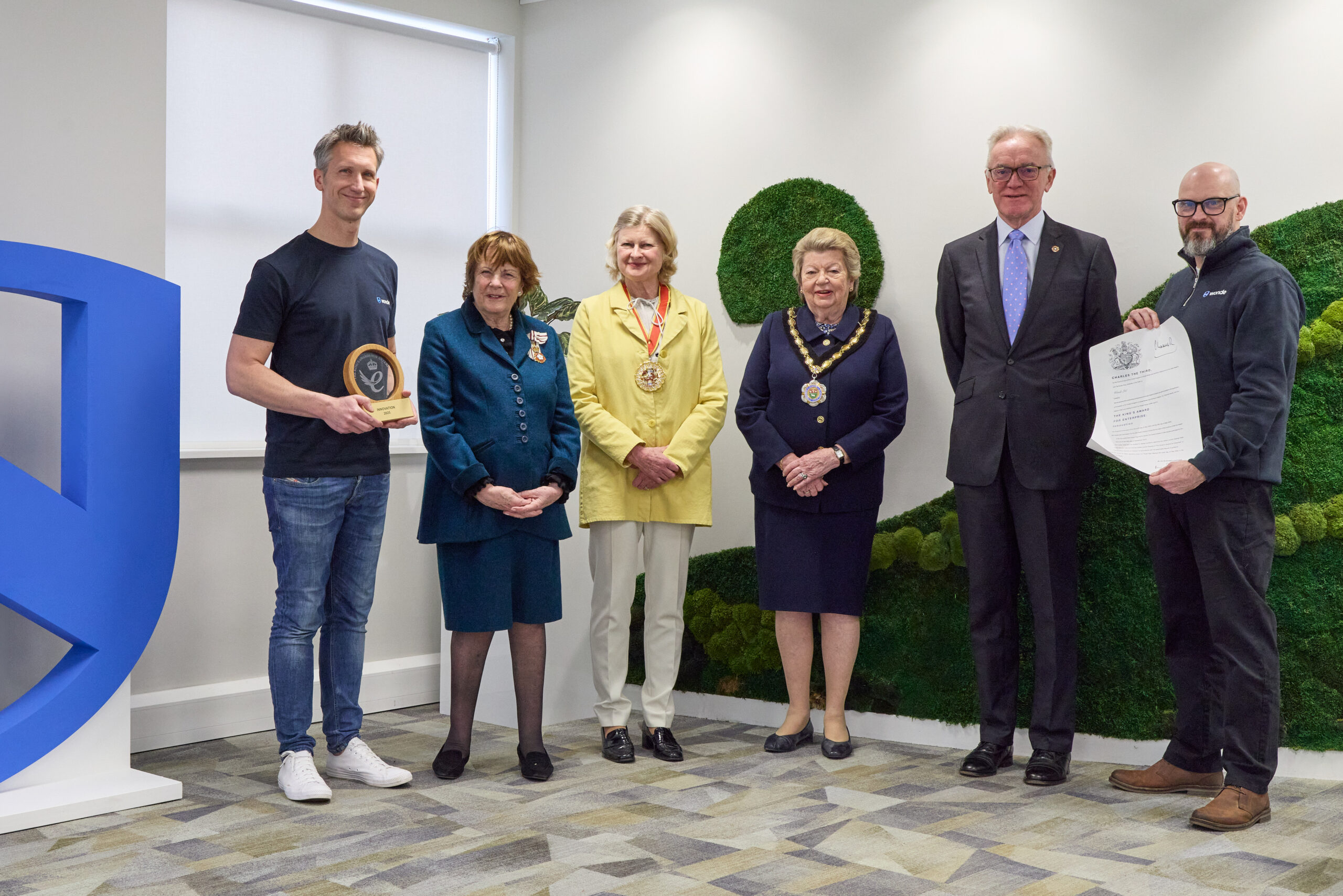
In March 2026, the scene returned to Wonde's Newmarket headquarters. The Lord-Lieutenant of Suffolk presented the company's King's Award for Enterprise in Innovation, announced the previous May. By then, the presentation account described a platform supporting more than 30,000 schools across 60 countries and a workforce exceeding 200.
The photograph supplies a modest visual joke: civic chains, formal clothes, a certificate, and Dabrowa in a Wonde T-shirt holding the award. The business of maintaining school connections has acquired a ceremonial moment. The company received the honour; the picture places its co-founder beside the people marking that achievement.
His explanation of the mission remained focused on simplifying technology so educators could concentrate on students. Read alongside the early eSchools experience, it suggests continuity through the expansion. The products have multiplied and the geography has widened, while the recurring problem remains recognisable: useful technology asks too much of the people expected to use it.
Dabrowa's career offers a concrete way to think about that problem. Notice the repeated task. Build a connection. Keep listening after the sale. Leave enough room to discover another use for the work already done. And, should the exhibition printer happen to provide two versions of the sign, take both to the conference.