Al Kingsley remembers climbing a mountain on a school trip to Yorkshire. Or rather, he remembers remembering it. With adult hindsight, he reckons the mountain was probably a small hill. There were bridges to build, rafting, things to climb and the unfamiliar freedom of staying away from home. The geography has shrunk. The experience has stayed with him.
Asked about his own schooldays, the NetSupport chief executive reaches for encouraging teachers and trips that offered independence. The memory is a useful introduction to someone whose working life involves classroom software, school boards and books about education. A child can leave a lesson with more than the material that was on the board. Sometimes the small hill does quite a lot of teaching.
Kingsley wants children to leave school wanting to learn more. His career has taken a similarly exploratory route, through bank accounts, remote computers, American business development and the responsibilities of school governance. Today he helps lead the company behind classroom.cloud. Alongside that commercial work, he chairs Hampton Academies Trust in Peterborough. He has made a career out of moving between rooms that often speak different languages.
An accountant meets a modem
The first rooms were in finance. Kingsley worked at Barclays Bank and Unilever, training as an accountant while computers were becoming tools for managing businesses and reporting their results. He found the technology more interesting than the accounting. One can sympathise with the spreadsheet: it had inadvertently introduced him to a more entertaining colleague.
After Unilever, he ran a business combining accounts for small local companies with help on their IT. Then he met Dave Apsey, who had developed a DOS-based product for controlling another computer remotely. This became an early version of NetSupport Manager. Its appeal was wonderfully concrete: a modem connection could spare someone a motorway journey to fix a distant machine.
Kingsley joined Apsey. Remote control had another application close at hand. Software that helped support a computer far away could also help someone work with a roomful of machines nearby. NetSupport launched its classroom management solution in 1995. Later in the decade, Kingsley moved to Atlanta to help grow the American business, returning to the UK in 2002. The detour through accountancy had become a lasting occupation.
- 1995Classroom management software launches
- 2002Returns to the UK after building in Atlanta
- 2014Chairmanship at Hampton Academies Trust
- 2020Early access to classroom.cloud
- 2025An MBE for services to education
The other side of the purchase order
His involvement in schools had a personal starting point. He had children and wanted to help local schools, so he became involved himself. Over time, that involvement developed into the board work that now runs alongside his business life. Selling a tool and accepting responsibility for a school’s choices expose a person to rather different kinds of questions.
Hampton Academies Trust dates his chairmanship to 2014. During his time as chair, the trust secured more than £30 million in government funding to help deliver Hampton Gardens secondary school and Hampton Lakes primary school. It is a useful counterweight to the digital part of his biography: some educational change still involves getting actual buildings into existence.
The distinction matters when considering his public work. His experience includes the long obligations of governance as well as the shorter attention span of a product presentation. A school board must keep asking whether a decision serves pupils after the enthusiasm of the meeting has passed. That responsibility gives his writing about procurement and strategy a practical setting.
His education work also includes supporting apprenticeships with City College Peterborough and serving as an East of England Apprenticeship Ambassador. Apprentices at NetSupport have won national gold medals. These are routes into working life built around doing and learning together, a natural interest for someone whose own professional direction changed when a new tool caught his attention.
Government funding secured by Hampton Academies Trust for two new schools during Kingsley’s chairmanship.
A classroom that could move
The link to classroom.cloud begins with a problem of place. NetSupport’s established classroom tools served a world in which teachers and learners were generally together. A cloud platform could help a teacher work with student devices across locations. The company says the product was already in development before the widespread disruption to school routines in 2020.
NetSupport accelerated access for a limited group of schools and districts that year. Kingsley announced classroom.cloud on LinkedIn in August 2020; a wider North American release followed in 2021. Its tools included screen sharing, messaging, quick surveys and ways for teachers to redirect student screens. Integrations with Google Classroom and Microsoft School Data Sync helped populate classes.
For Kingsley, the point was continuity: a teacher should be able to use a familiar platform while the location of teaching changed. That is an unglamorous ambition, in the productive sense of the word. Software used in a school has to survive the school day. A feature earns its place through what it allows a teacher or learner to do.
The product also puts a boundary around the description of his role. classroom.cloud belongs within NetSupport’s work; it is a company effort, developed and tested with schools. Kingsley’s contribution can be understood through his leadership of that business and his public explanation of the decisions behind its products.
Books with questions in the title
Writing has become another way of carrying experience between those rooms. My Secret #EdTech Diary appeared in 2021, followed by books on school governance and the growth of schools and multi-academy trusts. His catalogue includes handbooks, practical questions for governors and trustees, and questions for evaluating technology. There is a certain consistency here: even the bookshelf appears prepared for a board meeting.
The Awkward Questions in Education, published by Routledge in 2025, widens the discussion. Its subjects include how a good school is measured, the relationship between curriculum and future skills, the role of teachers as AI develops, attendance, and the need for longer planning horizons. It includes interviews with school leaders, teachers, governors and policy makers.
The title fits the pattern of his work. A useful question can make a familiar arrangement look less inevitable. Which skills deserve time? How should a school judge success? Who gains from an expansion? These are questions that require people to declare what they value before debating which intervention to purchase.
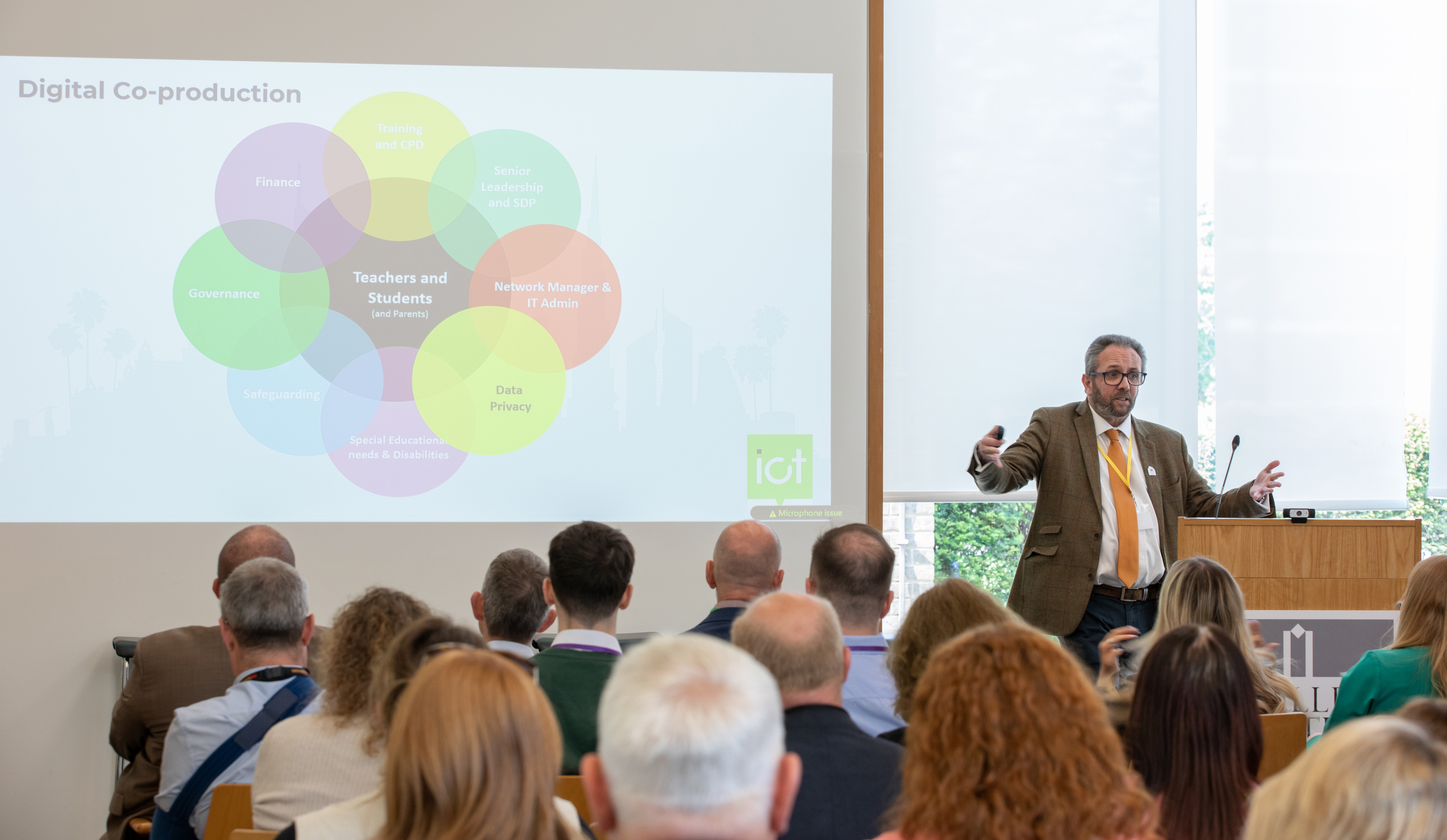
His work with educator Mark Anderson offers a more immediately usable example. Together they produced A Guide to Creating a Digital Strategy in Education, with a third version published in 2021. The collaboration brought a school technology voice together with a business leader and trust chair. The guide’s emphasis on involving stakeholders gives the strategy a constituency beyond the person responsible for the equipment.
“if you employ great people to work with you, you need to listen to them.”
Al Kingsley · on changing his mind
The microphone goes both ways
Kingsley’s public life is full of conversations: conference hosting, panel chairing, podcasts and interviews. His approach to chairing includes drawing quieter voices into a discussion and keeping a panel from becoming a sequence of separate speeches. Anyone who has sat through four presentations disguised as a conversation can appreciate the distinction.
Sometimes the questions come from a younger panel. During a visit to Woodland Academy Trust in 2023, pupils at Peareswood Primary interviewed him about school values and how his company reflected them. The trust shared the conversation on YouTube. It is a particularly apt encounter for a chief executive whose products are used in classrooms: pupils were doing the interviewing.
There are less institutional details, too. NetSupport’s American team biography identifies him as a Porsche enthusiast. His personal site mixes governance and technology with the occasional smiley face. The combination makes room for a public voice beyond the job title, without requiring every personal interest to become a leadership lesson. Sometimes a car can simply be a car.

The next purchase needs a better question
The 2025 New Year Honours recognised Kingsley with an MBE for services to education, naming his role as chair of trustees at Hampton Academies Trust. His LinkedIn profile also records a Global Leader award from EdTech Digest in May 2026 and ISTE’s Making IT Happen award in June. The recognition spans the school and technology parts of his work.
His current writing returns repeatedly to AI and the responsibilities surrounding it. AI Governance in Education sets out a journey through purpose, people, policy, process, practice and proof. It includes templates, registers and board reporting material. The intended reader needs a willingness to ask questions, rather than a technical background.
With Dan Fitzpatrick, he is also developing AI Ready, a school leadership guide covering strategy, procurement, governance and implementation. Its advertised scope includes evaluating pilots and recognising when an approach should stop. There is an appealing practicality in putting an exit route into a book about adoption. Buying something and continuing to use it are separate decisions.
In an August 2026 conversation about IT strategy, Kingsley questioned the impulse to change simply because everyone appeared to be using AI. He also argued that wider adoption could increase the value of human service, engagement and creativity. The concerns extend beyond schools, but the underlying question travels well: what are people trying to achieve with the technology?
A month later, he was hosting a discussion with John Murphy and Danielle Lewis-Egonu about leadership in schools and multi-academy trusts. The conversation continues across his books, newsletter, advisory work and school responsibilities. Kingsley has accumulated plenty of titles. The more revealing habit is his willingness to keep a question open long enough for someone else to answer. That small hill in Yorkshire still has something to contribute.
Keep the conversation going
More from Kingsley, plus the conversations and books explored here.