Consider the friend who sits beside you in class. That person is rarely mentioned in an education company’s pitch. The pitch usually contains teachers, curriculum, perhaps a clever algorithm. Yet the friend can make you turn up, ask a question, or stay for another problem. Noon’s history begins with two founders slowly recognising the commercial importance of that very ordinary person.
- Noon builds live classes around teachers, friends and exam practice.
- Its next chapter puts remote experts inside physical schools.
- The lesson for builders: make participation part of the product.
Six years to discover the obvious
Mohammed Aldhalaan and Dr. Abdulaziz Alsaeed, childhood friends, founded Noon Academy in Riyadh in 2013. They started with a simple test-preparation website. By the time Alsaeed wrote about their $8.6 million Series A in June 2019, six years and hundreds of experiments had turned it into something else: a place to study with friends, compete, and request live tutoring.
The change came from watching students. New arrivals brought school friends along. The founders followed that behaviour into group study and teacher-led communities. Alsaeed described the obstacle as “boredom.” More explanations could help a confused student. Keeping an otherwise capable student interested required a different design.
Progress was expensive in time. Alsaeed recalled years of bootstrapping and rejection from more than 45 investors and venture firms. The tidy version of a startup story begins with a brilliant insight. Noon’s version gives the insight six years to become useful.


In a 2020 Wamda interview, Aldhalaan reported almost 45 minutes of daily use overall, versus about 78 among students using social features. Treat that as a clue rather than a controlled experiment: sociable students may differ in other ways. Still, it explains why Noon recruited for its London office from the worlds of social media and gaming.
The lesson needs a room
Today, the app’s proposition is straightforward. Join a live teacher-led class. Ask questions through chat or a microphone. Practise exam problems during and after the lesson. Study alongside other students. Noon’s web and mobile products put those activities together, so help and company are close to the difficult question.
For school-age students and exam candidates, the alternatives include private tutors, tuition centres, recorded YouTube lessons and regional education apps. Noon’s distinctive bet is on the interaction surrounding instruction. A recorded lesson can be replayed whenever you like. A live group offers someone who can answer back.
Teachers are customers of the idea, too. In his 2020 interview, Aldhalaan described letting them open classes and upload materials without waiting for company permission. That approach draws on local knowledge: the teacher knows the syllabus, the language and the students. Noon supplies the space and the tools. It also means that content, classroom management and teacher quality matter as much as the software. A group can be lively and still need a better explanation of fractions.
The app is free to download, with paid courses and packages. At this research snapshot, Apple’s US storefront lists a Noon Plus Package at $67.99. That is one purchase listing, not a universal tuition rate. Alongside this consumer business, Noon now delivers school programs and invites sponsors to support community classrooms.
“Never study alone.”
Noon’s message to students
The company’s stated culture puts students first and asks employees to experiment, take ownership and improve. Those are familiar promises on a careers page. Here they connect to a concrete product choice: the student’s social experience is part of what the team must build. The same choice complicates the job. A useful class needs a teacher, questions, feedback and enough order for everyone to hear.
Noon Track makes the shift visible. The Saudi program operates inside partner private schools, combining university-entry preparation with English and AI skills during the school day. Diagnostic assessment, structured practice and a dedicated supervisor are part of the offer. The official timeline dates its launch to 2024.
Students + peers
Students + peers
Illustration of the delivery model, not classroom counts.
What $41 million was meant to buy
In 2020, Noon raised a $13 million pre-Series B led by STV. The initial target had been $5 million. In November 2023, a $41 million Series B co-led by Wa’ed Ventures and RAED Ventures backed plans for AI and social learning in physical classrooms. Those three disclosed rounds sum to $62.6 million of financing.
Capital raised. Not revenue or money spent.
In July 2026, Noon acquired Almakhfi, a Saudi platform specialising in Qudurat and Tahsili preparation. Almakhfi reportedly served more than 250,000 students over eight years. The deal adds specialised exam content to Noon’s wider offer. There is a pleasing continuity here: a company expanding into schools still sees value in the exam that originally brought students through its door.
The adult beside the screen
Pakistan reveals another application. Noon describes a dual-instructor model: an expert teaches remotely while a trusted local facilitator supports students in the room. Existing community spaces can become learning centres. Flexible shifts help children fit attendance around difficult circumstances. A JICA-validated accelerated curriculum is designed to compress ten years of foundational education into four.
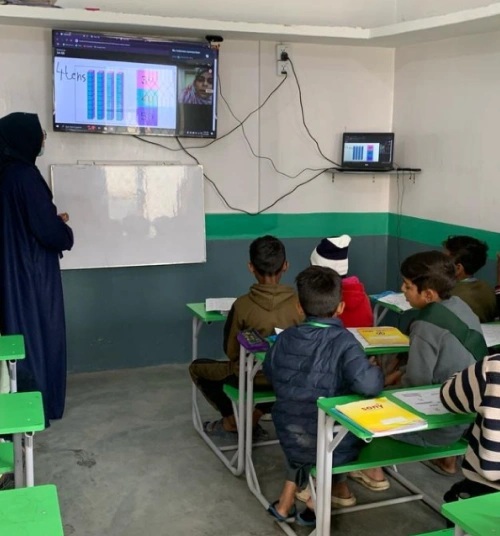
The Pakistan site reports 8,000 out-of-school children reached, 14 schools supported, $1.3 million spent toward educational impact and 95% retention. These are program claims with a particular scope. The spending figure is not annual tuition per child, and retention describes staying enrolled rather than mastering the curriculum.
Delivery depends on mundane things. Agora’s account says Noon changed communications providers after problems with quality and support. Broken audio can interrupt the very interaction the product promises. A remote expert also needs a capable local colleague, working equipment, relevant teaching materials and funding that lasts longer than a pilot.
Copy the group, then test the learning
These conditions put a limit on the approach. Sharing a teacher works poorly if classrooms cannot connect reliably or students need individual support the room cannot provide. Local facilitation deserves a budget and training, just as the remote lesson does.
The transferable idea is specific: notice which relationships already bring people back, and build useful activities around them. For an education business, that might mean classmates practising together, teachers forming their own groups, or facilitators keeping a room involved. Participation needs an owner.
Noon now reports more than 20 million learners taught across five countries. Reach is one achievement; learning is another question. A school operator copying this model should test attendance, skills gained and cost across comparable cohorts. Friends can help get a student into the lesson. The lesson still has to earn the next hour.
Try it. Watch it. Follow it.
Live classes and study tools · Noon app and packages · Noon Track in schools · Pakistan’s classroom program
LinkedIn · X / Pakistan · Instagram · Facebook / Pakistan · TikTok
Noon’s videos · A Noon Track student’s experience (Arabic) · Studying by morning, welding by evening
Inside the Almakhfi acquisition · Alsaeed on the first six years · Aldhalaan on social learning · The technology behind live classrooms · Founder interview on the future of education (Arabic)