- Engageli sells a quote-priced virtual classroom to universities, school systems and workplace-learning teams.
- Its signature idea is persistent tables: small groups that exist without the administrative theatre of opening breakout rooms.
- It combines live class, interactive playback, engagement analytics and AI-assisted course authoring.
- The company has raised $47.5 million. Public pricing is unavailable; adoption also costs institutions time in integration and faculty training.
- The copyable lesson is simple: make participation the room's default, then measure it carefully.
In 2020, Dan Avida and Daphne Koller watched their daughters attend school on Zoom. The children were present in the strict technical sense: cameras connected, audio carried, slides advanced. Yet the thing called a class had become a meeting with younger attendees. Avida had spent decades building companies. Koller had co-founded Coursera and taught at Stanford. They knew quite a lot about software and learning, which may be why the obvious answer - improve the meeting - looked wrong to them.
A classroom is not defined by the fidelity of its video. It is a social arrangement. People face one another, whisper to neighbours, form groups, get noticed drifting away and discover that the student two seats over has misunderstood the same sentence. General-purpose conference software preserved the lecturer and discarded much of the room.
With Stanford professor emeritus Serge Plotkin and former 2U executive Jamie Nacht Farrell, Avida and Koller founded Engageli. The company launched that October with $14.5 million in seed capital. Seven months later it raised a $33 million Series A co-led by Maveron and Corner Ventures. The total, $47.5 million, paid for a rather literal act of reconstruction: they put tables back into the virtual classroom.
A table is a small constitution
Engageli's screen does not treat every learner as an equally distant square. Students sit at persistent virtual tables. They can talk and work in small groups while an instructor observes, visits a table or calls the room together. Polls, quizzes, Q&A, shared documents and whiteboards sit inside the same environment. The instructor gets signals about attendance and participation while the class is still happening, not after a disappointing exam.
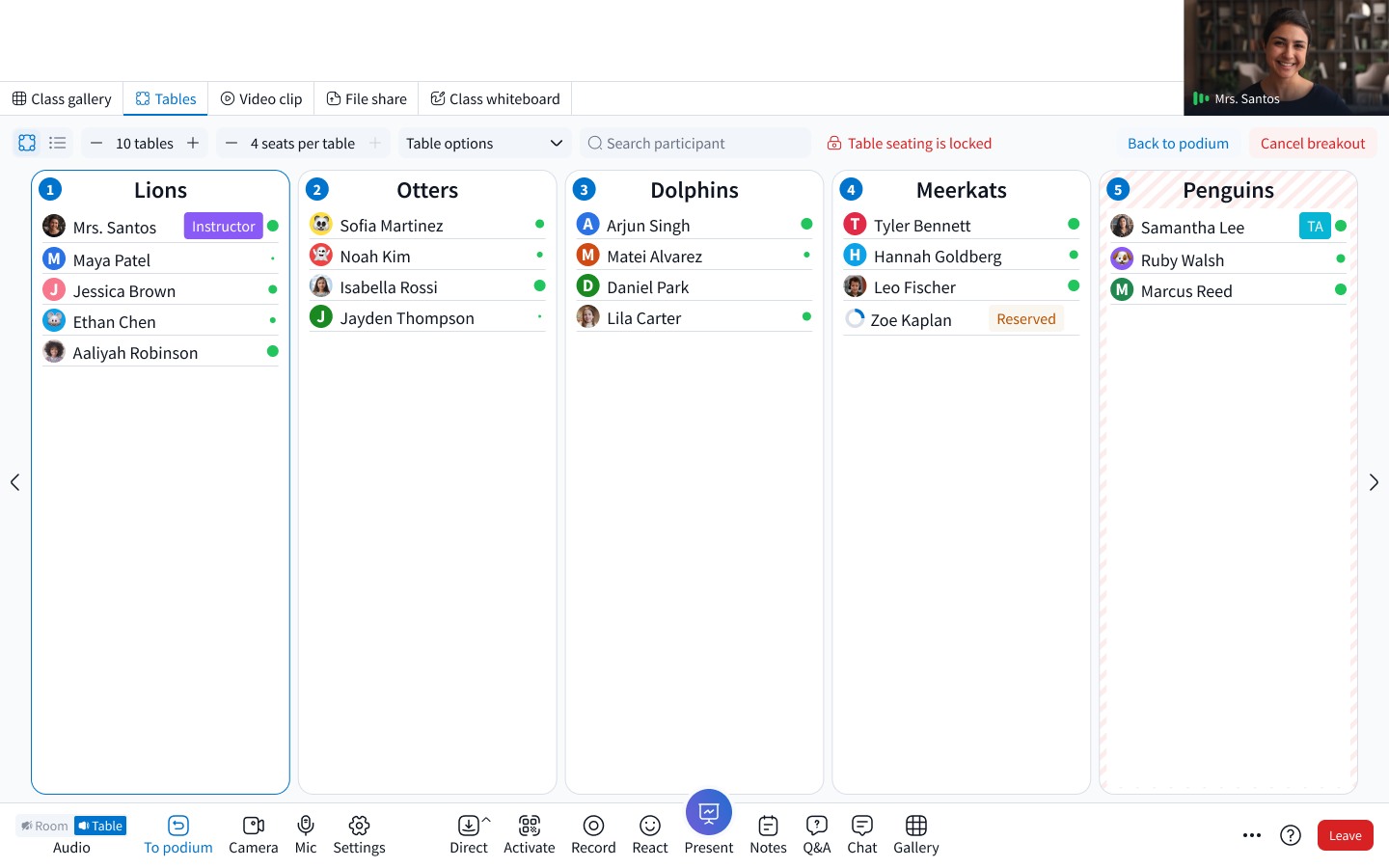
This sounds like interface furniture. It is really a claim about behaviour. A gallery grid says, “Watch the speaker.” A table says, “Someone beside you may ask what you think.” The difference is modest enough to escape a procurement spreadsheet and consequential enough to alter who speaks.
“The problem wasn't the students or the teachers - it was the tech.”Dan Avida, co-founder and CEO
The product has since expanded beyond the live room. Playback Rooms let a student arriving later answer polls and return to shared materials rather than consume a flat recording. Engageli Studio, introduced in early access in 2025, uses AI to divide existing video or presentations into shorter lessons and suggest quizzes, polls and activities. The AI Classroom Suite adds tutoring, summaries and activity generation. The ambition is a single environment across live, hybrid and self-paced learning, with the learning management system connected behind it.
The numbers are useful. The footnotes matter.
At DeVry University, an analysis covered roughly 3,000 students taught by 50 professors. Students using Engageli posted a 94 percent pass rate, against 88 percent among non-users. Those using it for at least 60 minutes reached 95 percent. DeVry also reported a 1.55 percentage-point improvement in persistence when comparing the same professors and courses before and after adoption.
Engageli's own active-learning experiment reported 13 times more learner talk, 16 times more nonverbal participation and test scores 54 percent higher one week later in its most active sessions than in lecture-style sessions. Those are striking results, but they are company research from three sessions, not a universal exchange rate between table talk and grades. DeVry's comparison is larger and grounded in actual courses, though it remains an institutional case study rather than a randomized trial.
These figures show that deliberately active sessions on Engageli can outperform passive formats in the settings studied. They do not show that buying the software automatically improves every class.
The more revealing result may be adoption. At the University of Nicosia, Engageli use grew from 90 to 850 students in the first year. Instructors using embedded polls reported participation between 90 and 100 percent in some classes. The university later chose Engageli to replace Webex Meetings for distance-learning lecturers beginning in spring 2026. Coventry University announced access for thousands of students and hundreds of staff. Salem-Keizer Public Schools uses the platform in a daily synchronous online program serving more than 1,000 children.
What failed first was the meeting metaphor
Engageli's origin story is easily mistaken for a pandemic fable: Zoom fatigue appears, founders have an idea, venture money arrives. The more durable point is that the emergency exposed a category error. Schools had used software designed to keep an agenda moving. Then they wondered why a student could vanish while remaining visibly present.
What changed the founders' minds was not a market report. It was the domestic spectacle of capable teachers and students being made dull by their tools. Their response can be copied without buying Engageli: create stable small groups, require retrieval and discussion throughout a session, preserve collaborative work between meetings, and give the instructor early signals that invite help rather than late signals that assign blame.
Engageli packages that playbook as enterprise SaaS. Pricing is custom and not published. The company offers free trials, including a configured sample classroom, optional setup and an impact report based on trial data. The real cost is therefore partly hidden from a price sheet: identity and LMS integration, instructor training, redesigned lesson plans, support procedures and the political work of asking faculty to change familiar habits.
Software cannot supply the seminar
This is also where the idea has limits. For a one-way webinar, persistent tables may be expensive ornament. An institution that installs the platform but preserves the uninterrupted lecture has purchased a room and refused to rearrange the chairs. Mobile access is useful, but Engageli's Android app still lacks some browser abilities, including screen sharing and file uploads in chat. Engagement analytics can reveal silence, but silence is ambiguous: reflection, confusion, disability, bandwidth and boredom may look alike on a dashboard.
Privacy deserves equal seriousness. A participation signal is helpful when it prompts an instructor to check in. It becomes crude when treated as a grade for visible busyness. Institutions need clear policies about what is measured, who sees it and how much weight it carries. Active learning is a teaching practice, not a surveillance setting.
Engageli competes with Zoom, Teams and Webex, which are familiar and often already paid for, and with education-specific systems such as Class, InSpace, BigBlueButton and Adobe Connect. Its best defence is not a longer feature list. It is coherence: tables, assessment, analytics, playback and authoring behave as parts of one teaching environment. Its customer-success team runs design sessions, asynchronous onboarding, integration workshops and support playbooks because the company appears to understand an awkward truth of education technology: implementation is part of the product.
The cleverest thing Engageli built may not be an AI tutor. It may be a room in which another student expects you to answer.
That is the useful, portable idea. Better online learning does not begin by asking how clearly the lecturer can be seen. It begins by asking what everyone else in the room is expected to do. The table is only a piece of furniture. But furniture, as any host knows, decides more conversations than the guests would care to admit.