Diego Fanara had the kind of founder insight that sounds obvious only after somebody builds it. At 18, newly arrived in London from Switzerland, he had chosen a university using rankings, brochures and websites that all seemed to dissolve into the same polished fog. What he needed was not another fact sheet. He wanted a student to tell him what Tuesday felt like.
That was the durable idea behind Unibuddy: the person best equipped to explain university life is often already living it. The product around that idea was far less durable. The company first thought high schools were the customer and built them a dashboard. Then it tried a marketplace where prospective students could find current students on Unibuddy's own site. One problem was emotional; the other was brutally mechanical. The founders knew why peer advice mattered, but they did not yet know who would pay, what they would buy, or how anybody would arrive.

The product was right. The route was wrong.
The original site, launched in 2015 under the one-d name “Unibudy,” signed up 500 would-be ambassadors in two weeks. Supply was enthusiastic. Distribution was not. Visiting high schools did not resolve the model. Universities liked the idea but kept asking where the marketplace's traffic would come from. It was the correct objection, repeated until it became strategy.
At a conference, a Coventry University recruiter suggested selling the service to universities. Then the sharper move arrived: do not merely link to a separate destination. Put the platform on the university's website, dress it in the institution's brand, and borrow the traffic already flowing through its recruitment funnel. Queen Mary University of London said yes. Royal Holloway, New College of Humanities, Imperial College Business School and Lancaster University joined the first group of five pilots.
“Eureka - we should capture the University's own traffic.”Diego Fanara, co-founder and CEO
This is the bit worth copying. Unibuddy did not solve cold-start distribution with a larger marketing budget. It changed the product so distribution came bundled with installation. The institution became buyer, channel and trust wrapper at once. Prospects saw familiar branding. Universities could supervise the experience. Ambassadors met people already considering their school.
A chat bubble with an enterprise basement
From a prospect's side, Unibuddy can look pleasantly small: choose an ambassador, ask about a course, accommodation, fitting in, or moving countries. Underneath sits a three-sided machine. Prospects need a frictionless widget. Ambassadors need profiles, an app, content tools, saved answers and sane conversation management. University teams need onboarding, moderation, safeguarding, analytics, branding controls and CRM integration. The founders had to build all three surfaces from the start.
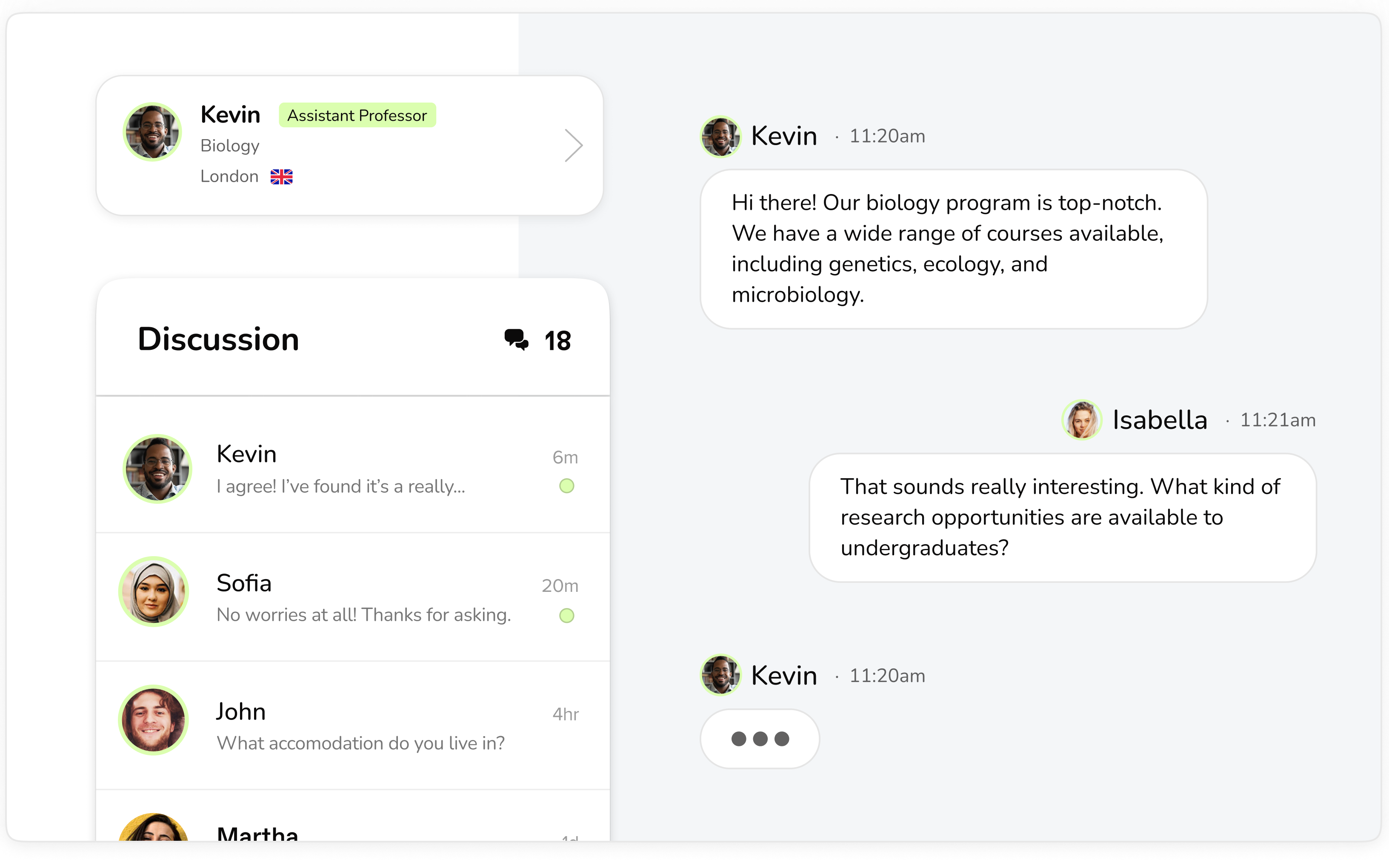
The suite now runs beyond one-to-one Chat. Community gives admitted and incoming students branded groups, direct messaging, recommended connections and updates before arrival. Discover places ambassador profiles on partner research sites such as UCAS. Assistant answers institution-specific factual questions around the clock, then hands the subjective ones to a human. Intelligence turns conversations into themes, microsurveys, benchmarks and CRM-ready summaries.
That last split is strategically neat. Earlier Unibuddy marketing argued that a chatbot could answer tuition questions but could not explain how it felt to move from India to Oregon. The newer product has not abandoned that distinction; it has operationalized it. Automation handles repetition. People handle lived experience. The sales pitch is not “AI replaces ambassadors.” It is “AI gives ambassadors fewer boring questions.”
Those numbers are customer case-study results, not controlled promises. Engaged students may already be more likely to enroll. Still, the individual reports reveal what the buyer is purchasing: not chat volume for its own sake, but more applications, higher yield, fewer repetitive emails and clearer evidence of what wavering students need.
Who pays - and what it can cost
Unibuddy is enterprise SaaS for recruitment, admissions, enrollment marketing and student-success teams. Pricing is tiered and quote-based. Packages can include Chat, Community, Assistant, Discover access, multiple ambassador programs, customization, safeguarding, conversational insights, integrations and enterprise analytics. The company says implementation can typically take one to two weeks, depending on the institution's resources.
Public contracts add texture, not a price list.
A 2024 University of the West of England award listed a roughly one-year Unibuddy subscription at £31,119.60. A separate 2025 public award listed £54,280.79 for one year. Both figures include VAT; scope differs.
The company reported $32 million in total funding when it raised a $20 million Series B led by Highland Europe in July 2021. Its $5 million 2019 Series A was led by Stride.VC, with investors including Emerge Education, Bart Swanson, Logitech co-founder Daniel Borel and Shakil Khan. The capital followed a pandemic year in which the company said revenue nearly tripled as universities rushed toward digital recruitment.
The market between brochure and belonging
Unibuddy sits in a narrow but consequential strip of higher education technology. Slate and other CRMs keep the system of record. Website platforms publish official information. Event tools stage presentations. Social networks host unofficial groups. Unibuddy tries to connect those pieces around peer influence, then make the interaction measurable enough for an enrollment budget.
Direct rivals include The Ambassador Platform and ZeeMee. The Ambassador Platform also sells managed peer-to-peer recruitment and conversion tools. ZeeMee leans harder into a student social network and US college communities. Unibuddy's argument is breadth and institutional control: global discovery, a branded web embed, ambassador management, pre-arrival community, human-plus-AI support, conversation intelligence and CRM plumbing in one system.
Its partnership with UCAS is especially useful because it recreates the original insight at national scale. A university's ambassadors appear where students already research choices. UCAS says 65 percent of students who chat with an ambassador convert into an application choice for that ambassador's institution. Again, that is not a randomized guarantee, but it explains why distribution partnerships matter as much as feature releases.
The newer benchmarking work attacks a quieter enterprise problem: a dashboard number without a reference point is barely a number at all. A recruitment director can see that conversations rose, but not whether the program is healthy for an institution of similar shape. In February 2026, Unibuddy added benchmarks that let customers compare performance and explain progress internally. University of Groningen said the reference point made two weeks of reporting clearer than the previous few years. It is not a glamorous feature. It is exactly the sort of feature that helps a department defend a renewal.
Recent cases also show the wedge widening. Groningen began with Chat and moved toward Community after sign-ups nearly doubled from 2024 to 2025. The University of South Dakota combined Chat, Assistant and ambassador-made content, reporting three times the engagement in January 2026 versus a year earlier without expanding its team. Buckinghamshire New University said Assistant 2.0 handled more than 1,800 enquiries, doubled lead capture and reached 95 percent answer accuracy. Each result belongs to one institution, but together they show the product's direction: one conversation layer becoming a recruitment operating system.
Where the playbook breaks
Software cannot manufacture a credible campus culture. A university still needs ambassadors who represent varied courses and backgrounds, respond thoughtfully, and are allowed to sound like students rather than junior copywriters. It needs enough incoming students to make Community feel inhabited. It needs promotion across web pages, email, events and campaigns. And somebody must read the insights and change the recruitment work.
Copy this
Use five design partners. Embed into existing traffic. Give every participant a purpose-built workflow. Automate facts, preserve judgment, and connect usage to the buyer's outcome.
Do not expect magic
A hidden widget, empty group, slow ambassador queue or ignored dashboard will not rescue weak demand. Peer software amplifies participation; it does not invent it.
There is also an authenticity wrinkle. Student ambassadors may be selected, trained or paid by the institution. They can offer honest firsthand experience while still representing a school they chose and generally like. Applicants should treat a conversation as a valuable perspective, not an audit. Institutions earn trust by letting ambassadors answer plainly, including when the answer is inconvenient.
Unibuddy's own culture language mirrors the product: “Power to the Peers,” “Hungry to Grow,” “Thrive in the Thick of It,” and “Impact over Input.” The phrasing is startup-bright, but the origin story supplies the useful proof. The founders were willing to discard two versions of the business without discarding the problem. Their conviction stayed fixed; the buyer, channel and interface did not.
A decade after Unibudy's misspelled debut, the current homepage says more than 500 universities and three million prospective students use the platform. The surprise is not that students want to talk to students. The surprise is how much infrastructure it takes to make one honest conversation easy, safe, visible and worth renewing.