The first version of Element451 did one thing that colleges desperately needed and almost nobody considered glamorous: it built online applications. The project, then called Luminious, lived inside the higher-ed marketing agency Spark451. Founder Ardis Kadiu thought the application module might be the product. Customers had other ideas. The form exposed all the work surrounding the form - reminders, events, messages, decisions, data cleanup and the tiny administrative chases that decide whether an interested student ever becomes an enrolled one.
That was the first useful wrong turn. From 2016 through 2018, the team built email and text marketing, landing pages, decisioning, event management, automation and analytics. In 2018, Element451 became an independent Raleigh company. Its specialty was not merely storing a prospect’s phone number. It was understanding the particular factory floor of college enrollment, where a missing transcript can be a sales problem, a service problem and a life problem at the same time.
“Once we released the applications module, I thought it was just the one product we were going to be working on, but that was just the tip of the iceberg!”Ardis Kadiu, founder
A CRM discovers unfinished work
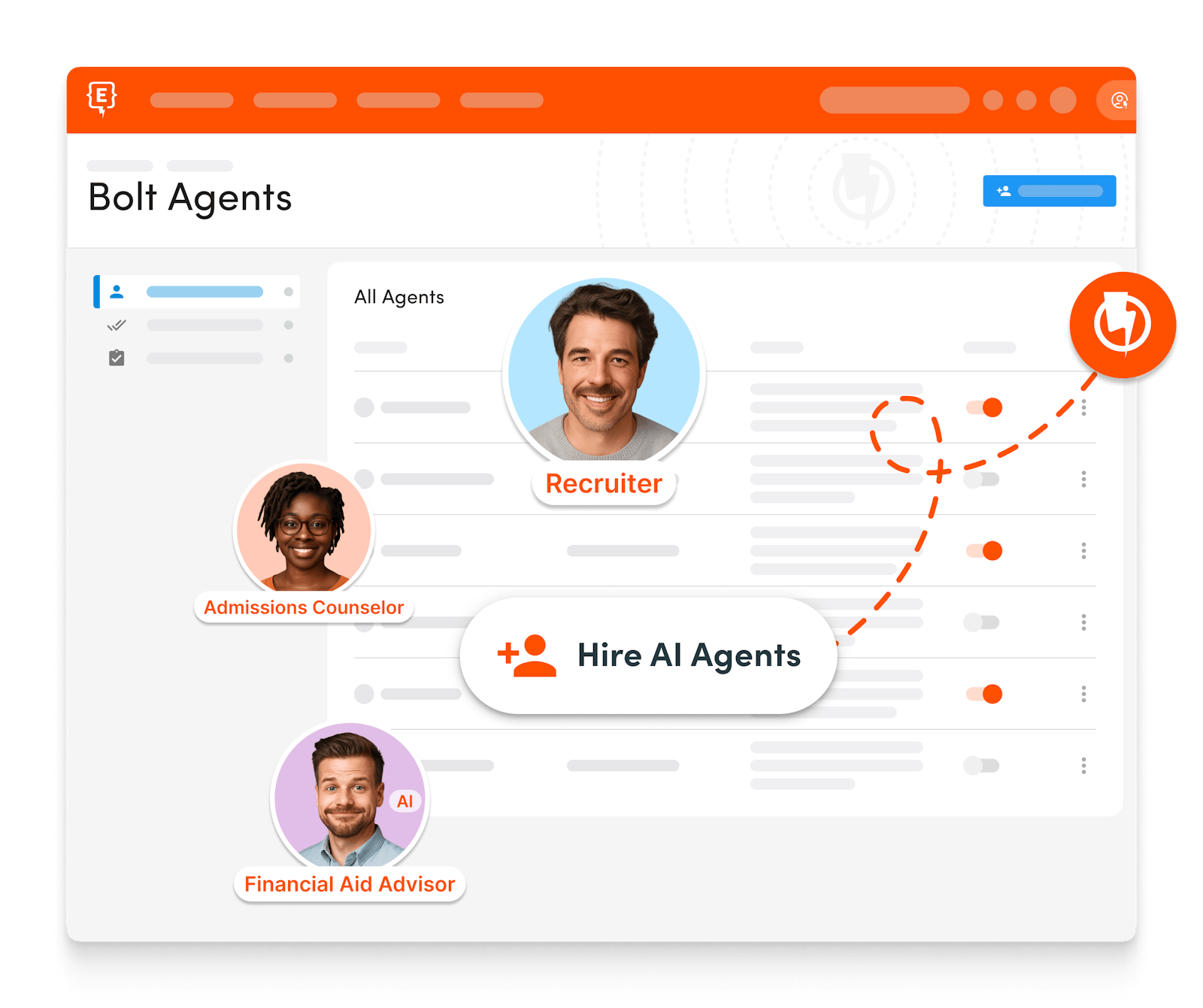
Today Element451 sells two products. Element is the AI-native CRM: records, campaigns, applications, events, analytics and student-success workflows. Bolt is the agent engine. Its specialized agents can answer questions, read applications, flag possible fraud, recommend programs, send personalized follow-ups, monitor engagement signals and prepare advisors before appointments. Bolt is sold in teams for marketing, admissions, student success, and continuing education and workforce programs.
The distinction matters. A chatbot waits for a question. A Bolt Agent Job starts with an objective - finish an application, collect a document, register for an event - and initiates work toward it. The institution defines segments, timing, milestones and approval points. The agent conducts outreach, records progress and escalates where a person should decide. In 2025, Element451 says it shipped more than 1,900 enhancements, with Agent Jobs the clearest statement of where the company had changed its mind: answering was not enough. The software needed to act.
The clever move: don’t demand a migration
Higher education is full of software that institutions cannot casually remove. Slate, Ellucian, Salesforce Education Cloud and a student information system may have years of configuration and political ownership attached. Element451’s answer is unusually pragmatic: a school can buy the full Element CRM, or put Bolt on top of the systems it already runs. Integrations include Ellucian Ethos, Salesforce, common learning-management systems and Zapier, plus APIs for less tidy edges.
This changes the competitive geometry. Slate is no longer only a rival; it can become the floor beneath Bolt. A college can test agents on one expensive queue without committing to a campus-wide replacement. That is the most copyable piece of Element451’s playbook: make the ambitious product adoptable through a narrow door. Pick one workflow with visible delay, keep human checkpoints, measure the outcome, then widen only if the institution trusts the result.
The customers range from community colleges and workforce programs to Columbia University, Tulane, Louisiana State University, the North Carolina Community College System and the University System of Georgia. The buyer is usually an institution; the daily operators sit in admissions, marketing, enrollment and advising. The end user may never know the vendor’s name. They simply receive a useful text at 8:47 p.m. instead of discovering a missing requirement three days after a deadline. That invisibility is part of the product: each school controls its voice, rules and content while Element451 stays backstage. Students encounter their college, not a generic software brand trying to become the relationship.
The numbers are good. Read the labels.
Element451’s customer stories report sharp gains. Texas State Technical College says it achieved 33 percent enrollment growth across 11 campuses, saved 1,160 staff hours and cut its cost per submitted application from $424 to $81. Community College of Baltimore County reports moving from fewer than 200 annual inquiries to more than 11,000, while saving over 900 hours through automation. Richard Bland College reportedly reduced application-review time by 80 percent. Cypress College reported a 300 percent rise in event registrations.
These are vendor-published case studies, not controlled experiments. A CRM rarely deserves sole credit for an enrollment cycle, and a school willing to reorganize its workflows is already doing half the hard work. The more revealing evidence is operational. CCBC created a dedicated CRM team, centralized inquiries, redesigned applications and events, and moved case management out of spreadsheets. The software worked alongside institutional change, not in place of it.
The company itself has scaled quickly. A MongoDB case study says Element451 grew from 15 customers around its 2020 database migration to more than 200, while processing 70,000 jobs per minute. By early 2026, Element451 reported 736 percent revenue growth and 479 percent customer growth since 2021. In May, it said Bolt conversations had grown 11.4 times in a year. The website now claims more than 350 institutions.
What did it cost?
Element451 does not publish a menu. Contracts vary by institution, product and implementation. One public record offers a useful anchor: a 2026 South Carolina contract for Midlands Technical College lists a five-year target value of $571,792 for a student-success and retention platform, including a $105,569 first-year software and implementation line. That is one deal, not a universal rate card. Still, it makes the sales argument concrete. This is institutional infrastructure bought against an ROI case, not a $49 subscription tried on somebody’s credit card.
The company gained room for that bigger sale in December 2024, when growth-equity firm PSG invested $175 million. Earlier disclosed rounds were comparatively tiny: roughly $3 million in Series A funding in 2021, $3.5 million in 2022 and $2 million in 2023. The PSG check funded a broader AI strategy. In February 2026, James Novak replaced Kadiu as CEO, while the founder moved to the board. Two months later, Element451 announced new customer growth of 50 percent and added a chief customer officer and chief technology officer.
The next moat is data that can move
Element451’s June 2026 partnership with Encoura shows the next layer. Encoura brings prospect records, predictive enrollment scores and decades of research. Element451 brings the system where staff and agents communicate. Encoura Connect puts both in one workflow, allowing a changed yield score or new intent signal to trigger action without a CSV export and a Friday-afternoon campaign build. For many customers already using both companies’ modeling, activation may carry no added cost.
That sounds like plumbing because it is plumbing - and plumbing is often where enterprise value hides. An AI agent without current institutional data is a fluent stranger. An agent connected to records, policies and changing signals can become useful. The risk is symmetrical. Bad data, an inappropriate trigger or loose permissions can produce personalized mistakes at machine speed.
“Banner is our system of record. PowerBI is our system of analytics. Element451 is our system of engagement.”Craig Klimczak, CIO, Community College of Baltimore County
When the playbook breaks
Element451 is not a magic layer for an institution that cannot name an owner for student data, map its processes or agree where humans must intervene. It will underperform when integrations are stale, policies differ by department, staff distrust the automation, or there is too little repeated work to justify implementation. A university with highly bespoke requirements and a deep bench of specialist administrators may prefer the open-ended control of Slate or Salesforce. A small school without clean data may first need process repair, not an agent.
Good conditions
A repeated, measurable workflow; current data; clear consent; named ownership; escalation rules; and staff willing to redesign the process.
Bad conditions
Dirty records, unclear policy, fragmented authority, no integration capacity, or a plan that quietly expects AI to fix institutional indecision.
The company’s own history supplies the sensible implementation sequence. Start with the application form, not the imagined operating system. Find the work accumulating around it. Automate the boring queue. Keep people where judgment, empathy or consequences are high. Element451 succeeded by discovering that its first product was only a doorway. Its future depends on remembering that an AI agent is also a doorway - not the institution on the other side.
Continue exploring