A shopper finds a coat, likes the coat, and discovers that the right size is somewhere else. To the shopper, this is a small inconvenience. To a retailer, it is a test of whether its stores behave like one business. Can the associate find the other coat? Take payment? Arrange delivery? Or does a perfectly good sale end with an apologetic shrug?
- Teamwork connects store checkout with orders, inventory, and customer records.
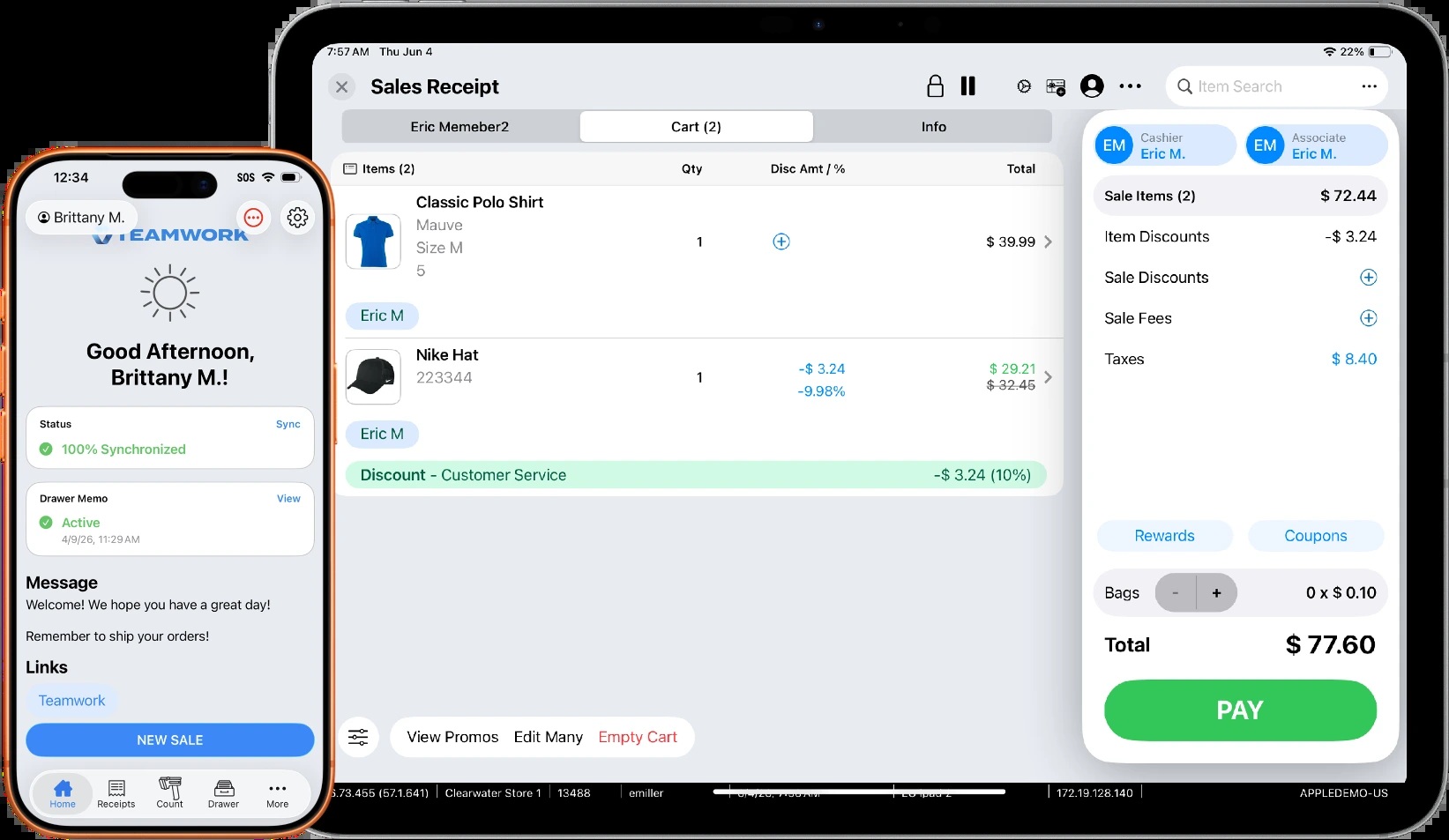
- Its iPhone and iPad tools put those records on the sales floor.
- The payoff depends on reliable stock data and a carefully managed rollout.
Teamwork Commerce works on that gap. Its cloud software joins point of sale, order management, inventory, customer information, and reporting. Retailers buy a way to complete transactions across locations and channels. An associate’s device becomes a window into merchandise beyond the nearest shelf.
A register with a longer memory
Founder and CEO Michael Mauerer came to the problem through retail software. Teamwork’s own history dates its founding to 2009 and its first live iPad customer to 2011. The sequence matters: the retail idea preceded the device that made it convenient to carry around. The company’s stated mission is to make commerce frictionless regardless of channel.

Consider Moose Knuckles. In its customer account, executive Andrea Elliott describes “send sales”: store teams can reach stock across the brand’s portfolio. The inventory belongs to a network of shops, rather than becoming commercially invisible once a customer steps into the wrong branch. Shared sales data also feeds reporting. The useful change is the associate’s ability to act on what another location has.
The toy store has a queue problem
At FAO Schwarz’s Rockefeller Center flagship, this becomes a question of stagecraft. A toy demonstration can delight a visitor; a checkout line can use up the goodwill. In Teamwork’s June 2025 case study, the retailer describes handling 10,000 to 15,000 guests daily across a 20,000-square-foot store.
Mobile checkout lets associates respond to where the crowd actually goes. Inventory visibility reaches the sales floor, stockroom, and distribution center. A tourist can arrange delivery to a hotel or home instead of hauling a large toy around Manhattan. The same account says staff learn the POS in under an hour. That is one retailer’s experience, rather than a promise about every deployment.
“It’s a single source of truth.”
Blake Gillen / FAO Schwarz
In Teamwork’s customer account
The phrase sounds technical until you imagine the alternative: a customer, an associate, and a website each holding a different answer about the same item. A shared record gives the conversation somewhere useful to go.

The tag is only the beginning
RFID adds another ingredient: identifying individual items without scanning every barcode. Teamwork puts RFID into receiving, counting, transfers, and checkout. In April 2025, it announced an integration pairing Bluebird’s RFR901 reader with Teamwork Commerce PRO on iPhone. The reader supplies the observation; the software updates the retail workflow.
- 01Identify
the item - 02Check shared
inventory - 03Route the
order - 04Complete
the sale
A June 2026 deployment account brings the hardware and software together. Teamwork, payments provider Adyen, and RFID specialist Miteq served a premium store at an unnamed European stadium. The account reports eight fixed tills, an average transaction time of 44 seconds, and no interruptions during peak demand. These company-published figures describe that event’s operation; they do not establish a universal speed advantage.
One stadium deployment.
Company-reported, June 2026.
There is quieter engineering underneath. Teamwork says its POS queues sales locally during a network outage and syncs them when connectivity returns. Offline card acceptance depends on the payment provider. That qualification matters: keeping the app open and getting a payment accepted are separate jobs.
The invoice includes more than software
This is enterprise retail software, sold through a conversation about stores and systems. A realistic budget has to include devices, payment arrangements, integrations, data migration, staff time, and support. The useful number is the cost of getting a retailer’s actual operation running, then keeping it running.
Teamwork also relies on specialists. Adyen supplies integrated payments. Loqate adds address lookup and verification. ShippyPro’s 2025 partnership brings shipping labels and fulfillment work into mobile POS. These connections make the claim of a connected operation concrete: an order needs a valid address, a carrier, and a successful payment as well as an attractive checkout screen.
The competitive field is crowded. NewStore combines mobile POS, order management, inventory, and clienteling. Shopify offers connected online and store selling. Teamwork’s case rests on its particular combination of Apple-device workflows, integrated RFID, international operations, and implementation support. A feature checklist will reveal overlap. A rehearsal of a difficult sale will reveal more.
The product roadmap extends to AI. In October 2023, Teamwork announced work with Google Cloud on assistants for inventory questions and natural-language reporting. The premise follows the same logic as mobile checkout: make business information available where a decision happens. Those were announced development goals; an announcement alone does not establish how broadly a feature has shipped.
Try the awkward sale first
Lammle’s Western Wear offers a useful rehearsal. Its September 2026 case study describes six months evaluating systems, followed by another six months building around its business. A hands-on, two-day demonstration helped Teamwork win. The older system’s limits included waiting until the next day for inventory visibility. The retailer delayed launch until after Stampede and brought stores online in stages.
The lesson travels beyond retail software. Put the people who receive stock, serve customers, and reconcile accounts in the evaluation. Give them an awkward return and a missing size. Budget their time. Shared inventory cannot rescue a stock record nobody maintains; a rushed launch cannot borrow readiness from a polished demo.
For a retailer with several locations and customers who move between channels, Teamwork offers a practical ambition: let the associate finish the job. The coat can come from somewhere else. The customer should not have to start again.