The object that explains Tatcha best is not its famous purple moisturizer jar. It is a sheet of paper. Founder Vicky Tsai encountered aburatorigami in Kyoto - soft abaca-leaf papers that gold-leaf artisans once placed between sheets of hammered metal, and that performers later used to lift oil without wrecking their makeup. It was an old material with a second life, an ordinary gesture made unusually precise. Tatcha launched with blotting papers in 2009, then built an entire prestige skincare company around the same commercial idea: take a useful ritual, make every touch memorable and give the customer a reason to repeat it.
The company is American, headquartered in San Francisco, but its center of gravity is deliberately split. Formulas are developed through the Tatcha Institute in Tokyo with Japanese scientists and cultural advisers. Sales run through a thoroughly modern American machine: direct ecommerce, subscriptions, social discovery, Sephora, QVC and, since January 2025, more than 1,400 Ulta Beauty stores. Unilever bought 95 percent of the company in 2019. The price was never officially disclosed, though reports put the deal near $500 million.
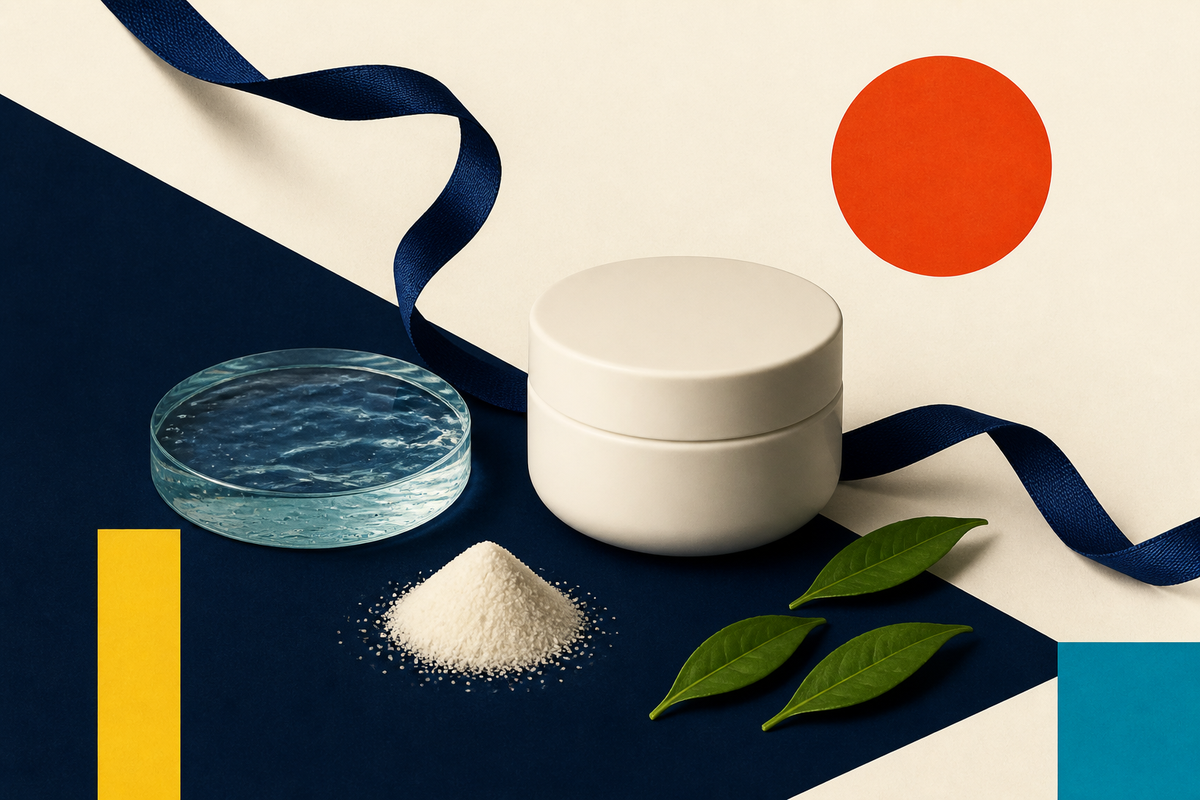
The formula is only half the formula
Tatcha sells cleansers, water-activated exfoliating powders, essences, serums, moisturizers, sunscreen, masks, lip treatments and selected body care. Its recurring ingredient story is Hadasei-3, a proprietary complex of twice-fermented Akita rice, Uji green tea and Okinawa algae. The brand describes the blend as a source of amino acids and gentle acids that can support hydration and resurfacing. Modern clinical ingredients such as hyaluronic acid, colloidal oatmeal and squalane sit alongside the Japanese botanicals.
But a list of ingredients misses the more interesting design work. The Rice Polish begins as dry powder and turns creamy when water is added. The Water Cream produces a lightweight burst on the skin. The Dewy Skin Cream is deliberately rich, comes with a gold spoon and leaves a visible sheen that plays well beneath makeup. The Essence is pressed in rather than rubbed. Each product contains a tiny piece of choreography. The customer does not simply apply it; she completes it.
That system solves several shopper problems at once. It makes a crowded category easier to navigate. It offers lighter and richer moisturizers for different skin types. The fragrance-free Indigo line addresses visible redness, dryness and a compromised barrier; its Calming Cream carries the National Eczema Association Seal of Acceptance. Trial sizes and curated sets lower the cost of discovery. For a customer who wants skincare to feel calm rather than clinical, the sequence supplies structure without demanding the sprawling routines associated with some Asian beauty trends.
“Our purpose at Tatcha is to change the way people see their skin and themselves.”Tatcha, announcing its Ulta Beauty partnership
A category position built between worlds
Tatcha occupies a productive middle ground. It is neither a laboratory-first dermatologist label nor a heritage Japanese conglomerate. It is not a low-priced viral brand chasing one active ingredient. It sells Japanese-inspired care through the language and channels of American prestige beauty. That gives it a visual and verbal territory distinct from SK-II, Shiseido and Sulwhasoo on one side, and Drunk Elephant, Sunday Riley, Fresh and Laneige on the other.
The distinction carries responsibility. A U.S. company borrowing from another culture can easily reduce context to decoration. Tatcha has tried to build more substance beneath the surface by working with Japanese formulators, artisans and cultural advisers, and by locating its research institute in Tokyo. Chemist Masato Tagawa leads the scientific work. Zen monk Toryo Ito, whom Tsai met at Kyoto's Ryosokuin Temple, serves as Global Director of Mindfulness. Even so, cultural authenticity is not a possession a brand wins once. It is a practice that customers can keep inspecting.
The other differentiator is unusually integrated giving. In 2014, Tatcha and Room to Read created Beautiful Faces, Beautiful Futures. A portion of every purchase supports literacy and girls' education. Tatcha says the partnership has funded more than 10 million days of school and helped print and distribute nearly 400,000 diverse books in the United States. The mechanism is worth noticing: impact is connected to checkout volume, not left to a holiday campaign or one founder's annual donation.
The shelf is the business model
Premium skincare has attractive repeat behavior. A jar empties; a routine persists. Tatcha sells directly at tatcha.com, where samples, sets, promotions and Subscribe & Save can raise conversion and retention. Wholesale partners offer reach, physical testing and trusted beauty advice. Limited editions make the same formulas giftable. Minis allow a shopper to try a $74 moisturizer without immediately buying the full jar. Refills create a small economic nudge to stay inside the system.
Its audience is broader than the word luxury might suggest, even if the prices are not. Dry-skin customers arrive for Dewy; combination and oily-skin customers are directed toward Water; sensitive-skin shoppers get an Indigo route. Makeup artists use the creams and mist as preparation, which puts the products in red-carpet content without requiring Tatcha to become a color-cosmetics company. Younger shoppers meet the brand through minis, lip care and social video. Established skincare buyers can move into essence, serum and richer treatment. The assortment is therefore less a ladder from cheap to expensive than a set of doors into the same room.
The two hero moisturizers show the architecture in miniature. The Water Cream, launched in 2017, is positioned for combination and oily skin. The Dewy Skin Cream, launched in 2019, is the richer option for dryness. One decision - water or dewy - segments the customer cleanly, while both products lead back to Hadasei-3 and the broader ritual. Tatcha said Dewy posted double-digit growth in every year between launch and the announced Ulta expansion.
Packaging matters here because luxury beauty creates a conflict between abundance and waste. In 2024, the full-size Water Cream and Dewy Skin Cream moved to refillable jars. Tatcha says the redesigned vessel contains 57 percent less plastic than the original, while buying one refill reduces plastic consumption by 74 percent compared with purchasing two original jars. The refill is also priced below another complete jar. Sustainability becomes both an operational improvement and a reason to repurchase.
What happens after the big exit
Tatcha's corporate story has been less serene than its packaging. Tsai had financed the early business with personal sacrifice and founder-led selling. After outside capital arrived, she stepped aside for professional management. Unilever's acquisition then gave Tatcha access to the resources of a global beauty owner. During the pandemic, after sales and internal morale weakened, Tsai returned to lead a turnaround. She later recruited Mary Yee as chief executive. Another leadership transition followed in late 2025.
The useful lesson is not that founders are always right or operators are always wrong. It is that a brand built on intimacy has to encode its judgment before scale dilutes it. Which retailers fit? How much context belongs around a Japanese ingredient? When does a sensorial flourish help efficacy, and when is it merely decoration? Those questions cannot all live inside one founder's head once hundreds of employees and thousands of stores are involved.
Recent moves suggest Tatcha is widening access without abandoning its recognizable grammar. Ulta brought the range to millions of additional shoppers. A 2025 partnership with meditation platform Open linked skincare to guided mindfulness. The Matcha Foam Cleanse, launched in June 2026, gave the cleanser aisle another texture transformation while keeping the ingredient story familiar. In Japan, the company introduced a Longevity collection. These are adjacent steps, not a frantic move into unrelated categories.
The purple-jar test
Tatcha's customers are not buying ancient secrets preserved unchanged in a bottle. They are buying modern cosmetic products, developed by a contemporary team and merchandised through global retail. The brand works when it says that plainly, then lets the Japanese ingredients, advisers and practices add depth rather than mystique. Its best products translate research and ritual into an obvious use case: lighter hydration, richer hydration, calmer skin, softer lips, a cleaner face.
The competitive question is whether the ritual remains meaningful after the fiftieth use. A beautiful jar wins attention. A surprising texture wins a demonstration. Clinical performance and comfort decide whether the customer empties it. Easy replenishment decides whether another pod arrives. Tatcha's advantage is that it has designed all four moments as one experience.
That is what the first blotting paper foretold. The product was small, practical and satisfying to use. It did not ask the customer to become someone else. It made an existing act feel considered. Seventeen years later, the company is much larger and the shelf is crowded. The durable part of its strategy still fits in the palm of a hand.