In La Gacilly, a village in Brittany with stone houses and hedgerows, the Yves Rocher story has the tidiness of folklore. A young man begins mixing a plant-based salve in the attic of his family home. He sells it by mail. The envelopes multiply, the catalog thickens, and the tiny operation becomes a cosmetics company with stores around the world. The lovely part is that the attic is still legible in the modern business: direct contact with customers, curiosity about plants and a conviction that useful beauty need not be rare or forbiddingly priced.
Founded by Yves Rocher in 1959, the brand now sells facial skincare, haircare, bath and body products, makeup and fragrance. It reaches more than 20 million customers through roughly 2,300 points of sale and operates in 90 markets. Yet scale is only half the story. Many beauty companies speak about natural origin. Yves Rocher can point to 60 hectares of organic, agroecological fields, a botanical garden containing more than 5,000 species, laboratories that extract and test plant ingredients, and a nearby manufacturing base. The parent company says 93 percent of the brand's products are made at La Gacilly.
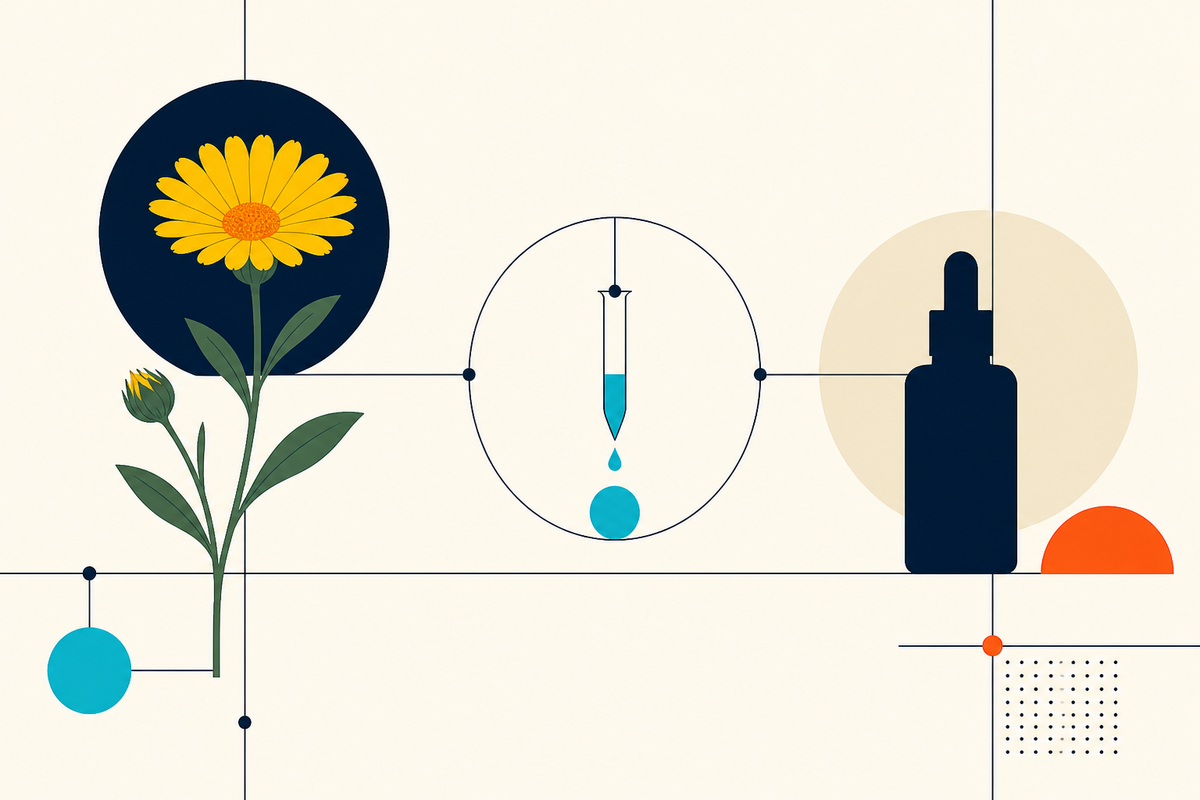
The village is part of the formula
The company calls its territory an open-air laboratory. That phrase could be marketing decoration, except the operational details keep intruding. Emblematic plants such as calendula, chamomile and cornflower are grown locally. The fields have held French organic certification since 1999. Plant specimens are preserved and studied in the garden. Groupe Rocher reports nearly 70 patents and more than 60 exclusive ingredients across its research work. Thirteen emblematic plants from La Gacilly appear in more than half of Yves Rocher products, and the brand says its face, body and hair formulas average 93 percent ingredients of natural origin.
This is the company's chief difference from competitors. The Body Shop, L'Occitane, Weleda, Caudalie, Garnier and dozens of younger clean-beauty labels all offer some version of nature, provenance or ingredient transparency. Yves Rocher's harder-to-copy asset is the chain itself. It can grow, observe, extract, formulate, manufacture and distribute while keeping the customer relationship close. The arrangement does not make every claim automatically better. It does give the company more places to learn and more evidence with which to explain itself.
It also solves a specific consumer problem: the shopper who wants botanical cues and a pleasurable routine without climbing to luxury prices. A serum, shampoo, shower gel and perfume can sit in one basket. Stores add advice and sampling; loyalty programs add offers; websites and apps add convenience. In Turkey, for instance, Yves Rocher combines ecommerce with a mobile app, membership benefits and a physical store network. The brand occupies a useful middle ground between drugstore ubiquity and specialist prestige.
“Nature is my guide, I just follow it.”Yves Rocher, founder
A catalog business in an algorithmic age
Before “direct to consumer” became a pitch-deck category, Yves Rocher was posting the Green Book of Beauty to households. The catalog did three jobs: it taught, sold and captured attention without surrendering the relationship to a department store. The modern version includes ecommerce, email, social platforms and an enormous store network. The media changed; the logic endured. Products with finite lives and daily-use rituals create replenishment. Broad categories raise basket size. Promotions and loyalty encourage return visits. Advice reduces the uncertainty of buying something destined for one's face.
That business model contains its own tension. Stores are expensive, but beauty remains tactile. Shoppers want to smell perfume, feel a cream and ask whether a serum belongs before or after moisturizer. Groupe Rocher's 2025 strategy therefore pairs omnichannel investment with physical expansion: renovate 200 Yves Rocher shops in France and open more than 150 in Asia and the Middle East over five years. The group allocated an additional €100 million over four years, increasing investment budgets by 50 percent across its refocused beauty and wellness portfolio.
Mail order built a direct customer file and a habit of explaining products outside a department-store counter.
Marketplaces and TikTok Shop increase reach, but they compress heritage into a thumbnail and a few seconds of proof.
India is one of the sharper tests. In late 2025 Yves Rocher announced a push there as part of a wider Asian strategy. The plan mixes digital commerce, regional marketplaces and selective physical retail. Elsewhere in Asia, the brand uses Shopee, Lazada, Coupang and TikTok Shop. This is practical distribution, not nostalgia. But it creates a communication puzzle: how do you translate a Breton field, a 50-year-old botanical garden and dermobotanical research into the rapid grammar of a marketplace listing?
Sustainability meets the returns desk
Yves Rocher's nature story is strengthened by the Yves Rocher Foundation, created by Jacques Rocher and recognized as serving the public interest. The brand is its leading benefactor. Through Plant For Life, the foundation works with local organizations on tree planting, preservation and regeneration. Groupe Rocher's brand page credits Yves Rocher's sponsorship with contributing to more than 125 million trees planted. The foundation's newer French-language count has passed 130 million. It also supports women environmental leaders through the Terre de Femmes awards and uses photography to pull environmental questions into public view.
The less romantic work happens in packaging. In 2024 the brand introduced fully recyclable refill packs that use four times less plastic per weight-to-volume measure than the classic 400 milliliter bottle. Groupe Rocher aims to reduce plastic use per milliliter by 30 percent from its 2019 baseline by 2030. Its 2024 responsibility report recorded a 15 percent reduction, with recycled material representing 38 percent of plastic. Those numbers show movement, and distance still to travel.
A reusable-glass pilot reveals why the final mile is behavioral. In three French stores, customers could return any of 36 facial-care jars and receive a €1 gift card. At the end of 2024, 4.5 percent came back, against a 10 percent target. The company continued the test in 2025. It is a modest, useful result. A recyclable pack can be redesigned in a laboratory; a return loop needs memory, convenience and a customer carrying an empty pot back into town.
The science has to earn the adjective
The market for “green” cosmetics has matured into a thicket of claims. Plant-based can describe the origin of an active ingredient without settling efficacy, concentration or total formula impact. Natural origin does not erase agriculture, processing, transport, water or packaging. Yves Rocher's opportunity is to be unusually precise. Its current language of dermobotany joins plant knowledge to skin expertise. Its formulas and clinical results must do the proving, while provenance provides the memorable frame.
The group is putting money behind that proposition. Its strategy concentrates on four beauty and wellness brands - Yves Rocher, Arbonne, Sabon and Dr Pierre Ricaud - and increases resources for formula innovation, eco-design and scientific collaboration. A scientific council announced in December 2025 adds outside scrutiny. In April 2026, Groupe Rocher and Dassault Systèmes announced work on virtual-twin technology for natural-cosmetics formulation. The intriguing possibility is faster simulation of ingredient interactions and fewer physical iterations. The standard remains ordinary and severe: does the finished product work?
Culture is another part of the operating system. Groupe Rocher is more than 99 percent controlled by the founder's family and has about 13,000 employees. It became a French mission-driven company in 2019, placing reconnection with nature into its corporate purpose. The group's 2024 reporting says 99 percent of employees had access to a nature experience or environmental-awareness action, while women represented 51 percent of brand and function management committees. Family control allows patience, but it does not remove commercial pressure. The group spent recent years restoring profitability and narrowing its focus.
The moat is not a leaf printed on a carton. It is the number of difficult, unglamorous steps the company can connect behind that leaf.
Where Yves Rocher fits now
Yves Rocher is neither a tiny farm-to-face atelier nor a generalist beauty conglomerate. It is a large specialty brand with mass reach, accessible prices, owned retail and a vertically integrated botanical platform. That places it beside natural-positioned specialists but gives it more control than many of them, while leaving it smaller and more focused than the global giants. Its customers are not buying raw plant science. They are buying smoother skin, cleaner hair, an agreeable scent, a gift that feels thoughtful and a routine they can understand.
The next phase depends on making the infrastructure visible without making the experience heavy. A shopper in Istanbul, Mumbai or Manila should not need a lecture on agroecology to enjoy a shower gel. But when she becomes curious, the story needs to survive inspection. Fields should map to traceable ingredients. Research should map to performance. refills should map to less material, not merely different material. Foundation programs should remain concrete and locally partnered.
The attic in La Gacilly offered a simple lesson: own a useful idea, explain it directly and make it easy to order. Sixty-six years later, Yves Rocher has more machinery, more markets and many more adjectives. Its most persuasive move may be to keep returning to the same sequence - plant, study, make, sell, listen - and let the chain carry the claim.