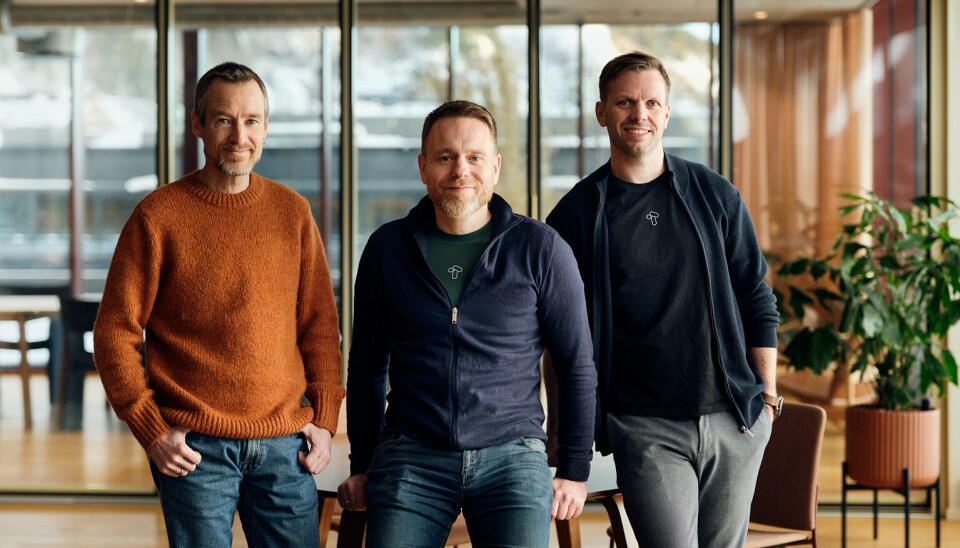
The future of work announced itself to Tarjei Vassbotn outside a conference restroom, which is a useful corrective to the idea that technology arrives in immaculate white rooms. Olav Sindre Kriken had just heard Vassbotn speak and wanted to pitch him an augmented-reality company. The idea was lively. The eventual verdict from engineer Grim Iversen was less so. AR would not become mainstream quickly enough. The pitch died; the trio survived it.
They looked at education next. Every worthwhile problem seemed to have a workable solution already, while institutional buyers often optimized for price and procurement rather than delight. So the three used a small internal prototype to organize their research. It had grown from Iversen’s old fascination with connected lists and tables, an idea with roots in his Google Wave years. Kriken found himself unusually productive. Slowly, the founders noticed that their research instrument was more interesting than the businesses it was helping them reject.
This is how Tana entered the world: sideways. Not as a manifesto about artificial intelligence, but as a useful thing its own makers kept reaching for. In 2020, Vassbotn, Iversen and Kriken founded the company around a basic irritation. People’s work was scattered across email, calendars, documents, chats and private notes. Computers could store every scrap and still fail to preserve what any of it meant.
The name comes from a large Norwegian river. It is an unusually honest product metaphor. Information moves. It branches, floods, collects debris and refuses to remain in the folder somebody assigned on Tuesday. Tana’s proposition is to give that flow structure without turning it into concrete. Notes become connected objects. A tag can give an item a type, fields and behavior. A meeting can yield decisions and tasks. Voice can become material that a person and an AI system can both work with.
A career spent taming systems
Vassbotn did not arrive at this problem from the fashionable end of AI. His route began in Norway’s early internet industry. An older personal profile lists him as the founder of Onsite Solutions, trening.no, O2 Framework and LinkPulse, and as a former chief technology officer of Scandinavia Online. The names belong to an earlier web, when merely getting information online felt like a kind of civic construction.
He later spent roughly five years at Google. From Silicon Valley, he led global developer relations for the Internet of Things and helped develop a partner network across Asia, ranging from small organizations in Cambodia to large telecommunications companies in Japan and Australia. His job sat at the seam between code and persuasion: understand what a platform could do, understand what distant developers needed, then make the two intelligible to each other.
In 2016 he left Google for Disruptive Technologies, a Norwegian company building tiny wireless sensors and a cloud platform around them. The move traded a famous employer for a physically small object with a very large promise. Sensors needed to be inexpensive, secure, easy to deploy and capable of living for years without a battery change. Vassbotn led the engineering organization during the company’s early growth, coordinating as many as 35 employees and contractors across several technical fields.
The pattern is clearer than the job titles. Early websites, developer ecosystems, billions of connected devices, tiny sensors, virtual fences for livestock, a graph of organizational knowledge: each asks how a complicated system can become useful without making the user carry its complexity. Even the goats at Vassbotn’s home in Volda fit the theme. He used Nofence collars, which guide livestock with virtual boundaries, and once brought photographs of them to an IoT talk. Invisible infrastructure, visible result.
The useful residue of failure
Google Wave sits quietly behind the Tana story. Wave attempted to combine email, chat and real-time collaboration, with conversations that could branch while participants watched one another type. Its ambition outran its accessibility. It closed, but some of its people and questions kept moving. Iversen had worked on Wave. Lars Rasmussen, who led its development and co-created Google Maps, later became an early Tana backer.
Tana reverses part of Wave’s sequence. Wave began with powerful communication and hoped knowledge systems would grow on top. Tana begins with structured knowledge, leaving room for communication to emerge from it. The distinction sounds technical. In daily work it is almost comic: another chat window gives a team more places to forget; a connected record gives it fewer reasons to repeat itself.
Vassbotn’s public career also contains smaller artifacts of this builder’s instinct. At Google he authored Kratu, an open-source JavaScript reporting tool. His GitHub includes a do-it-yourself radar-based traffic speed logger. He contributed a chapter about the Internet of Things to the 2017 book Teknologien endrer samfunnet. He has taught in a master’s program on digital strategy and leadership and spoken around Norway about AI, organizational culture and technology. The common activity is translation. A system becomes valuable when someone can see how it applies to Tuesday morning.
Many captains, one direction
Tana’s team offers another experiment in structure. By early 2025, nearly half its employees had founder experience. A company crowded with former founders could become a dinner party where everyone reaches for the bill and nobody agrees on the restaurant. Vassbotn’s explanation was practical: titles matter less than rolling up one’s sleeves and doing what needs doing.
Former founders bring an inconvenient memory of the whole. They know that a customer complaint may be a product problem, a sales problem and a cash-flow problem wearing one coat. The benefit is agency. The cost is that agency requires a culture strong enough to absorb disagreement. Vassbotn’s colleagues have repeatedly described his ability to align people, communicate complex questions and move multidisciplinary work forward. These are not decorative leadership traits in a company attempting to redesign the basic furniture of knowledge work.
The founders applied similarly deliberate thinking to capital. Early in Tana’s life, they chose backers for network, patience and future rounds, not simply the highest possible valuation. Rasmussen and Olympic skier Aksel Lund Svindal were among the early believers. Northzone led a seed round, with Lightspeed participating. In February 2025, Tana announced a $14 million Series A led by Tola Capital, bringing disclosed funding to $25 million. The company emerged from stealth with more than 160,000 people reported on its waitlist.
There is discipline under the ambition. Vassbotn has advised founders to think one phase ahead when choosing investors: who stands behind the money, what can they do, and will they remain useful in the next round? Tana’s early years were also filled with unscalable work. Kriken personally contacted hundreds of potential users. The team cultivated a community and invited a small group of productivity experts close to the product. When Tana launched publicly, that accumulated attention arrived all at once.
The computer that remembers
Tana now describes its work as making interaction with computers feel natural. Its workspace can capture meetings and voice, organize information as typed, connected items, and make tools available to AI agents. In 2026 it added support for custom servers using the Model Context Protocol, allowing outside tools to connect to Tana and compatible AI clients to work with Tana from the other side. The product is widening from a place where knowledge lives into a layer through which other software can use it.
The leadership titles have widened too. During Tana’s 2025 launch, Vassbotn was chief executive, Iversen chief technology officer and Kriken chief operating officer. The company’s current team page lists Kriken as CEO, Iversen as chief AI officer and Vassbotn as chief information officer. Founder jobs are often described as permanent identities. In practice, good ones can be redesigned when the company needs a different arrangement.
Vassbotn’s aspiration remains larger than a better notebook. Tana’s founders talk about reinventing how humans, teams and computers work together. Their wager is that AI becomes more useful when work already has shape: the person is linked to the meeting, the meeting to the decision, the decision to the task and the task to the project. Context stops being a scavenger hunt.
It is a fitting project for someone whose old personal profile also lists telemark skiing, splitboarding, running and fine woodworking. Each rewards a particular relationship with structure. A slope has contours. Wood has grain. A graph has connections. Skill does not abolish those constraints; it reads them well enough to move.
And so the conference-restroom encounter looks less like a quirky origin story than a miniature of Vassbotn’s career. A conversation arrived unstructured. One idea was tagged as unworkable. Another path connected three people who had accumulated different pieces of technological history. Years later, those links became a company dedicated to ensuring that useful thoughts do not vanish after the conversation ends.