Five million people had tried Genspark's AI search engine by the spring of 2025. For most software companies, that would be the opening sentence of a triumphant fundraising memo. For Genspark's co-founder and chief technology officer, Kay Zhu, it was the beginning of a less comfortable question: what happened after the search?
The user had a tidy answer and still needed to make the presentation. Or the budget sheet. Or the awkward phone call. Search had shortened the first leg of the journey while leaving the rest to the person who asked. Genspark chose to retire its search-first product and put an agent in its place. It is the rare pivot that sounds more surprising as its starting number grows.
- Genspark began with AI search and custom pages called Sparkpages in 2024.
- In April 2025 it shifted to Super Agent, which can plan tasks and use tools to make editable work.
- Its workspace now spans slides, sheets, documents, browser actions, email, meetings and team workflows.
- The practical bet: people will pay to skip the handoffs between finding, making and revising.
The answer was only the appetizer
Genspark's first product, built by Palo Alto company MainFunc, made custom web pages in response to queries. These Sparkpages gathered and organized material that a person might otherwise have hunted through links to find. Founder and CEO Eric Jing had worked on Microsoft Bing; Zhu had spent years in search. They were well equipped to make finding information less tedious.
But an answer engine has a design problem. It tends to follow the same choreography: interpret a question, retrieve pages, rank them, summarize them. Genspark added specialized data, parallel searches and agents that checked one another. Zhu later argued that the choreography itself had become the ceiling. A request to compare vendors, prepare a decision deck and write the follow-up cannot be handled as a single search result, however elegant that result looks.
“We built Genspark to be more than a chat interface, it’s an all-in-one AI workspace.”Kay Zhu, co-founder and CTO, quoted by OpenAI
By late 2024, users were asking for presentations, video scripts and emails rather than summaries alone, according to OpenAI's account of the partnership. Longer model context and multimodal APIs made those requests more plausible to automate. In April 2025, Genspark launched Super Agent. The company moved from answering a question to planning a sequence of actions: choose a model, pull data, use a tool, inspect the result, try another route if needed, then hand back something a person can edit.
The company that kept adding doors
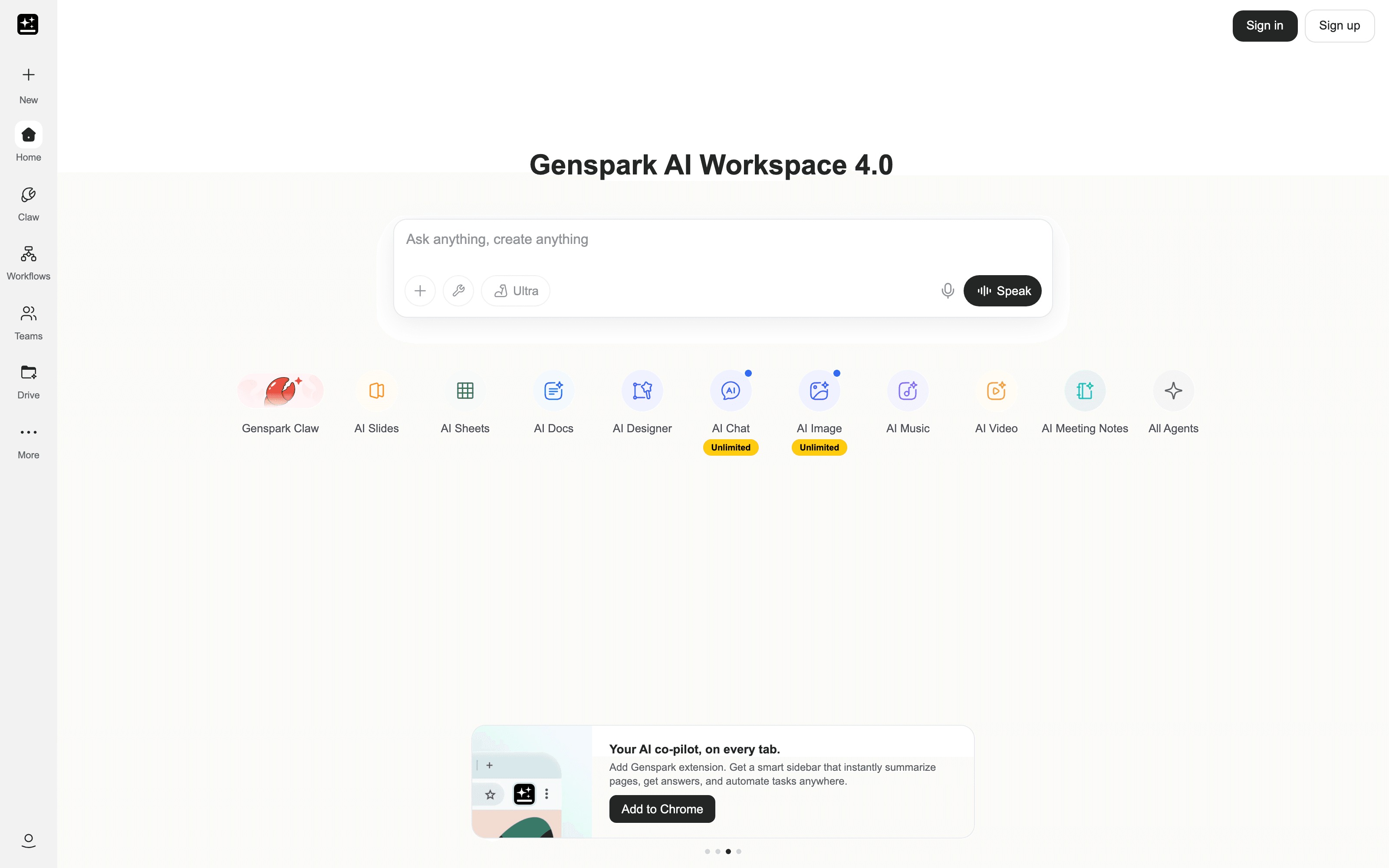
Today, Genspark sits in several markets at once. Its AI Slides makes presentations; AI Sheets collects and analyzes data; AI Docs writes and edits documents. Super Agent handles requests that cross those borders. The browser can act on websites. GenMail and the Inbox extend the idea to correspondence. Its desktop Super App is pitched as a place where the agent can read files, use the browser and work inside other applications.
That breadth is both the appeal and the difficulty. A conventional slide maker can focus on slide design. Genspark has to keep the research, the numbers and the deck connected, then leave each editable. The company's mixture-of-agents approach routes work across models, tools and datasets, rather than asking one model to do everything. It is closer to managing a small, fast department than typing into a single chatbot.
There are cheaper ways to get a quick paragraph and more specialized ways to make a perfect deck. ChatGPT and Claude answer and create across formats; Perplexity is a natural comparison for research; Microsoft Copilot and Google Workspace with Gemini already live in office software. Genspark's position is the connective tissue. Its claim is that the user can ask for an outcome, and the system will cross the necessary apps and formats to produce it.
One brokerage team, one tighter clock
A Genspark case study with a CBRE commercial real estate team provides a more useful picture than any promise to “transform work.” Facing a competitive listing pitch, the team began with the client's decisions and the story the deck needed to tell. Genspark then helped assemble market positioning, commute analysis and presentation material. The team reported that a first draft that once took four hours took 35 minutes. It also reported a 40% shorter research cycle.
Those numbers describe one team's experience, not a universal productivity multiplier. The repeatable part is less glamorous: decide the narrative before asking the agent to decorate it; give the tool the data and design language it needs; inspect the output before a client sees it. Genspark can reduce the mechanical distance between research and presentation. It cannot decide what a client ought to believe.
Growth bought room to keep experimenting
Genspark announced a $100 million Series A in March 2025, then a $275 million Series B that November at a $1.25 billion valuation. In March 2026 it said its annualized run rate had reached $200 million, eleven months after the Super Agent launch. A June 2026 Series B extension added $100 million and put the company's announced post-money valuation at $2.6 billion. The revenue figures are company-reported run rates - a snapshot of subscription pace, rather than a year's booked sales.
The company makes money through paid individual, team and enterprise access, with credits for resource-heavy AI work. The model suits an agent that might call several models and tools to finish one request. It also makes the cost of a task less obvious than a traditional per-seat subscription. A user should check the plan's credit rules before moving a whole workflow into it.
Company-reported milestones. Bars show run rate, not audited revenue.
Its partnership with Microsoft points to another route into the market. Genspark announced work with Agent 365 in 2025 and later brought its agents into Word, Excel and PowerPoint through add-ins. That puts the tool where many customers already work. It also puts Genspark in the same room as Microsoft's own Copilot, a formidable neighbor with the keys to the building.
A free office suite with a meter inside
The August 2026 release of GenOffice adds a curious coda to the search pivot. Genspark published a free, open-source desktop suite for documents, spreadsheets, slides and PDFs. Ordinary editing is free; hosted AI work uses credits. The company said an early alpha took one engineer, one week and $10,000 in model tokens. Its invitation to users was unusually plain: expect bugs, open an issue, send a fix.
That is a different way to put an agent in front of a person. The first Genspark experience brought information to the user as a generated page. GenOffice starts with the file already on the user's desk and lets the agent work inside it. The common thread is the handoff. If the work begins with a search and ends in a document, every extra transfer is an invitation to abandon the tool.
What can another company borrow? Watch where users carry the output after they use your product. Genspark saw people leave search with an answer and continue working elsewhere. It built toward that next step, despite a large audience for the old one. The lesson is strongest when the next step is frequent, costly and clear enough to automate. Where data is private, actions are hard to reverse, or the definition of “finished” is political, the agent needs a human editor with time to read carefully. Even a very fast draft can be wrong at full speed.