A search box makes a modest promise. Type a question and it will bring back places to look. A person still has to read, judge, combine, format, send and, quite often, start again. Eric Jing has spent much of his working life staring at that gap. He joined Microsoft as a software developer in 2006, helped ship Bing, moved on to product leadership at Baidu, and eventually co-founded Genspark in Palo Alto. The names changed. The irritation stayed remarkably consistent: people were asking machines for help because they had something to finish.
At Bing, the team sometimes called the ambition a “task engine.” It was a good phrase, and for a long time, a difficult product. Search could map the web with considerable skill. It could not draft the presentation, sort the figures, or book the appointment at the end of the query. Jing says the idea became newly plausible when large AI models learned to carry out more of the steps between a request and a result. Genspark was his chance to try the old idea with new machinery.
There is a small irony in the first chapter. Genspark itself began as AI search. It attracted more than five million users, a number most young companies would frame and hang by the coffee machine. Jing moved the product toward agents anyway. The destination, as he tells it, had been there from the start.
The search result was never the destination
Jing’s route through the industry looks unusually coherent in hindsight. Microsoft gave him an engineering seat on the founding team that shipped Bing. At Baidu he became a product executive and worked across search, voice and devices. In an essay about his career, he says the AI voice devices he helped build sold more than 40 million units. These are very different surfaces - a browser, a speaker, a workspace - but each asks the same design question: how does a machine understand what someone wants well enough to help?
Search taught him to look at intent rather than at the page returned. A query for competitors might mean research for a meeting. A request for hotel options might mean a trip needs booking. The visible input is a line of text; the actual job lives beyond it. Jing has said that the old Bing team imagined end-to-end workflows, yet the technology of the time could only move so far. When ChatGPT arrived and later models improved, he saw a route through the rest of the journey.
This does not make the Genspark change painless by definition. A company with millions of search users has a working entry point and an understandable pitch. Recasting it as an agent workspace means explaining a less familiar behavior: ask for an outcome, then edit the outcome itself. Jing judged the larger risk to be waiting while the capability arrived around him. That is a founder’s calculation, but it is also the calculation of someone who has watched one generation of search become another.
“Standing still and missing the opportunity is the far bigger risk.”Eric Jing, on moving beyond AI search
A slide should be a slide
Jing’s description of the new interface is refreshingly literal. If someone wants a slide, they should talk to the slide. If they want a spreadsheet, they should talk to the spreadsheet. Behind the plain language sits a fairly elaborate system of models, tools and agents. To the user, the important object is the file that can be opened, changed and used.
The history of Genspark’s presentation product is a little comic in the way real product histories often are. The team began by creating slides in HTML, a format friendly to AI generation. Users asked for an online editor. Then they wanted to edit those slides in desktop PowerPoint, so the team built a plugin. The plugin brought its own costs and limits. Eventually Genspark built GenOffice, an office suite for documents, sheets, slides and PDFs. One request had become a chain of increasingly specific requests. That chain, rather than a tidy diagram on a strategy wall, shaped the product.
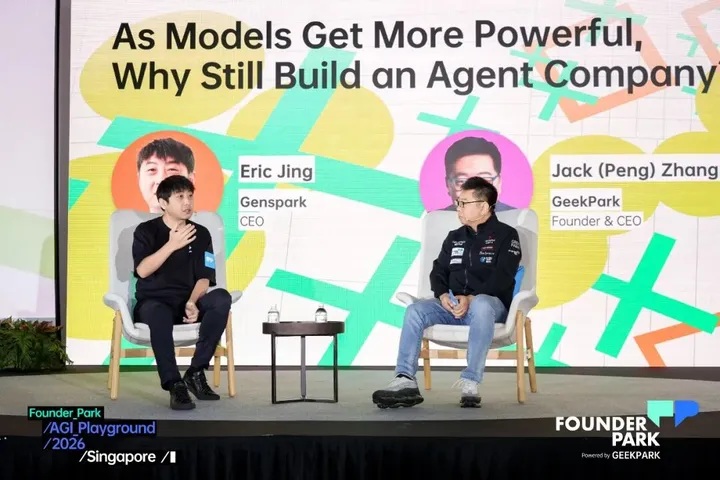
At the August 2026 Singapore event, Jing described an engineer producing a GenOffice prototype in a week. He did not present that speed as permission to ignore users. He described the opposite habit: build something the team itself would trust in daily work, then see where actual use exposes a problem. Fast prototypes are useful because they make the question concrete. A person can respond to a file that opens, a slide they can edit, or an email the agent misplaced.
His favorite example is wonderfully unheroic. He has trouble finding important old emails when he cannot remember the words to search for. So the company put an agent in an email client. For the Singapore event, Jing asked it to assemble a schedule from correspondence, pull PDFs from attachments, put sessions on his calendar and draft suggested adjustments. A grand theory of autonomous work met the less grand reality of inbox archaeology. The latter is where many people would gladly accept help.
The company inside the product
Jing’s Genspark essays suggest that he is as interested in the organization using AI as in the software it sells. In May 2026, he described a company of roughly 70 people working in small groups of one to three. New employees, he wrote, could ship substantial work in their first week. This is the internal version of the same product thesis: reduce the handoffs between understanding a problem and making a useful thing.
It also exposes the part of the work he does not think machines can simply absorb. In a Microsoft interview, Jing put the share of preliminary work AI might handle at 80 to 90 percent, then insisted people verify the last stretch. The numbers are his estimate, not a universal law. The practical point is clear enough. A polished deck can contain a bad conclusion. An agent may execute the steps and still miss the judgment. Someone remains answerable for the result.
That insistence gives an edge to his interest in shared context. Jing argues that an AI workspace improves when it understands the files, conversations and habits relevant to a person’s work. A model can write a paragraph; context tells it which paragraph belongs in this project. The thesis is attractive and demanding. It depends on trust, careful access and work that is good enough for a person to check rather than redo. Jing’s analogy casts model providers as suppliers of ingredients and Genspark as the place that turns them into meals. Restaurants, of course, are judged by what arrives at the table.
The audience for that meal is deliberately broad. Jing has described the United States, Japan, South Korea, France, India and Brazil as important markets. Genspark also began working with Microsoft’s Agent 365 ecosystem in 2025, a route into the software many offices already use. The connection has a pleasing loop: a former Bing engineer returned to Microsoft’s orbit with a product meant to go further than search could.
His ideas have also traveled with the company. In Japan, Genspark established a local business and introduced a newer version of its workspace in January 2026. Jing appeared at the Tokyo launch with fellow leaders Kay Zhu and Wen Sang. By summer, the company was speaking about deeper investment there. The geography is part of the product problem: a tool that works only for one office culture has a smaller future than a tool that understands the same ordinary needs across languages and workplaces. Jing says he visits markets and listens to local users before changing priorities. Search trained him to see the universal part of a request and the particulars that make its answer useful.
The partnerships bring a separate test. Genspark can ask an agent to prepare a PowerPoint file, but a company already runs on Microsoft documents, calendars and permissions. Jing has described four iterations of Genspark’s PowerPoint export alone. That is the kind of detail an ambitious demo can glide past and an actual office cannot. A finished file must fit into the handoff that follows: colleagues need to open it, change it and trust that its contents survive the trip. The phrase “autonomous work” sounds futuristic. Four rounds of export fixes sound like Tuesday. Both belong in the same story.
Even his public writing follows this practical line. In his Seeing AGI series, Jing has examined how AI changes the roles inside a small company, and he has described the temptation to treat it merely as a quicker version of old software. His own examples return to judgment: which work to attempt, which result to keep, and who accepts responsibility. The question behind Genspark is therefore not simply how many steps an agent can take. It is how those steps leave a person with better choices when the work comes back.
A founder still asking what happens next
Jing is candid about the odds. He has said most startups fail, and his own company has changed its form several times in barely two years. Search became agents; agents became a workspace; the workspace gained an office suite. Each turn followed a model capability or a user request, but the thread running through them is older. He wants the person with the question to spend less time ferrying information between tools and more time deciding what the finished work should mean.
The most revealing detail may be his email example. It is easy to speak about the future of work in grand nouns. It is harder, and more useful, to ask why a person cannot find the PDF they need by three o’clock. Jing’s answer is still evolving. That is the story of Genspark so far: a search veteran following the job past the answer, one inconvenient task at a time.