Notion AI makes the most sense for people with a Notion problem, not merely an AI itch. If your team already keeps product plans, meeting notes, policies and project databases in the same workspace, the assistant arrives with a useful advantage: it knows where the bodies are filed. It can find a decision buried in Slack, summarize the meeting that changed it, update the roadmap and draft the status note. A blank chatbot waits for context. Notion AI sits inside it.
That distinction decides who should pay attention. Product and operations teams drowning in handoffs are the natural audience. Recruiters can ask what a role requires and pull the answer from company documents. Support teams can route reports. Managers can turn a week of scattered updates into a brief. Solo writers get a capable editor, but they are also being asked to buy a wider Business workspace for access after the trial. If your notes are split among three apps and a desktop called FINAL-final-2, the magic will be patchier.
A writing assistant learns to move the furniture
Notion introduced AI in private alpha in November 2022. The first pitch was familiar: brainstorm, draft, summarize, improve. The surprise came from the users. Notion says it expected 200,000 people on the waitlist and got one million in five weeks. More revealingly, the most popular early command was “Improve Writing.” People preferred bringing their own thought and asking for a sharper version to ordering prose from an empty box.
The company listened and kept widening the job. Workspace Q&A became search across Notion and connected tools. Meeting Notes gained transcripts and action items. Autofill began extracting and classifying database properties. In September 2025, Notion 3.0 recast the whole thing as an Agent that could act across pages and databases for more than 20 minutes. By spring 2026, Custom Agents could wake on a schedule or trigger, answer in Slack, route work and keep databases fresh.
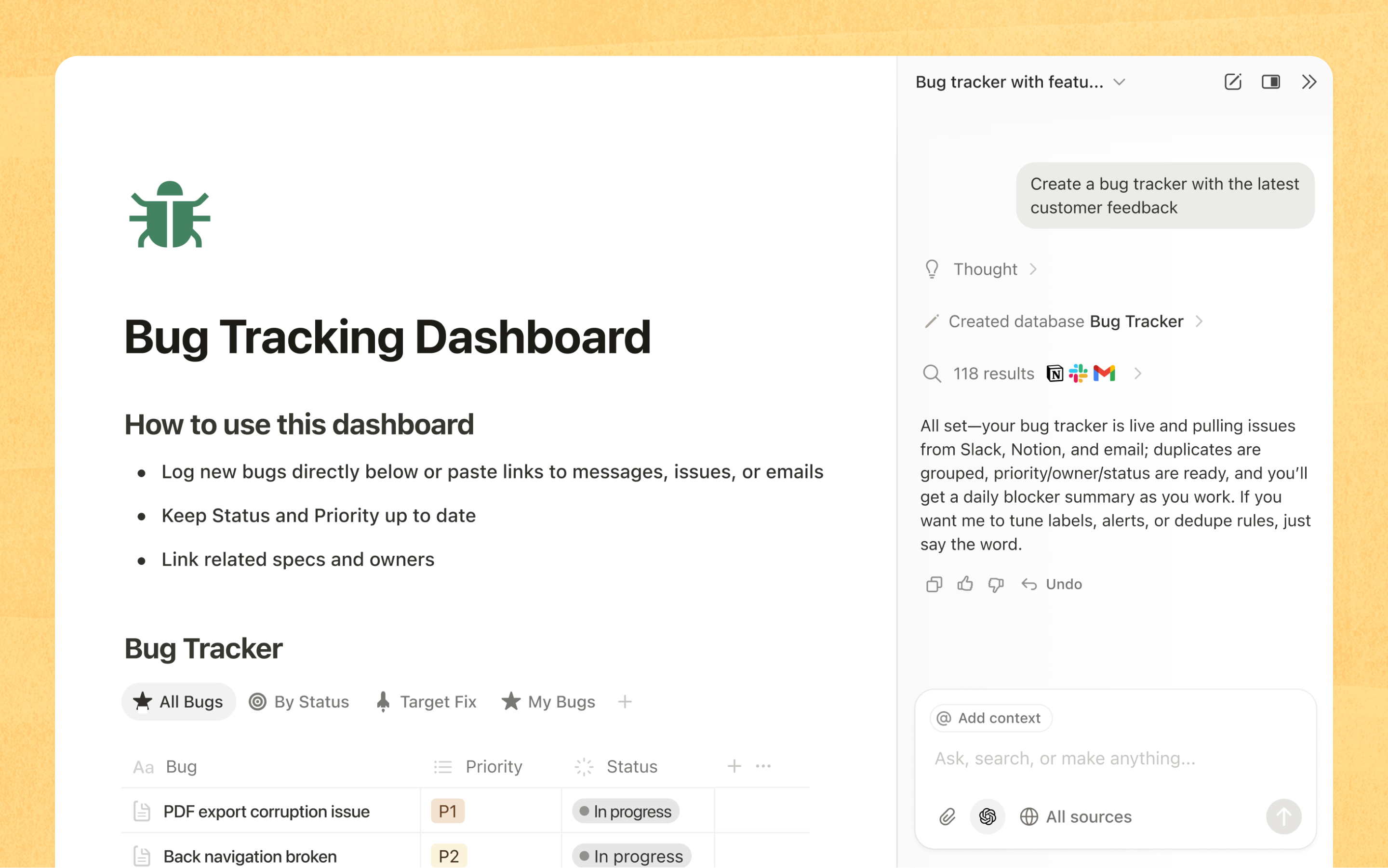
The tiny green bug has acquired a project manager. Here, Agent builds the tracker while the human keeps the adjectives mercifully brief.
“It does the dirty, boring and error-prone work for me.”A self-described AI skeptic writing in r/Notion, June 2026
That Reddit verdict lands on the product's genuine strength. Building a linked database by hand can feel like designing a small municipal government. Agent understands Notion's own objects - pages, properties, views, formulas and relations - and can perform the repetitive clicking. Another longtime user complained that summaries of pages they had written were pointless. Both reactions are reasonable. Generic text tricks are easy to replace; context-aware workspace surgery is harder.
What it can do before lunch
| Job | What happens | Best fit |
|---|---|---|
| Find an answer | Enterprise Search checks Notion, selected apps and the web, then links back to its sources. | Onboarding, policy questions, project archaeology |
| Do the work | Agent creates or edits pages, databases, forms, charts and formulas under your permissions. | Project setup, bulk changes, reporting |
| Remember a meeting | AI Meeting Notes records, transcribes, summarizes and extracts action items without a meeting bot joining the call. | Customer calls, stand-ups, interviews |
| Run on repeat | Custom Agents follow schedules or events and can work in approved Slack channels. | Triage, routing, recurring briefs |
| Polish a draft | Inline tools rewrite, translate and now suggest individual edits for approval. | Writers who want a second pass, not a ghostwriter |
The model picker is unusually pragmatic. Auto chooses for you, while the current menu spans models from OpenAI, Anthropic, Google and xAI. An August 2026 update added scorecards for speed, intelligence and cost, plus favorites and an effort control. Model choice matters most for Custom Agents because stronger models consume more credits. It can also change where the answer comes from: Notion warns that some selected models may search only the web rather than your workspace or connected apps.
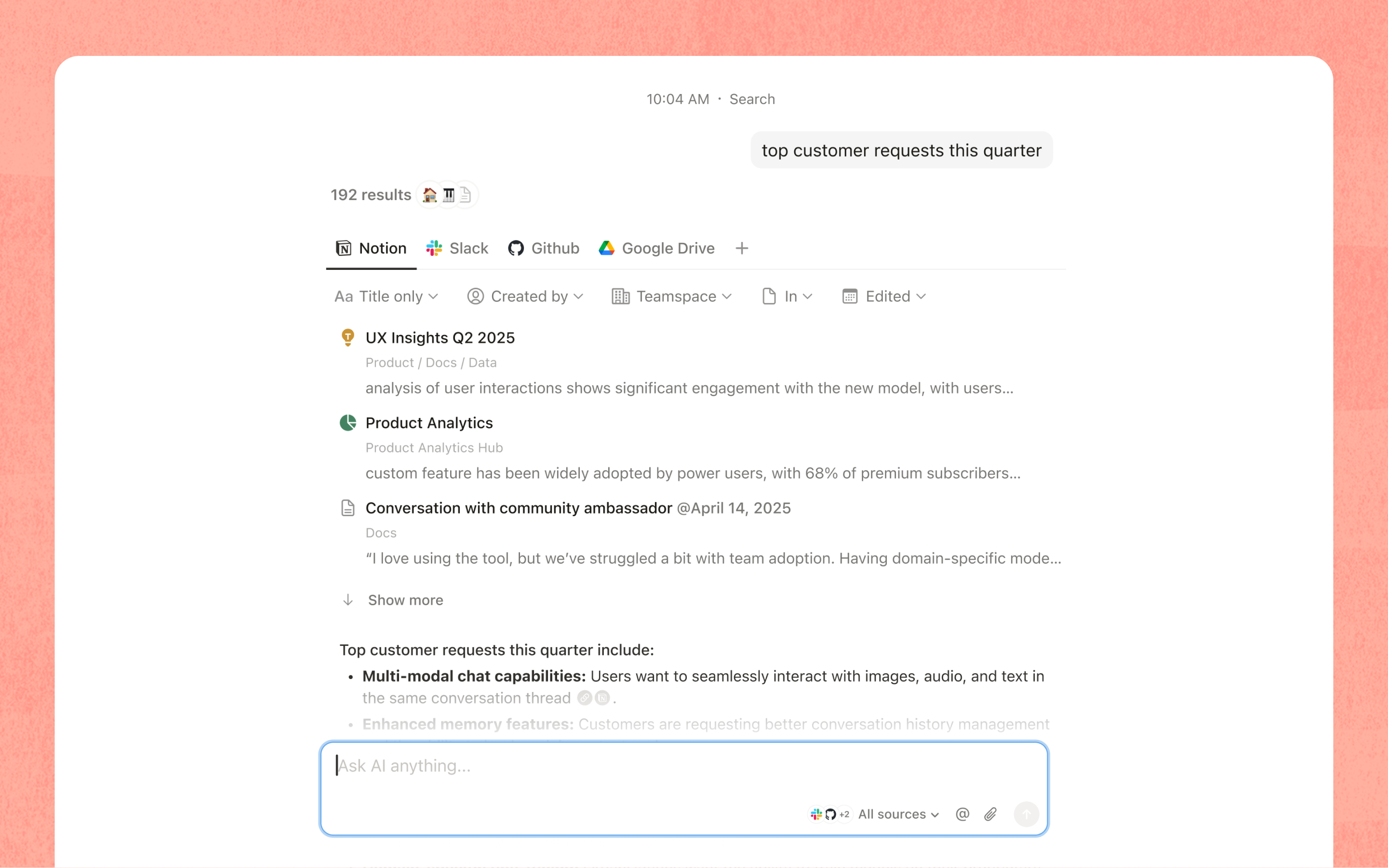
Search pulls a customer answer from four places. Somewhere, an abandoned “Q3 notes” document feels seen.
The price has a trapdoor
Free and Plus users get a limited taste. Continuing access to core Notion AI requires Business, listed at $20 per member per month, or a custom Enterprise contract. That includes Agent, Meeting Notes and Enterprise Search. For a team already paying for Notion, compare the full plan difference rather than pretending the AI has a neat standalone price. For a solo note-taker who wants occasional rewriting, the upgrade is difficult to defend.
Custom Agents have a second meter. Since May 4, 2026, they consume Notion credits sold at $10 per 1,000 monthly credits. A simple Q&A run is estimated around three to eleven cents; a daily brief around ten to thirty cents. Reading more material, taking more actions, running more often and choosing a heavier model all raise the bill. Credits are shared across the workspace and do not roll over. Admins can set limits, watch usage and stop an enthusiastic agent before it turns Tuesday's status report into a fiscal event.
A pilot that will tell you something
Do not begin with “make everyone more productive.” Pick a visible nuisance with a countable before and after: the Friday project digest that takes ninety minutes, the support queue that needs labels, or the ten customer calls nobody revisits. Give the Agent a small set of named pages, an example of a good output and a clear stopping point. Run it beside the human process for two weeks. Track minutes saved, corrections required and credits spent. This turns an AI demo into an operating decision.
Workspace hygiene matters more than prompt theatrics. Mark canonical pages, archive duplicates and name databases like a colleague might search for them. Tell the Agent where facts live and where drafts belong. For anything that can notify customers, alter many records or expose private material, require a plan and human review. A clever agent pointed at a chaotic workspace can produce chaos at a brisker pace. A bounded agent with decent source material can quietly earn a permanent shift.
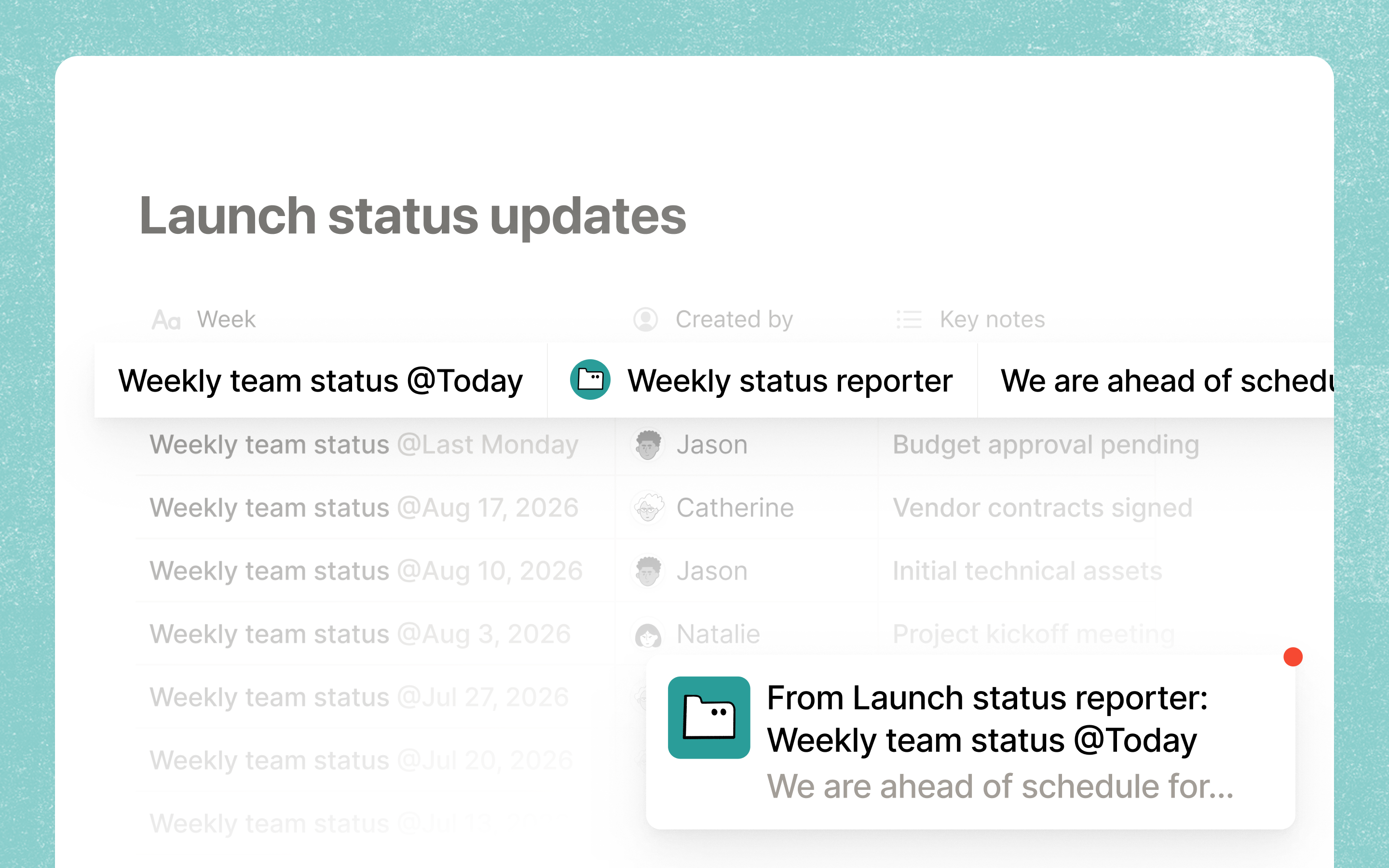
A launch-status agent turns a sleepy database row into a weekly report. No coffee, but it does charge by the chore.
Trust it like a quick colleague
Notion says Agent obeys the user's existing permissions, Enterprise Search cites its answers, and customer data is not used for model training unless a customer opts in to a request to share it. Its contracts bar AI subprocessors from training on customer data. Enterprise workspaces get zero data retention for the standard LLM features; the product page says non-Enterprise retention is 30 days. Specialized external Claude agents in beta have different retention terms, a reminder to read the feature-specific policy before handing over regulated or sensitive work.
Accuracy still needs supervision. Search citations make checking easier, but a citation is a route back to the evidence, not a warranty. For consequential database changes, use Plan Mode, narrow the pages involved and review the proposed work. Suggested edits, released in August, are a particularly sane pattern: Agent proposes line-level changes and the human accepts them one by one. The product is most trustworthy when it leaves footprints.
Open your workspace and count how many valuable decisions are already there. If the answer is “most of them,” trial Enterprise Search, Meeting Notes and one bounded Agent workflow. If the answer is “we mostly use Notion for a holiday calendar,” keep your money.
How it compares
| Option | Natural advantage | Choose it when |
|---|---|---|
| Notion AI | Acts directly on Notion pages and structured databases. | Notion already holds the work and the company memory. |
| Microsoft 365 Copilot | Context across Word, Outlook, Teams and the Microsoft estate. | Your organization runs on Microsoft 365. |
| Gemini for Workspace | Native reach across Gmail, Docs, Sheets and Meet. | Google Workspace is the office. |
| Atlassian Rovo | Search and agents around Jira and Confluence workflows. | Software delivery revolves around Atlassian. |
| ChatGPT or Claude | Broader standalone conversation, analysis and creation. | You need a general assistant more than an embedded workspace operator. |
The deciding feature is not which vendor won this week's model benchmark. Notion can swap models. The durable question is where your context lives and where you want the result to land. Notion AI keeps the round trip short. It is less compelling when the source material remains elsewhere or the team has not agreed how to structure its workspace.
The verdict
Notion AI has become useful in a more interesting way than its launch suggested. It does not need to write your manifesto. It needs to locate the decision, clean the database, remember the call and leave the project in better shape than it found it. That is a clear win for mature Notion teams and an expensive curiosity for workspace tourists.
Start with one boring loop that people already resent. Ask Agent to plan before acting. Check the citations. Measure the credit spend. If it saves a real hour, give it another chore. If it merely produces a handsome paragraph about productivity, you already know where the delete key is.