virtual-cards
(21)
SAP Taulia makes a business out of waiting
Big buyers want to pay later. Their suppliers want cash sooner. SAP Taulia sells a way for both to get their wish - provided someone funds the days in between.

Taulia and the price of waiting
An invoice can be perfectly good and perfectly useless until it is paid. SAP Taulia built a business in that awkward interval - and learned what happens when the money behind the button disappears.

The App That Found Its Business in a Bank Transfer
Afriex’s founders tried a chatbot and a trivia game. The nuisance that survived both experiments - moving money between the US and Nigeria - became their company, then a much larger payments network.

The Sneaker Bank That Outgrew Sneakers
A banking startup found its first customers in sneaker raffles. When that market fell apart, Slash used the lesson - build around the customer's actual money movements - to pursue a much bigger business.

You clicked pay. BillGO wants to cancel the paper chase.
An online bill payment can still end up in an envelope. BillGO built a business around catching it before the printer - and getting small businesses paid sooner.

Modulr wants to make payday boring
Behind the payroll run, the used-car sale and the supplier invoice sits a surprisingly complicated money journey. Modulr is building a business by taking the manual work out of it.
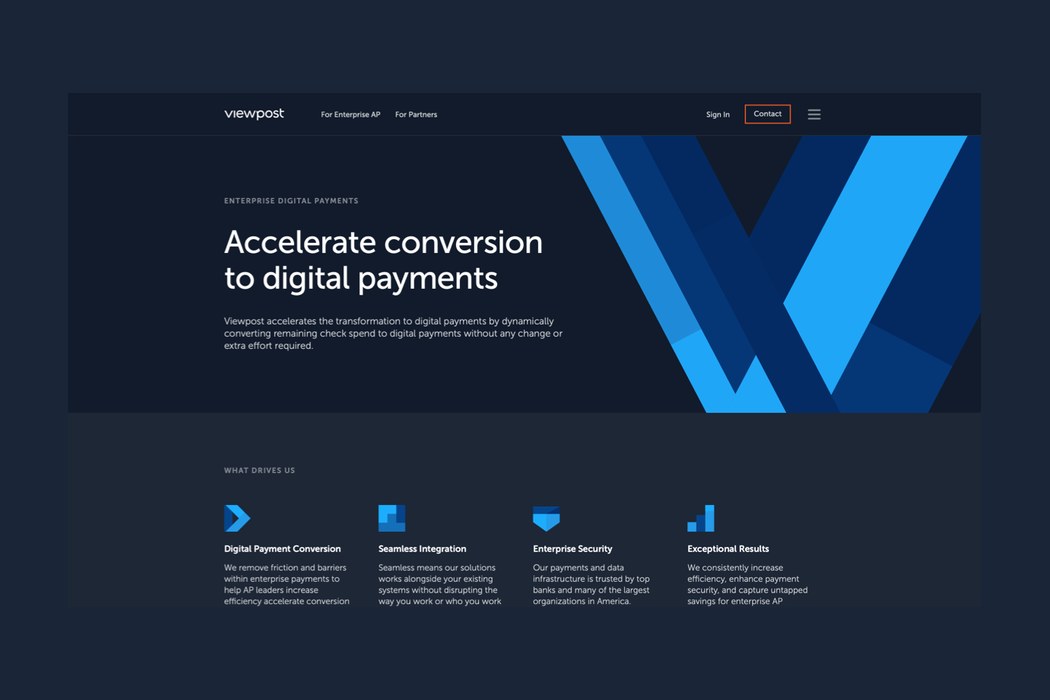
Viewpost Found a Business in the Checks Everyone Else Gave Up On
Most payment companies want to replace the plumbing. Viewpost built its second act around the opposite promise: send the same check file, keep the same partners, and let it hunt for digital payments in the stubborn remainder.

CorServ Built the Credit-Card Business Small Banks Were Told to Give Away
For years, a community bank had two bad choices: hand its card customers to a bigger issuer or build an expensive operation from scratch. CorServ found a third door - and more than 40 financial institutions have walked through it.

Marqeta Failed Twice. Then It Sold the Machine Underneath the Failure
The loyalty card flopped. Facebook's gift card vanished. What survived was the custom payment processor underneath - now a public company handling $120 billion in a quarter.

Mastercard
The famous circles sit on billions of cards, but Mastercard's real product is the invisible choreography behind a payment - a global network now learning to serve bank accounts, virtual cards, stablecoins and shopping agents without losing the trust that made the plastic useful.

Cardda
Cardda is a Chilean fintech (YC W22) building all-in-one spend management for Latin American businesses. It combines virtual and physical corporate cards, automated local and international transfers, reimbursements, and accounts payable in one dashboard, plus a payments API for mass payouts. It plugs into Chile's SII tax service and ERPs like SAP, Oracle, Defontana and Nubox, giving finance teams real-time control over company spending.

Miden
Miden is a Nigerian fintech building payments infrastructure for businesses across Sub-Saharan Africa. Through a single API, companies can issue virtual and physical cards in USD, NGN and multi-currency formats, run banking-as-a-service programs, open business accounts, and handle bill payments - the plumbing that lets other companies launch financial products without building banking rails from scratch. Founded in 2022 and part of Y Combinator's Winter 2024 batch, Miden has issued over a million cards and processes billions in transaction volume.

Weel
Weel (formerly DiviPay) is a Sydney-based fintech that gives Australian and New Zealand finance teams an all-in-one corporate card and spend management platform. It combines virtual and physical Visa cards, budget controls, approval workflows, accounts payable automation and AI-powered receipt and invoice capture so businesses can track every expense - from a coffee to a large invoice - in real time and sync it straight to their accounting system.
YAP
YAP is a Dubai-based digital banking platform that lets people open an account, get an instant IBAN and Mastercard, send and receive money, pay bills and track spending entirely from a mobile app. Launched in March 2021 as the UAE's first independent digital banking platform, YAP does not hold its own banking licence in the UAE; instead it partners with licensed banks (originally RAKBANK) to provide the underlying accounts while YAP builds the customer-facing experience, analytics and card controls. The company has raised roughly $41 million and is expanding across the Middle East, Africa and South Asia, targeting Saudi Arabia, Egypt, Pakistan and Ghana.

Cledara
Cledara is a software management and spend platform that helps growing companies discover, buy, manage and cancel their SaaS subscriptions from one place. By pairing virtual cards with a system of record for every application, Cledara gives finance and IT teams real-time visibility into software costs and usage, automates invoice collection and accounting, and enforces approval workflows. Founded in 2018 by Cristina Vila Vives and Brad van Leeuwen, it serves 1,000+ customers across 32 countries.
ConnexPay
ConnexPay is a Plano, Texas payments-technology company that unifies the two traditionally separate halves of the payment process - accepting customer payments (PayIns) and issuing supplier payments via virtual cards (PayOuts) - into one platform, one contract and one reconciliation. Founded in 2017 by former U.S. Bank payments executive Bob Kaufman, it lets travel agencies, marketplaces, insurers and other 'high-risk' merchants use incoming card revenue to instantly fund outbound supplier payments, removing the need for pre-funded accounts and reducing risk while capturing card rebates.

Pliant
Pliant is a Berlin-based B2B fintech that turns corporate payments into programmable infrastructure. Its API-first platform lets companies issue physical and virtual credit cards, automate spend controls and receipt handling, and plug card data straight into accounting systems like DATEV and NetSuite. Through its cards-as-a-service model, banks and software platforms can launch their own branded card programs. Founded in 2020 by Malte Rau and Fabian Terner, Pliant runs on the Visa network across 30-plus countries, serves more than 3,500 businesses, and raised a $40M Series B in 2025 to expand into the United States.
Increase
Increase is a banking infrastructure company that gives technology companies a programmatic way to store, move, and reconcile money. Through a single set of APIs it exposes the core U.S. payment rails - ACH, wires, real-time payments, FedNow, checks, and cards - with direct network connections and transparent access to the underlying data. Founded in 2020 by Stripe's first employee Darragh Buckley and based in Bend, Oregon, Increase is self-funded, became profitable in 2025, and processes hundreds of billions of dollars in payments each year for fintechs like Ramp, Check, and Pipe.

Boost Payment Solutions
Boost Payment Solutions is a New York-based fintech that quietly removes the friction from large commercial card payments. Founded in 2009 by payments veteran Dean M. Leavitt, Boost uses patented straight-through processing and a rules-based payment engine to let buyers pay with cards while suppliers get paid automatically, with the data and reconciliation already handled. Operating in dozens of countries and partnered with Visa and Mastercard, Boost has positioned itself as a leading independent infrastructure layer for B2B card payments.

Interlace
Interlace is a Singapore-based fintech that lets companies issue branded physical and virtual cards through a single API, connecting to 30+ card BINs and bridging stablecoins with traditional banking rails. As a Visa Hong Kong Principal Member, it offers card-as-a-service, multi-currency business accounts, banking-as-a-service and crypto on/off ramps to over 12,000 enterprise clients across 180+ countries, having issued more than 6 million cards.

Lithic
Lithic is a New York-based fintech that gives developers programmable card issuing and money-movement infrastructure. Born out of consumer brand Privacy.com, the company builds the API rails that let other companies create, manage and process virtual and physical payment cards with minimal code. Today it powers debit, credit and prepaid card programs for fintechs like Mercury and Coinstar, processing more than $1 billion in annual volume.