You pay the bill on your phone. Somewhere downstream, a printer may be warming up. A check goes into an envelope, the envelope joins the mail, and the business you paid waits for money you consider long gone. The screen was digital. The delivery can still involve a stamp.
BillGO has made that mismatch its business. The Colorado payments company connects financial institutions, payment providers and the businesses receiving their customers’ money. Its current focus is the smaller biller: the office with invoices to match, wages to cover and better things to do than wonder what the mail carrier is bringing.
The appeal is easy to understand. If a payment already exists, getting it to its destination sooner can be more useful than another reminder to the customer. BillGO Exchange aims to convert incoming check payments into electronic ones and collect the information needed to post them. The interesting work happens between the familiar screens.
The opportunity was behind the app
Founded in 2015, BillGO initially approached bill paying from the household side. Co-founder Dan Holt described the ambition in an early interview: put managing, splitting and paying bills into one application. He had already worked in bank technology and served in the Air Force. Co-founders included Scott Miller and Kelly Seidl, who brought experience from Google Payments and later became BillGO’s chief technology officer.
The first customers were acquired with shoe leather. Holt said the team recruited its first 1,000 users on campuses. Looking back, he wished he had launched sooner so actual users could shape the product earlier. Asked about an entrepreneurial failure, he pointed to hiring decisions in which he had ignored his instincts. Those are specific admissions, more useful than a polished tale of uninterrupted foresight.
“Get out of the building and talk to customers.”
Dan Holt · IdeaMensch interview, 2016
By June 2025, BillGO was describing a different center of gravity. As its technology spread, the company said, it saw greater value in the network and payment infrastructure. It could identify checks headed to small businesses before they were printed, then help convert those transactions into digital payments. That observation, BillGO explained, prompted its strategic focus on small-business cash flow.
The mission became practical and narrow: make payments simple for small businesses. Read together, the early interview and the later explanation suggest a company following the useful machinery it had built. A household wanted fewer places to pay. A business wanted the payment to arrive, with enough information to recognize it.

Catch the check before it becomes a check
BillGO’s explanation begins with an electronic biller directory. When someone uses a bank’s bill-pay service, the payment can be routed through a directory to a receiving business. If the business is missing from an electronic route, the transaction may become a mailed check. BillGO’s FAQ puts that journey at seven to ten days.
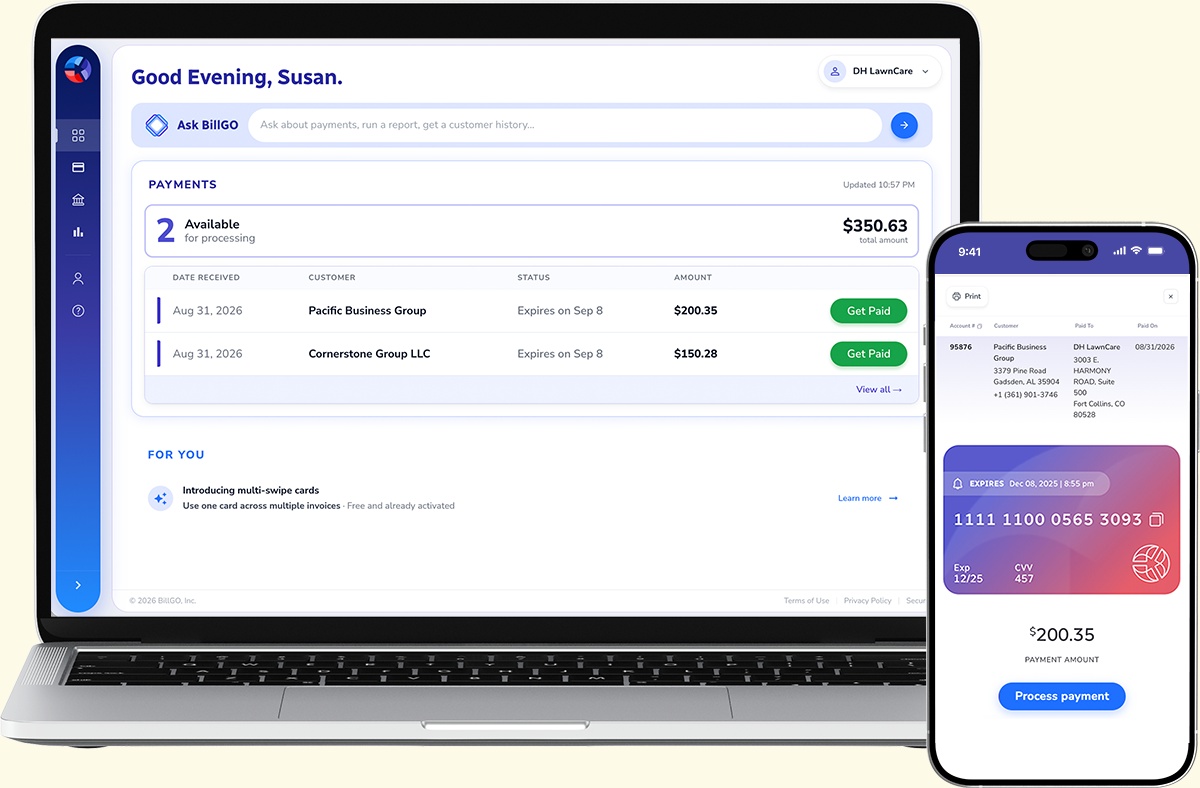
Exchange enrolls businesses in BillGO’s directory and gives them a portal for payment information and history. Its advertised options include virtual cards and ACH deposits. A virtual card can be processed through a business’s existing card processor; ACH sends money to a bank account. The FAQ describes ACH receipt as typically taking one to two days.
Conceptual routing, not a universal delivery guarantee. Method and receiving arrangements affect timing.
That distinction matters: a payment notification, a processed card and spendable funds are different events. A sensible buyer asks about the whole journey. BillGO’s same-day language describes parts of the service; it does not make every payment method identical.
The company also markets widgets driven by APIs and a hosted bill-pay experience to banks and fintechs. Those institutions can use its technology within their own customer experience. On the receiving side, the sales pitch is deliberately modest: use a portal, retain familiar processing arrangements and reduce the physical paperwork.
The people who actually post the money
Accounts receivable sounds bloodless until you meet the person doing it. In a March 2026 BillGO customer story, Katrina Mason, billing and insurance manager at Peninsula Dermatology, describes a straightforward routine: receive an email, retrieve the payment, post it, reconcile it and send the patient a receipt. Faster movement helps, but a usable record is part of the product.
At Pye-Barker Fire and Safety, the setting is larger. BillGO’s February 2026 account profiles receivables director McKell Brock, who leads 23 AR professionals while the organization absorbs acquisitions. She describes the usefulness of consolidating accounts and handling single-use card payments during growth. The operational issue is consistency across a changing business.
These are company-published customer accounts, rather than independent measurements of savings. Their value is the view of the work itself. One office needs a clean patient-payment trail. Another needs order across branches and acquisitions. Neither problem ends when money is sent.
BillGO’s own research widens the frame. In a July 2025 Ipsos survey of 253 small-business decision-makers, 49 percent identified late customer payments as a top cash-flow challenge. The study was unweighted and excluded sole proprietors and independent contractors. It describes those respondents, with enough specificity to be useful without pretending to represent every business.
Among respondents to BillGO’s 2025 Ipsos study. Sample: 253 small-business decision-makers; unweighted.
Free enrollment has a price tag next to it
BillGO’s business model joins institutional distribution with payment services for billers. The clearest public view of the receiving side comes from its June 30, 2026 Exchange terms. Enrollment is free. Processing costs depend on how a business takes the payment.
For manual card processing, BillGO says it does not charge a processing fee, but the business remains responsible for third-party costs, including interchange and charges from its merchant acquirer. For automatic processing through Auto-Settle ACH, BillGO says it charges a fee unless the portal specifies otherwise. The applicable amount is communicated through the portal or email.
That makes the buying decision a calculation. How much staff time disappears? How much sooner does usable cash arrive? What processing cost is deducted? The word “free” at enrollment cannot answer all three. The current terms are more informative than broad marketing language about no added costs.
Joining the service
Third-party processing charges
BillGO fee unless otherwise specified
There is a separate cost to building the company. BusinessDen reported approximately $94.33 million in a May 2023 equity raise, based on securities filings. An earlier, June 2019 strategic financing announcement named a USAA affiliate, Commerce Ventures and CheckFree founder Pete Kight. Kight now appears as BillGO’s board chair: an experienced bill-pay operator helping oversee a newer one.
A network is useful when it reaches the other end
The 2018 acquisition of Prism shows how BillGO assembled its reach. Prism brought a consumer app, a team and a network of more than 11,000 billers. At the time, the acquired app had handled $1 billion in bills. The stated plan was to incorporate those connections into BillGO’s payment technology.
The consumer application was discontinued in February 2024. That ending belongs alongside the acquisition, especially for readers who remember the app. BillGO’s subsequent small-business strategy is best judged by the payment infrastructure it describes today.
Connections also came through cooperation. In May 2022, Deluxe and BillGO announced an agreement linking their networks. If BillGO could not process a payment through its own network, Deluxe Payment Exchange could offer another digital delivery route before a check went into the mail. That is a concrete reason to partner: the next network may reach an address yours does not.
The announcement also reported BillGO’s reach at more than 32 million consumers and over 170,000 supplier endpoints. Those are historical network measures, not a count of businesses paying BillGO directly. They help explain the distribution model: infrastructure can touch many people who never choose its brand.
On bank bill pay, Fiserv’s CheckFree Next is an established alternative offering centralized payments and automation. BillGO’s more distinctive current emphasis is the smaller receiving business and the check-to-digital handoff. The relevant comparison is practical: which provider reaches the billers a customer actually pays, through which methods, at what cost?
Start with the mail tray
There is a useful lesson here for anyone buying or building business software. Follow one transaction all the way through. BillGO’s change of emphasis came from noticing a problem beyond its original consumer interface. The recipient’s waiting time and bookkeeping were part of the same payment, even if they happened elsewhere.
For a business considering Exchange, start with a small, measurable group of incoming payments. Record arrival time, processing charges and minutes spent matching payments to invoices. Compare the result with the existing routine. That is an evaluation method, not a promise of savings; an office already receiving inexpensive electronic payments may have less to gain.
BillGO’s opportunity depends on reachable payers, suitable payment methods and accurate remittance data. Speed alone will not repair an incorrect invoice or persuade a customer to initiate a payment. But where the money has already been sent and paper is slowing its arrival, there is a worthwhile job to do. The next payment may be able to skip the envelope.