anti-money-laundering
(20)
Pelican.ai and the expensive art of the false alarm
A payment can travel the world and still get stuck on a name. Pelican.ai has spent three decades teaching banking software to untangle the instructions, checks and false alarms that hold money up.
XTransfer’s big business in small exporters’ money
Selling across borders is hard enough. XTransfer has built a payments business around the next headache: convincing the financial system to let small traders get paid.
VinciWorks wants your staff to stop clicking and start thinking
The compliance company built its early business around a pact between law firms. Now it sells editable courses, automated workflows and AI conversations - with a railway training overhaul showing what the combination can do.

Elliptic follows the money. Banks are following Elliptic.
The bitcoin-vault startup became a business built around an awkward question: where did this money come from? Now a $120 million funding round is backing its next push into crypto compliance.

Thirdfort’s £25,000 reason to check the paperwork
A friend lost a home deposit despite the anti-fraud checks. Thirdfort’s founders built a business around the gap between collecting documents and understanding what they prove.
Facctum Wants Banks to Stop Chasing the Wrong Names
A familiar name can send a payment into a compliance queue. Facctum is tackling the data, screening and review work that decides whether it belongs there.
Abrigo’s Quiet Bet: Make 2,400 Community Banks Move Like the Giants
Community banks cannot outspend the giants. Abrigo’s answer is to package the unglamorous machinery of lending, fraud, compliance and risk into one operating layer - then let smaller institutions automate the work that used to eat their week.

The Software That Turns Financial Crime Investigators Into Case-Closing Machines
Anti-money-laundering work is where good design goes to die. Hummingbird bet the opposite - that compliance investigators deserve tools as sharp as the criminals they chase.
Fenrock AI
Fenrock AI is a San Francisco startup from Y Combinator's Winter 2026 batch building AI agents for the banking back office, starting with financial crime compliance. Its AI workspace helps compliance analysts investigate AML and fraud alerts at roughly 20x their normal volume while keeping bullet-proof audit logs and human oversight. Founded by repeat entrepreneur Charu Sharma and ex-Apple/Google machine-learning engineer Michael M, the company overlays on a bank's existing stack to automate investigations, loan processing, and complaint resolution.

Elementus
Elementus is a New York-based blockchain intelligence company that adds an identity layer to raw on-chain data, letting banks, regulators, government agencies and investigators trace crypto transactions, score risk, detect sanctions exposure and follow the money across multiple chains. Founded in 2018 by data scientist Max Galka, the company pairs proprietary attribution data with forensic algorithms and became widely known for mapping the flow of funds in the Celsius and BlockFi bankruptcies.
NICE Actimize
NICE Actimize is the financial-crime, risk and compliance division of NICE Ltd. and one of the largest providers of anti-money laundering, fraud prevention and trading-surveillance software to banks, regulators and financial institutions worldwide. Its AI-driven X-Sight platform, ActOne case management and SURVEIL-X surveillance suite help more than a thousand institutions detect suspicious activity, screen against sanctions lists, manage regulatory reporting and investigate financial crime - increasingly using agentic AI to cut investigation time.
Silent Eight
Silent Eight is a Singapore-headquartered regtech company that builds purpose-built artificial intelligence for financial crime compliance. Its Iris platform automates name screening, transaction screening, transaction monitoring, investigation and case documentation for banks, producing decisions with written, auditable narratives instead of black-box scores. The company is used by Tier 1 institutions including HSBC and Standard Chartered, and has raised roughly $55 million to date, including a $40 million Series B in 2022.
Feedzai
Feedzai is an AI-native platform that helps banks and financial institutions detect and prevent fraud and financial crime in real time. Founded in Portugal in 2011, its RiskOps platform unifies fraud detection, anti-money laundering, transaction monitoring, identity verification and scam prevention across the customer lifecycle. Feedzai screens transactions for institutions such as Citi and Lloyds Banking Group, and in 2025 was selected by the European Central Bank to help safeguard the forthcoming digital euro. The company reached a $2 billion valuation in October 2025.

Consilient
Consilient is a New York- and Washington, D.C.-based financial technology company that applies federated machine learning to anti-money laundering and financial crime detection. Its models learn from behavioral patterns across multiple banks and share the algorithms - not the underlying customer data - so institutions can collaborate on catching illicit activity while preserving privacy. Founded in 2020 as a joint venture between K2 Integrity and Giant Oak, the company's Dozer platform has demonstrated in bank trials that it can sharply cut false positives while improving true-positive detection.
Pastel
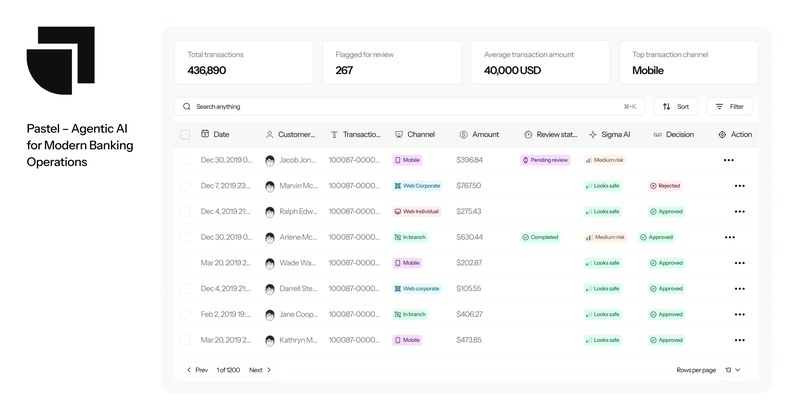
Pastel builds agentic AI for banking operations, aimed at the regional, mid-tier, and community banks that most fintech innovation skips over. Its flagship platform, Sigma, deploys AI agents across customer onboarding, due diligence, fraud detection, anti-money laundering, screening, and executive reporting - trained on local data and regulations rather than retrofitted Western systems. Founded by Stanford graduate students and rooted in African markets, Pastel started as a small-business bookkeeping tool called Sabi before pivoting into compliance infrastructure for financial institutions.

Roe AI
Roe AI builds agentic AI that investigates fraud, disputes, and anti-money-laundering (AML) cases end to end - reading documents, images, websites, and structured data to produce cited evidence and audit-ready dispositions. Founded in 2024 by ex-Snowflake and ex-Meta engineers and backed by Gradient Ventures and Y Combinator, the company started as an AI-powered data warehouse for querying unstructured data with SQL and sharpened into a financial-crime investigation platform used by teams at Affirm, eBay, and a Global Systemically Important Bank.
SymphonyAI
SymphonyAI builds vertical, industry-specific AI software that runs core workflows for demanding sectors - financial services, retail and CPG, manufacturing, media, and enterprise IT. Founded in 2017 by billionaire technologist Dr. Romesh Wadhwani and led by CEO Sanjay Dhawan, the Palo Alto company stitched together a string of startups and acquisitions into a single, profitable enterprise AI company built on its Eureka generative AI platform. With a roughly $500M revenue run rate, 2,000+ customers across some 40 countries, and around 2,300-2,500 employees, SymphonyAI sells ready-to-deploy AI rather than build-it-yourself tooling - and has openly signaled plans to go public.

TigerGraph
TigerGraph is a Redwood City-based software company building a native, massively parallel graph database and analytics platform designed to find patterns across deeply connected data in real time. Founded in 2012 by Dr. Yu Xu, it powers fraud detection, anti-money laundering, customer 360, recommendation engines and, increasingly, the relationship-intelligence layer behind enterprise AI and GraphRAG. Its cloud-native platform, TigerGraph Savanna, lets organizations query trillions of edges with the GSQL query language across AWS, Azure and Google Cloud.
Unit21
Unit21 is a San Francisco-based risk and compliance platform that uses agentic AI to detect, investigate, and report financial crime. Its no-code rules engine, transaction monitoring, case management, and AI investigation agents serve banks, credit unions, fintechs, and crypto firms including Chime, Brex, Intuit, Crypto.com, and Jack Henry. The company is responsible for roughly 5% of all SARs filed in the US.

DataWalk
DataWalk is a graph- and AI-enabled analysis and investigation platform that unifies disparate data sources so analysts at banks, insurers, and government agencies can spot hidden relationships, run no-code queries, and pursue fraud, money laundering, and threat investigations at scale.