The sentence landed in the conference room like a denied claim: “You haven't set us up to win.” Rachael Jones was on the health-plan side of the table. Across from her sat a physician leader whose practice had entered a shared-risk deal. The theory was agreeable enough - improve outcomes, lower medical costs, split the savings. The reconciliation was not. One team looked defensive, the other defeated, and the contract between them had become a machine for producing surprise.
That meeting supplied the useful kind of founder pain: narrow, expensive, and embarrassing. Jones had spent years in healthcare payment, analytics, and product roles. She knew the industry's problem was not a shortage of value-based-care manifestos. It was that payers and providers could sign the same agreement while carrying different assumptions about attribution, benchmarks, trends, quality gates, and the order in which the math should run.
Syntax Health, developed at company builder Redesign Health and launched publicly in 2023 with $7.5 million in seed funding, turned that disagreement into software. Its enterprise SaaS platform gives both parties a shared place to model terms, inspect the inputs, make counterproposals, monitor performance, and eventually reconcile what happened. In December 2025, Lightbeam Health Solutions acquired the Atlanta company for an undisclosed price and began folding its contracting engine and actuarial expertise into a broader population-health system.
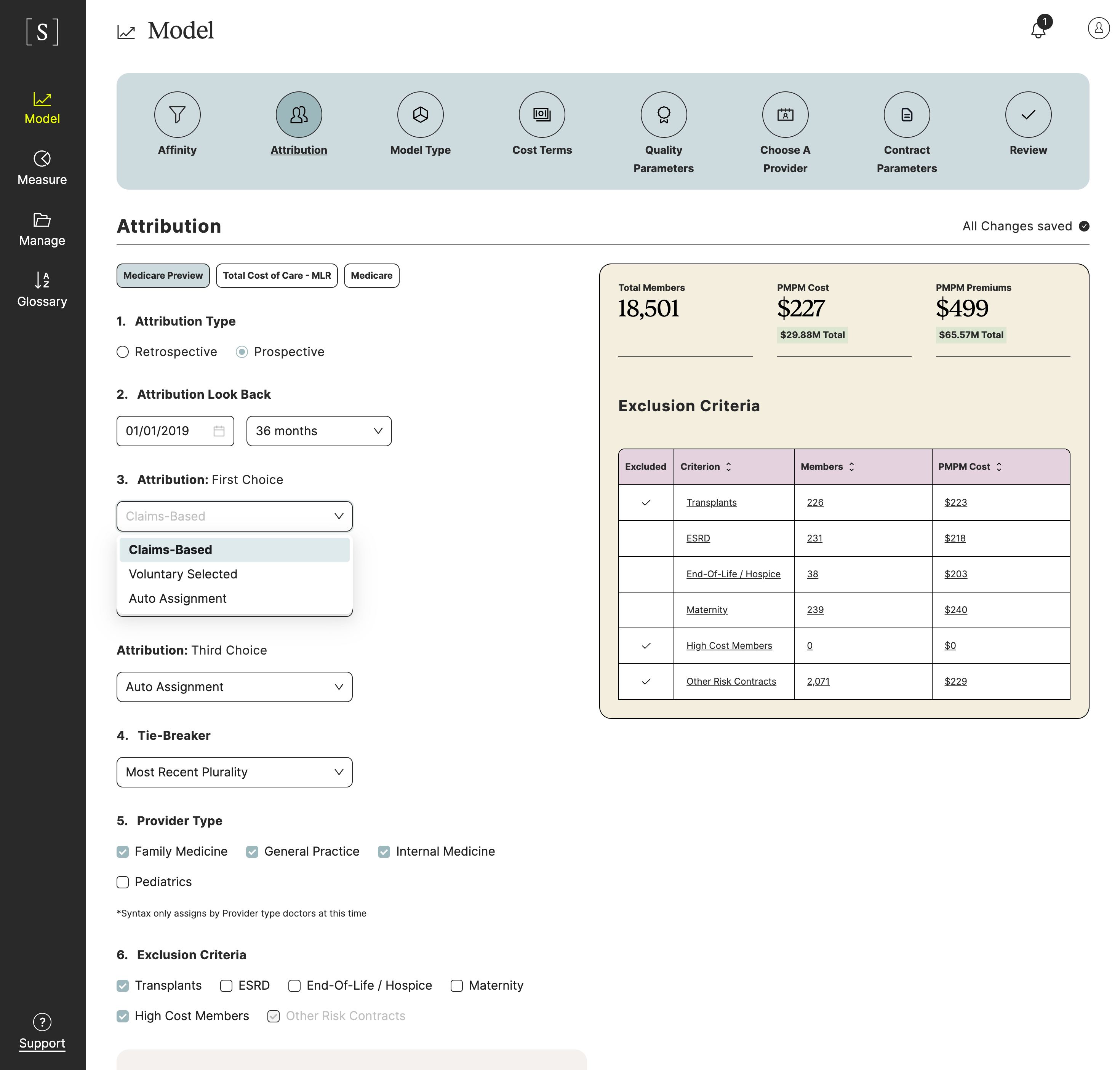
The product is a negotiating table with a calculator built in
Syntax organizes its work into three verbs: Model, Measure, Manage. Model is where a team configures the population, assignment rules, financial benchmark, quality terms, and incentive scenarios. Measure previews actual performance against those targets, giving operators time to change course before year-end reconciliation. Manage provides oversight across contracts, provider groups, lines of business, and markets. Actuarial advisory services sit alongside the software for organizations that need an expert, not merely another login.
The Syntax loop
Price the promise
Test attribution, baseline, trend, cost, quality, and incentive choices before signing.
Watch the weather
Compare live performance with targets while there is still time to intervene.
See the portfolio
Track arrangements across providers, products, markets, and negotiating cycles.
The distinction is the two-sided workspace. Traditional contract work often travels as spreadsheets, email attachments, slide decks, and findings from an internal actuarial team or outside consultant. The model's author can see the gears; the counterparty sees the output. Syntax exposes more of the mechanism. Actuaries, analysts, network managers, and provider leaders can compare savings, revenue, quality measures, and trends against a common data set, then see how a changed term alters the projected outcome.
That does not make Syntax a neutral regulator. It remains a commercial tool sold to health plans, ACOs, systems, community health centers, and provider groups. Pricing is not published. But product design can still alter the social physics of a negotiation. When the order of operations is visible and assumptions are inspectable, “trust us” has to compete with “show us.”
“Value-based care only works when everyone at the table can finally see the same picture.”Rachael Jones, CEO and co-founder
What it did, what it cost, and where the numbers moved
The purchase price, annual subscription price, and company revenue are not public. The known cost of building the company is easier to frame: Syntax announced $7.5 million in seed financing at launch. It was a small team - supplied company data puts it near seven employees before the acquisition - selling into buyers famous for long reviews, sensitive data, and procurement committees. That is a difficult habitat for a young SaaS company, which helps explain the mix of software, actuarial advice, design partnerships, conferences, and case-study selling.
The customer evidence is specific enough to be interesting, though it comes from company-published case studies. Brevard Health Alliance, a Florida community health center, said its contract review became 50 percent faster. Syntax's analysis indicated proposed incentive pay should have been 236 percent higher, moving from $246,000 to $572,000. That is not merely workflow efficiency. It is $326,000 of negotiating context.
MCR Health offers the darker version. By mid-2024, it faced more than $1.5 million in downside exposure across three contracts whose attribution rules and performance benchmarks were difficult to track. Syntax says its work reduced one contract's downside from $900,000 to $175,000, flagged another in time to avoid a potential $650,000 loss, and improved MCR's position before a later negotiation. PanCare of Florida was presented as another community-health-center case, with more than $1 million in value-based earnings potential identified.
In 2025, Sound Long-Term Care Management ACO selected Syntax to model arrangements, improve forecasting, test provider onboarding, design its network, and monitor contract performance. This is the customer profile in full: not a consumer looking for a better appointment app, but an organization taking financial responsibility for a population and needing to know whether the contract rewards the work clinicians are being asked to do.
What failed first was not the software
The original failure was institutional: one-sided tools produced one-sided confidence. Poor assumptions upstream turned reconciliation downstream into a blame session. Jones's account of that formative meeting is useful because the physician did not say the team lacked a dashboard. He said they had not been set up to win. Syntax's product thesis is that contract design is care infrastructure. If the incentive is unreachable, unclear, or mismatched to the population, a beautiful analytics screen later cannot repair it.

What changed Jones's mind was the recognition that better analysis held privately was not enough. Both parties needed symmetry: shared data, shared definitions, and the ability to test proposals together. That pushed Syntax away from a one-sided dashboard and toward a collaborative contract room. The 2024 CareJourney partnership deepened the idea by adding provider cost, quality, and market benchmarks. A provider exploring a new market, or a payer testing an ACO proposal, could supplement its own history with external context.
The company's culture echoed the product. Syntax described itself as inclusive, accountable, and transparent. Engineering posts went further: every engineer was expected to own quality and security, with threat modeling attached to feature work. That sounds procedural because it is. Healthcare data punishes improvisation, and a product asking two adversarial parties to trust one workspace cannot treat governance as decoration.
The acquisition makes sense from upstream
Lightbeam sells population-health technology and services: risk analytics, care management, remote monitoring, and operational support around value-based care. Syntax sits one step earlier. Before a care team can perform against a target, somebody has to define the population, benchmark, risk corridor, quality measures, and money attached to them. Buying Syntax gave Lightbeam a contracting and actuarial layer that could connect agreement design with operating performance.
It also moved Syntax into a larger distribution system. The startup had gained traction with community health centers, ACOs, and provider-led networks, joined the 2024 Healthworx Accelerator, and appeared on Atlanta Inno's Startups to Watch list. Lightbeam offered customers, data infrastructure, and a broader product surface. Syntax offered the part of the stack where everyone decides what success means.
Copy this
- Start with the expensive meeting, not the broad market.
- Make assumptions inspectable by both parties.
- Tie workflow savings to financial outcomes.
- Add expert service where software confidence is thin.
Know the limits
- Bad or delayed data still produces bad models.
- A shared screen cannot force good-faith negotiation.
- Small practices may lack data and actuarial capacity.
- Unique contracts resist perfect standardization.
The part readers can steal
Syntax's most portable lesson is not “build in health tech.” It is to look for a high-stakes workflow where two parties use different versions of the truth. Map the assumptions, not just the tasks. Give each side enough visibility to challenge an input without rebuilding the model. Preserve an audit trail. Then measure the result in the currency the buyer already cares about - time recovered, risk avoided, money negotiated, or decisions made earlier.
The service layer matters, too. When a category requires specialized judgment, a pure self-serve tool can strand the customer at the hardest step. Syntax paired software with actuaries and operators who had lived inside payer and provider teams. The expertise helped translate messy contract language into model inputs and helped cautious buyers trust a young vendor. Founders can copy that combination without pretending every service must become a button on day one.
There are conditions where the model will not work. Parties must contribute usable claims, membership, quality, and contract data. They must agree on definitions or at least be willing to expose disagreements. They need someone with authority to renegotiate. A community clinic without analytical staff may need substantial support; a payer committed to a black-box offer may not welcome symmetry. Software can reveal a power imbalance. It cannot repeal one.
Jones now puts the AI question in similarly practical terms: the math has to work first. AI might summarize a clause, accelerate analysis, or reduce administrative labor. It cannot rescue a contract built on the wrong baseline or manage the human change required to use a new payment model. That restraint is refreshing in a market busy attaching “AI-enabled” to every workflow with a pulse.
Syntax found a business inside a bad meeting. It made the hidden calculations visible, attached them to a collaborative workflow, and sold the result to organizations with real dollars at risk. Lightbeam's acquisition closed one chapter, but the original tension remains: healthcare wants providers to accept more accountability while often leaving them to decode the economics after signing. A shared calculator will not fix American healthcare. It can make a very consequential conversation harder to bluff.