Suzanne Behrens has a tidy way of describing a corporate arrangement that is usually anything but tidy. When asked to introduce herself beside Granicus revenue chief Amir Capriles, she called herself his “partner in crime.” The joke lasted a second. The operating idea behind it had taken a career to sharpen.
Behrens ran marketing. Capriles ran revenue. In many companies, that fact would produce two calendars, two dashboards and a quarterly argument about lead quality. At Granicus, the pair tried to erase the seam. They held joint goals and joint accountability. They strategized together. Capriles could meet with her direct reports; she could meet with his. When bookings missed, both had failed. When the number arrived, both celebrated.
It sounds almost impolite in a world where departments defend their metrics like small hereditary kingdoms. Behrens's view was that the buyer does not care which kingdom produced the email. A government customer researching software may cross a website, an article, a sales conversation and a procurement review without once admiring the internal handoff. The experience either feels coherent or it does not.
“We are one go-to-market team.”Suzanne Behrens, on the sales-marketing compact
Thirty years inside the public-sector maze
Behrens's career was unusually consistent in subject, even as her title changed. “My whole career has been in the public sector,” she said when joining Granicus in 2022. The setting was technology, but the destination was government: agencies, employees, residents and the complicated systems that connect them.
She spent 16 years at Microsoft helping to build and manage public-sector marketing and inside sales. During that period, the business grew from $100 million to more than $3 billion in revenue under her leadership. That is a 30-fold change in scale, reported when Granicus hired her. It is also the sort of number that can flatten a career into a trophy. The more revealing evidence is what she did afterward.
Public-sector revenue grew at least 30 times during the years Behrens helped lead its marketing and inside-sales operation.
Behrens became a founder and adviser through Proven Outcomes, a consultancy for government technology and financial technology companies. In 2015, she announced its expansion into a full-service marketing communications agency. She later served as chief executive of Kenner Technologies, a small company that assembled experienced teams for technology work across federal, state and local government. The marketer had moved into the chief executive's chair, where positioning eventually has to survive payroll, delivery and the customer's actual problem.
Those roles gave her a useful set of sightlines. Microsoft offered enormous scale. Proven Outcomes offered the founder's intimacy with strategy and execution. Kenner offered an operator's accountability. Granicus brought her back to the CMO seat at a company whose products sit close to ordinary civic life: websites, communications, meetings, records and digital services.
Features are easy. Outcomes require listening.
Public-sector technology marketing is vulnerable to nouns. Platforms, clouds, workflows, records, portals, compliance, analytics. They accumulate quickly and soon a resident trying to complete a form has vanished beneath the product sheet.
Behrens pushed in the other direction. She argued that the old features-and-benefits conversation had largely run its course. Government customers want a seller who understands policy changes, procurement, funding and the outcome an agency is trying to produce. Marketing's job is to design messages around those needs, then meet the buyer at the point in the journey where the message becomes useful.
This sounds like ordinary empathy until one considers the machinery required. Marketing has engagement data, intent signals and content performance. Sales hears objections, priorities and deal dynamics. Separate the two and each team owns half a map. Join them and the customer's behavior can change the message while the seller's experience improves the next campaign.
Precision, without losing the person
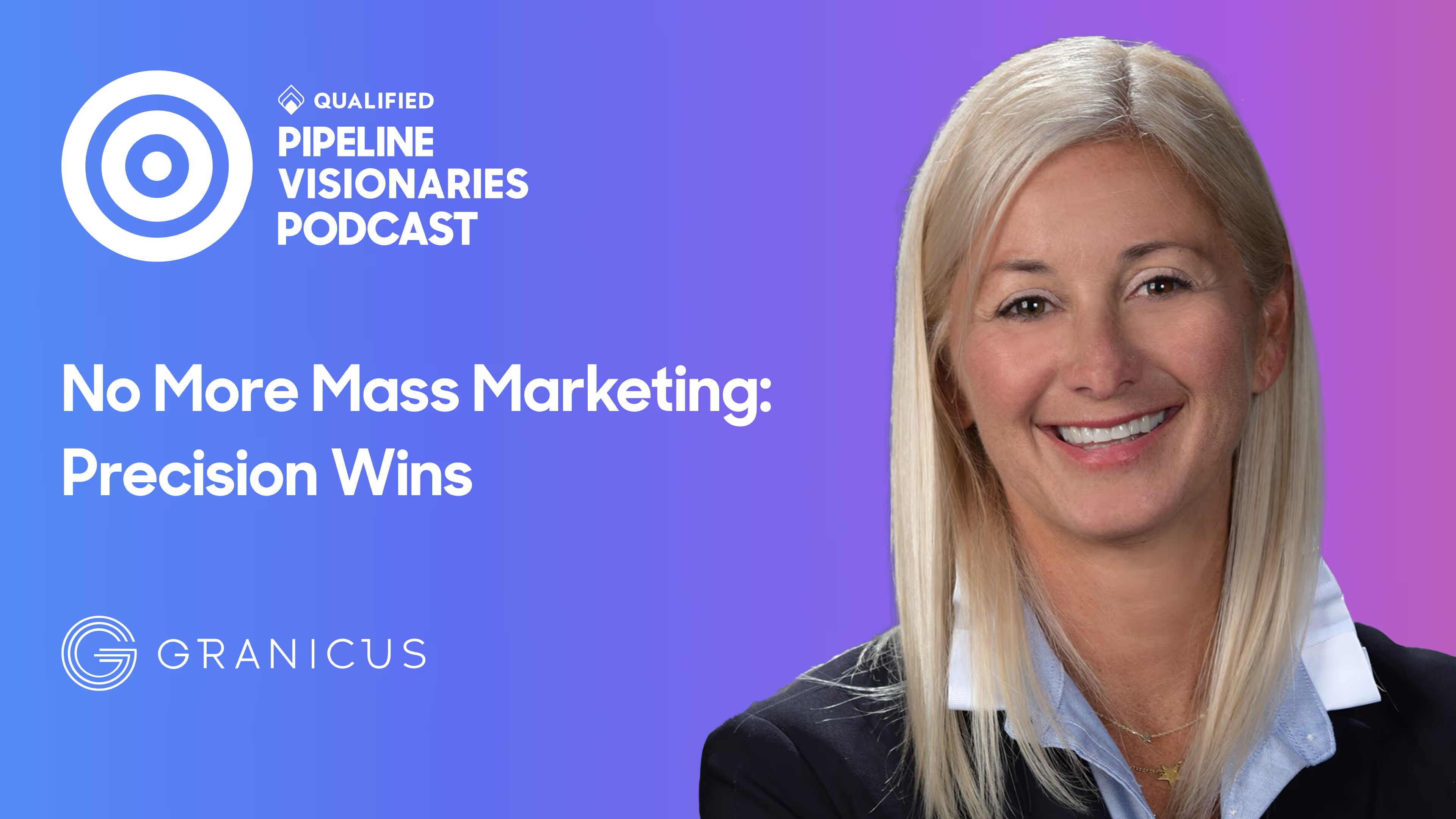
By 2025, Behrens was speaking plainly about AI. Granicus used AI-enabled tools to analyze historical data, current intent, engagement patterns and online behavior. Predictive lead scoring helped prioritize prospects. Automation handled routine outreach and follow-up. A virtual agent directed website visitors toward relevant information.
Her most memorable comparison was between this approach and mass marketing, where a team could throw a message into the world and hope someone called. The new model was narrower: read the behavior, customize the experience and reach a prospect when readiness was visible. Precision was not merely cheaper distribution. It was a way to stop wasting the buyer's attention.
There is a tension here, and Behrens's language helps resolve it. The tools are predictive; the message remains empathetic. AI can suggest who may be interested and when. It cannot decide what a permit delay feels like, why a public-records request matters or how a city employee experiences one more disconnected system. The technology improves timing. Public-sector fluency supplies meaning.
“We're reaching them when they're ready.”Suzanne Behrens, on leaving the wide net behind
Her colleagues' descriptions fill in the leadership style behind the model. A former Microsoft colleague recalled a general manager willing to question senior decisions that did not make sense for her business, yet capable of aligning a team around the larger objective. The same account describes someone who removed roadblocks, encouraged risk-taking, recognized individual work styles and gave credit freely. The picture is of a leader who could challenge upward while creating room below.
Another recommendation emphasizes fairness and magnanimity, two words rarely invited into a revenue forecast. Behrens set a high standard, the colleague wrote, while protecting morale, recognizing achievers and respecting life beyond work. These details make the operating doctrine more credible. Shared goals can focus people, but only trust lets them expose bad data, question a campaign or admit that a buyer is not ready. Precision begins with software signals. It depends on a team willing to tell the truth about them.
The recognition she received in Washington's technology community fits this practical profile. DCA Live included her among its 2023 Star CMOs, little more than a year after she joined Granicus. Yet her public commentary seldom dwells on the award. She talks about common objectives, useful content, customer self-discovery and the work of keeping messages consistent. It is the vocabulary of an operator who regards applause as a pleasant interruption between planning meetings.
That matters because shared accountability can become a slogan with sharper teeth for junior employees than for executives. Behrens's version began at the top. Sales and marketing leaders owned the same outcome. The departments did not merely attend more meetings; they accepted the same consequence.
The title ended. The footnotes continued.
Early in 2026, after nearly four years at Granicus, Behrens announced that she would retire at the end of March. She wrote about milestones and growth, but lingered on the people. What she expected to remember most was the collaboration, energy and shared belief that the work mattered.
Her summary of the Granicus chapter was specific. The company had launched programs, products and solutions; acquired companies; moved from point-product selling toward solutions and outcomes; and changed how it went to market. The list reads like a CMO's departing inventory. Her next sentence made it human again.
Retirement, in her telling, meant more time with family and room for adventures and opportunities. It did not mean silence. Around the same period, she published essays on why successful teams require intention, why sales-marketing alignment is a growth engine and why a GovTech company might bring in a fractional CMO. The corporate role stopped. The pattern recognition remained available.
There is an instructive echo in the dates. Her earlier LinkedIn articles appeared in January 2015, when she wrote about marketing resolutions and the expansion of Proven Outcomes. Eleven years later, the subjects had moved from building an agency to building an aligned organization. The connective tissue is execution. In both periods, strategy is valuable only when somebody turns it into an operating plan, assigns responsibility and watches what happens next.
The fractional-CMO argument is a fitting coda. A growing company may not need another permanent title, she wrote, but it may need experienced help connecting marketing to revenue, clarifying its position or entering the public sector. Sometimes the missing ingredient is not more resources but the right experience at the right moment. After a career devoted to meeting buyers where they are, Behrens had found the same formulation for leadership itself.
Her public story offers no grand reinvention. It offers repetition, in the best sense: public-sector technology, customer outcomes, aligned teams, useful data, humane messages. Across a giant, a consultancy, a small technology firm and a GovTech platform, she kept returning to the same proposition. Understand the person on the other side. Share the number inside. Make the institution's boundaries less visible to the customer.
That is not a bad legacy for a marketer in an industry crowded with abstractions. Government technology can become a thicket of systems and procurement language. Behrens spent three decades insisting that somewhere beyond the dashboard is a citizen or public servant trying to get something done. The best campaign, like the best government service, should help them get there with less friction.