The Startup Teaching Governments to Read the $20 Trillion They Can't See
Most financial crime hides in plain sight, scattered across the open web. IVIX built an AI platform that reads all of it at once - and hands governments a map.
There is a market bigger than the economy of almost any country on Earth, and no government keeps a ledger for it. Economists put the global shadow economy - the untaxed, unreported, and illicit activity moving beneath official statistics - at roughly $20 trillion a year. It is not one thing. It is a landlord who never declared three short-term rentals, a seller running six storefronts under different names, a trader moving money through wallets that were never supposed to point back to a person. Each piece is small. Together they are enormous. And almost all of it is visible, in fragments, on the open internet.
IVIX is a company built on that last observation. Founded in 2020 and headquartered in New York, it sells an AI platform to the people whose job is to find that money - tax authorities, financial regulators, and law enforcement agencies. The pitch is not that IVIX has secret access to hidden data. It is the opposite: the data is already public. What has been missing is a way to read all of it at once, connect the fragments, and put a name to the activity behind them. In August 2025 the company closed a $60 million Series B, bringing its total funding to $85 million and giving the idea a serious balance sheet.
01 / What it doesReading the open web as one document
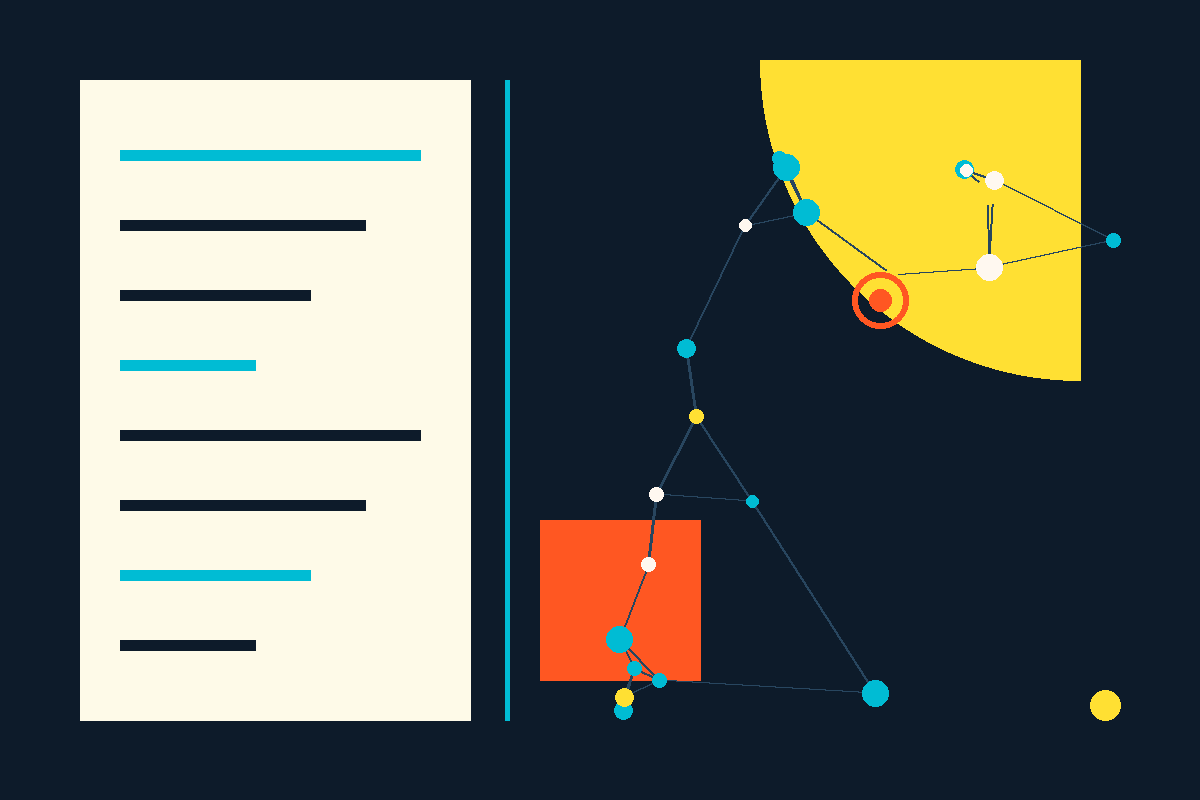
The core product is an OSINT platform - short for open-source intelligence, meaning information gathered from publicly available sources rather than surveillance or subpoena. IVIX combines two technologies that have matured at the same time. Large language models do the reading: scanning listings, marketplaces, corporate filings, and blockchain records, and pulling structure out of messy text. Graph analytics does the connecting: treating every entity, wallet, address, and transaction as a node, then drawing the edges between them until a network appears.
The result is a map. An analyst can start with a single anonymous crypto wallet and watch the platform attribute it to an individual, trace its activity across platforms, and surface income that was never reported. The same approach works on a host renting properties across several booking sites, or a business whose real revenue is spread across accounts that were never meant to be read together.
What makes the approach hold up is that none of it depends on a single tell. A username reused across two marketplaces, a shipping address that appears in an unrelated filing, a wallet that cashes out through a known exchange - individually, each is circumstantial. Stacked and cross-referenced by the graph, they harden into something an investigator can defend. The platform is less a search engine than a corroboration engine, and that distinction is what separates a hunch from a lead a prosecutor will accept.
The pipeline in four moves - from scattered public fragments to a lead an investigator can act on.
02 / Who uses itA business that only sells to governments
IVIX runs a business-to-government model. Its customers are public agencies in North America, Europe, and Asia, and the company says they have collectively uncovered more than $1 billion in previously hidden business activity. That number is the closest thing the company has to a scoreboard, because its work is largely invisible by design - the point of a tax investigation is not the software that found the lead.
The customer profile shapes the product. Governments need tools that integrate with the systems they already run, and they need assurances about how data is handled; IVIX holds an ISO/IEC 27001:2022 information-security certification and is listed on the Microsoft commercial marketplace. It is a slower, more deliberate sale than consumer software, but a durable one: agencies do not switch enforcement tools casually.
03 / The peopleFrom cyber intelligence to the tax office
The company was founded by Matan Fattal, its chief executive, and Doron Passov, its chief product officer, both with backgrounds in mathematics. Fattal previously co-founded the cybersecurity firm Silverfort, helped build large-scale products at Intucell before its acquisition by Cisco, and served in Israel's 8200 intelligence unit. That lineage matters: mapping illicit financial networks is, structurally, close to the work of mapping adversaries in cyber defense.
What gives IVIX credibility with its buyers is the enforcement experience it has folded in. Among its executives is a former chief of IRS Criminal Investigation, the law-enforcement arm of the U.S. tax agency. It is one thing to build software that finds patterns; it is another to know which patterns a prosecutor can actually use. That combination - intelligence engineering on one side, enforcement instinct on the other - is the company's real moat.
04 / The moneyTwo rounds, one thesis
IVIX raised a $12.5 million Series A in 2023 and the $60 million Series B in 2025, led by Monaco-based O.G. Venture Partners with participation from Insight Partners, Citi Ventures, Team8, Disruptive AI, Cardumen Capital, and Cerca. The presence of a bank's venture arm and a security-focused foundry is telling - these are investors who understand both the regulatory tailwinds and the sensitivity of the work.
05 / The edgeDifferent from Palantir, different from Chainalysis
IVIX sits near several well-known names without directly overlapping any of them. Palantir built its business helping organizations make sense of their own internal data. Chainalysis, TRM Labs, and Elliptic specialize in tracing activity on the blockchain. IVIX's bet is broader and, in a sense, simpler: focus on open-source data across the entire shadow economy, not a single asset class and not an agency's private records. Crypto is one input among many, alongside rentals, marketplaces, cash businesses, and corporate structures.
The timing helps. By 2028, dozens of jurisdictions are due to implement the OECD's Crypto-Asset Reporting Framework, a mandate that turns "we should probably track this" into "we are legally required to." IVIX built the enforcement tooling before the deadline arrived - a positioning that looks less like luck than like a thesis about where regulation was always going.
06 / What people can do with itTurning noise into a case
For an agency, the practical value is leverage. A tax authority has finite investigators and near-infinite potential leads; most of the shadow economy stays hidden simply because no one has the hours to reconstruct it by hand. IVIX compresses that reconstruction. The company reports 99% accuracy in identifying the entity behind hidden activity and 97% accuracy in detecting non-compliance - numbers that, if they hold in the field, change the economics of an investigation. An analyst spends less time gathering and more time deciding.
It also changes the economics of hiding. The shadow economy has always relied on friction - the assumption that no one will connect the fragments because connecting them costs too much. Automate that, and the calculation flips. You do not need to catch everyone; you need to make being caught plausible enough to change behavior. That is the quiet argument beneath IVIX's product: enforcement at scale is a deterrent, not just a recovery tool.
07 / Where it fitsA market defined by mandates
IVIX operates in a market that grows every time a government writes a new reporting rule. Crypto is the obvious near-term driver, but the same machinery applies wherever value moves through public channels and someone is legally required to account for it. The company's reported annual revenue - roughly $7.3 million against $85 million raised - suggests it is still early in converting that opportunity, which is precisely what a Series B is for. The wager investors made is that the gap between what governments are owed and what they can currently see is wide, durable, and finally addressable with the tools that arrived this decade.
There is a broader shift underneath the specific product, too. For decades, financial investigation ran on tips, whistleblowers, and the slow work of following one thread at a time. The volume of public data has since outgrown any manual method - too many platforms, too many identities, too much churn. IVIX is one answer to that mismatch: not more investigators, but a way for the ones you have to see further. If the model works, the interesting question is not whether governments adopt it, but how quickly the shadow economy adapts once being unread stops being a safe assumption.
Whether IVIX becomes the default layer for financial-crime detection or one strong option among several, its founding insight is hard to argue with. The shadow economy is not invisible. It is unread. IVIX is a company built entirely on closing that distance.