Before Superside sold enterprise creative capacity, it sold nerve. Its founders put up a website in 2015 promising to handle nearly any business task that could be done through a browser. Customers could order a polished presentation, research, translation, data entry, a landing page or whatever else arrived before lunch. The website worked before the company did. People found it, clicked buy, and left the founders scrambling through Upwork and Fiverr to assemble a delivery team.
One early assignment involved a handful of people staring at Google Maps and measuring British rooftops for a solar company. It is a wonderful startup image: ambitious Norwegians, no real technology, several strangers online and a ruler pointed at suburban England. The business was called Konsus, a made-up word chosen partly because the domain was free. CEO Fredrik Thomassen later admitted he did not know what it meant either.
The improvisation produced growth and a place in Y Combinator's Winter 2016 batch. It did not produce a durable business. The marketplace was broad, the back end was manual, and every novel request created a new miniature operation. Retention was weak. Few customers arrived by word of mouth. The company burned through much of its early funding trying to scale too many categories at once.
“We were just chasing the moment... trying to get growth, however we wanted.”Fredrik Thomassen, co-founder and CEO
The first thing to fail was retention
This is the useful part of the Superside story because the correction was not cosmetic. Around late 2018, the founders made three linked decisions: go all in on design, switch from one-off jobs to subscriptions, and build around mostly full-time creative people instead of an opportunistic freelancer pool. In 2019, Konsus became Superside. It stopped being the internet's willing assistant and became an extension of in-house marketing and creative teams.
The change solved a quiet problem that lives inside sophisticated companies. Amazon, Microsoft and Salesforce have designers. They also have quarterly campaigns, localization, landing pages, executive decks, product launches, social variants and requests that multiply faster than headcount. A traditional agency can supply a campaign, but procurement, briefing and markups make small production jobs awkward. Freelancers are flexible, but the client must source, direct and quality-check them. Hiring is slow and turns peak demand into permanent payroll.
Superside's answer is elastic capacity with memory. A customer submits a brief, brand guidelines and preferences. A project manager assembles the right mix of designers, writers, motion artists, strategists or specialists. The work moves through Superspace, the company's collaboration and project-management layer, where estimates, milestones, budgets, approvals and brand context live. Over time, the assigned team is supposed to get faster because it has learned the account. That accumulated context is the difference between a subscription and a parade of strangers.
The price reveals the customer
There is nothing ambiguous about Superside's current floor. Flex subscriptions begin with a $15,000 monthly creative budget on a 12-month commitment. Superspace adds a fixed $1,000 monthly software fee. Dedicated AI-Native Teams start at $30,000 a month, plus the same fee. A faster three-week onboarding called Quick Start costs $20,000. Planned project boosters begin at $15,000.
At the minimum, the first-year commitment is $192,000 before extra work. That is expensive compared with a freelancer and comprehensible compared with an agency roster, several hires and an internal project manager. Unused Flex budget can roll over for three months, which softens seasonal demand. It does not rescue a buyer whose creative queue is fundamentally occasional.
This is where the conditions matter. Superside works when briefs are continuous, skills vary from week to week, several markets need versions, and internal leads spend too much time coordinating production. It fails the value test when a company needs a logo, six social posts and silence until next quarter. The annual term is a feature for Superside's staffing model and a liability for an uncertain customer.
Good fit
- A queue that rarely empties
- Many formats, markets or brands
- Strong internal direction, thin production capacity
- Enough volume to reuse brand knowledge
Wrong fit
- Occasional one-off requests
- Month-to-month budget uncertainty
- A buyer who wants one named freelancer
- An in-house team with spare capacity
AI moved into the plumbing
Superside now describes itself as AI-first, but the more credible claim is operational rather than theatrical. AI helps teams explore concepts, remove repetitive production steps, localize work and create brand-consistent starting points. Humans still interpret the brief, choose directions, refine output and take responsibility for the result. The company says more than 90 percent of its creatives are AI-certified and more than 5,000 AI-powered projects have been completed.
Brand Models are a good example. Superside curates customer assets into custom image models for branded photography, illustration, products, packaging, characters or 3D-style visuals. Customers can use them through Superspace, Figma and FigJam. The promise is not that a prompt replaces a studio. It is that a reusable model gets the studio past the blank canvas and keeps visual ingredients closer to brand rules.
Superads attacks the other end of the process. Launched in November 2024, it connects paid-social accounts and presents creative performance across Meta, LinkedIn and TikTok in a visual form meant for both performance marketers and creatives. In 2026, Superspace added account analytics, consolidated project plans, Brand Brain, Agents and planned workflow Apps. The direction is clear: store the brief, store the brand, automate repeated moves, then feed performance back into the next piece of work.
Those numbers require care. The 94 percent return and six-month payback come from a Forrester Consulting study commissioned by Superside and modeled on a composite organization. They describe the study's scenario, not every customer's invoice. The more durable achievement is structural: Superside has turned a labor-heavy service into something that can be bought, budgeted and managed with some of the predictability associated with software.
A rebrand as an internal audit
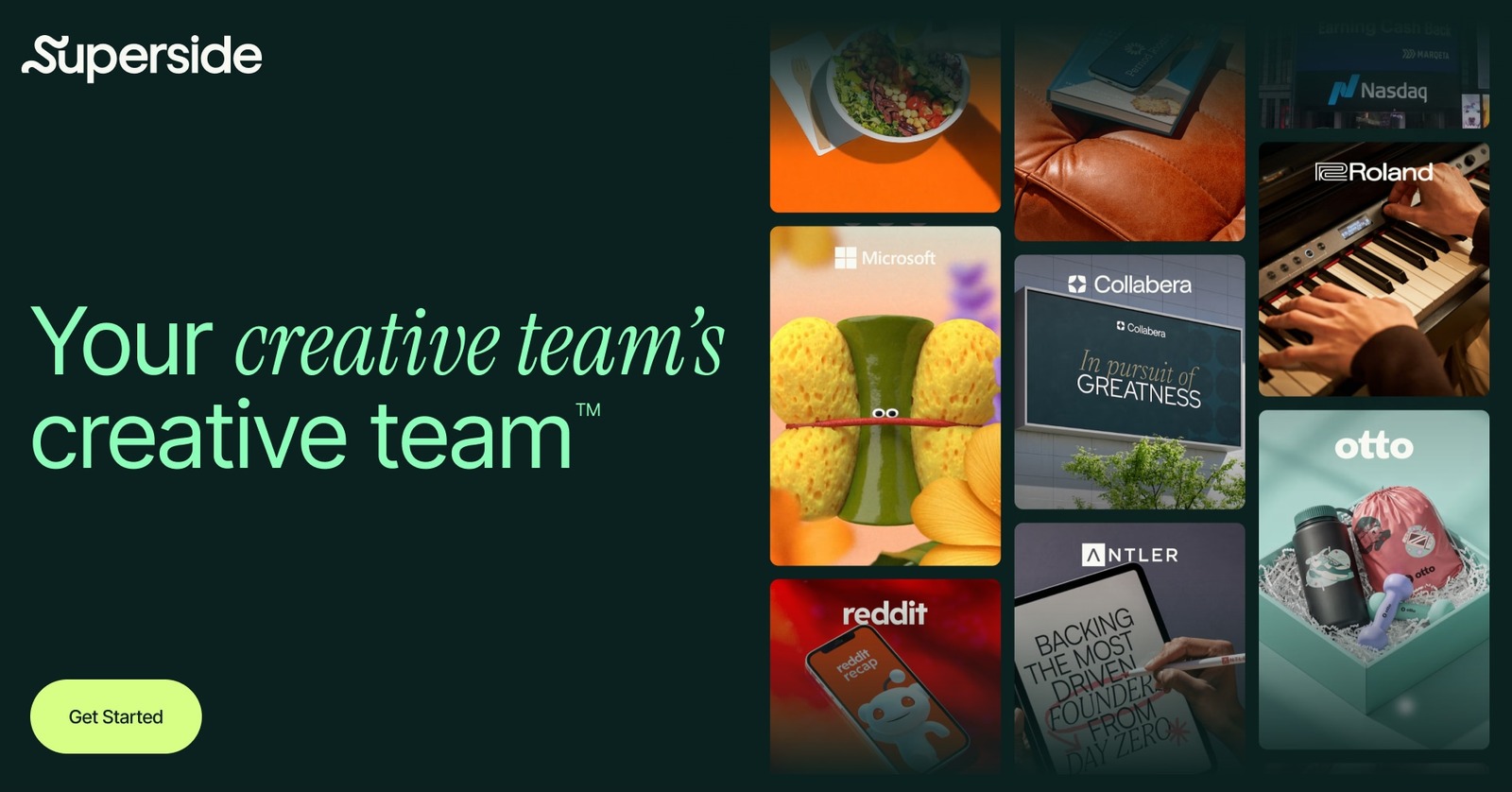
In 2025, Superside became its own conspicuous customer. CMO Jen Rapp, who had first hired Superside while leading brand work at Klaviyo, oversaw a complete repositioning toward enterprise and AI. The company interviewed more than 200 marketing, brand and creative leaders, developed concepts in weekly rounds, used AI for high-fidelity exploration and wrote brand-voice rules that could be used by a company-wide GPT.
The exercise was partly proof and partly necessity. An identity built for a scrappy design subscription no longer matched a company selling strategy, software and custom models. Superside reported its best sales quarter after the launch and said 90 percent of its third-quarter pipeline was enterprise. The figures are company-reported, but the decision itself tracks the business: move farther from commodity production and closer to the planning, systems and accountability that justify an enterprise contract.
Konsus launches with design, data entry, research, translation and assorted online tasks.
Weak retention and too many bets push the company toward design-only subscriptions.
A new name accompanies a premium, enterprise-focused operating model.
Prosus Ventures and Lugard Road Capital back expansion at a reported $400 million-plus valuation.
Brand Brain, Agents and workflow automation deepen the Superspace layer.
What another operator can copy
The copyable idea is not “hire hundreds of designers.” It is the sequence. Start manually enough to understand the customer's ugly work. Watch what repeats and which buyers return. Cut the categories that create novelty without retention. Package the recurring work into a budget customers can plan. Build software around the coordination bottleneck after the process is visible. And keep a clear boundary between the customer's core team and the capacity being added.
Superside's original breadth was useful research disguised as chaos. Measuring roofs was not a scalable service, but saying yes exposed where willingness to pay lived. The founders changed their minds when the business data became embarrassing: retention was soft, referrals were scarce, cash was disappearing and investors were unimpressed by 50 percent annual growth from an undifferentiated marketplace. Design produced deeper, repeatable relationships. The company followed that evidence.
Today, Superside sits between agencies, staffing and software. Design Pickle, Designity, Penji, Kimp and Flocksy compete on subscription creative services. Upwork and Fiverr offer cheaper control for teams willing to manage talent. Canva, Adobe and generative tools let internal teams produce directly. Traditional agencies remain credible for high-stakes strategy and campaigns. Superside's place is the middle layer: more managed than a marketplace, more elastic than hiring, broader than a single tool and more standardized than an agency relationship.
That position is defensible only while the service remembers more than the customer has to repeat. If every brief begins at zero, the software fee is decoration. If brand models drift, the AI layer creates review work instead of removing it. If demand dries up, the annual contract feels like rent on an empty studio. Superside learned once that being willing to do everything is not the same as being needed. Its current model works because, for a specific kind of overcommitted enterprise team, the queue really never ends.