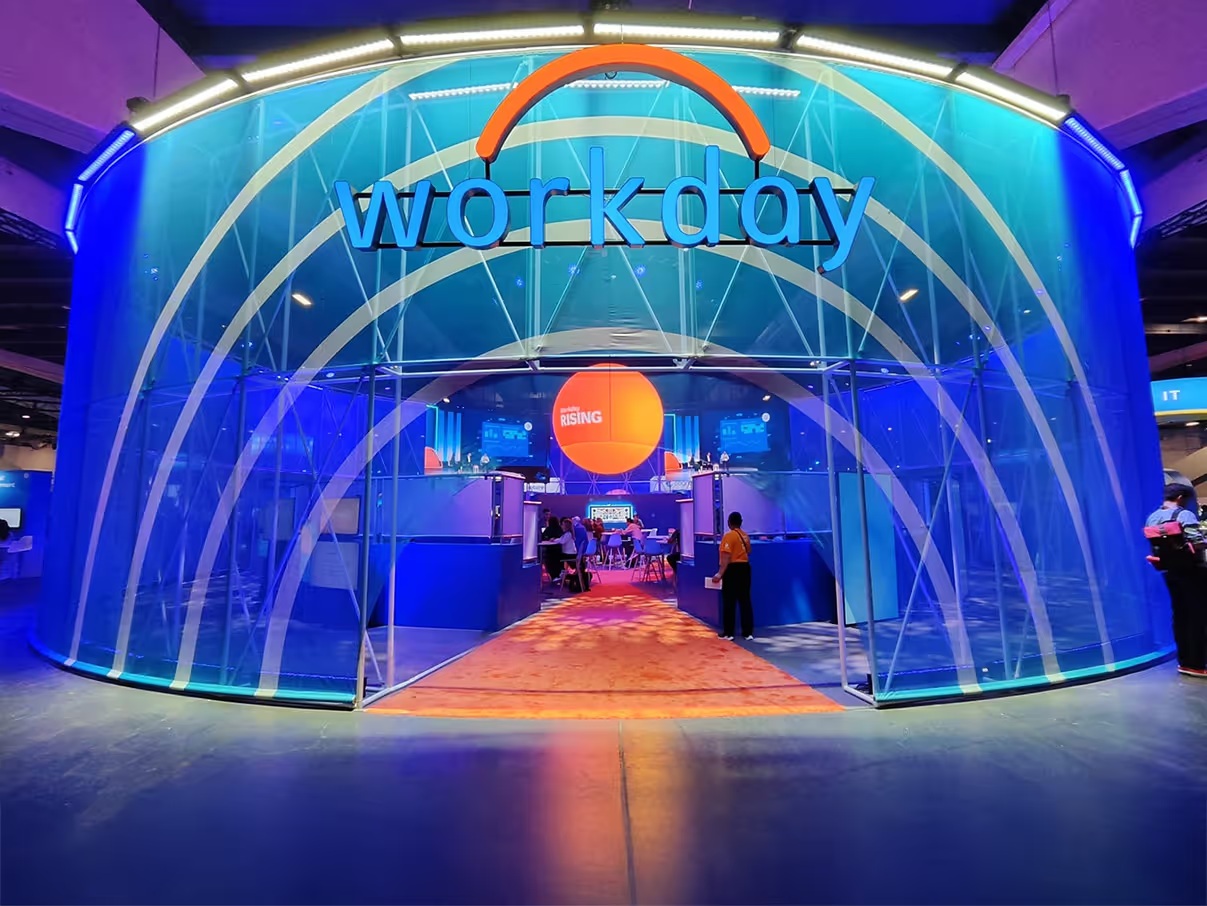
The orange carpet goes straight through the middle. Above it, a blue enclosure curves around the Workday name, turning an exhibition stand into something closer to a room. In Super Color Digital’s portfolio photograph, visitors are already inside. The image looks effortless in the particular way that a finished installation can: all the awkward questions have disappeared behind the surfaces.
How does it travel? What holds it up? Will the graphics meet at the right place? A visitor has little reason to ask. For the people making the display, those questions are the job. Looking at this photograph, it becomes easier to understand why a business classified under printing might employ metalworkers, prepare structural calculations, and offer to take the whole thing apart again.
A room that began as a file
Super Color Digital produces large-format graphics and the physical systems that carry them: fabric walls, illuminated frames, custom signs, exhibit structures, and digital displays. Its customers occupy the places where brands meet people in person. Think dealerships, shops, convention halls, corporate interiors, and casinos. A casino graphic and a showroom wall have different practical demands, but both must fit a real surface.
The company dates its beginnings to 1981 and describes its origins as a one-hour photo lab. Today, its listed production locations are Irvine and Las Vegas. Peyman Rashtchi is identified as founder and CEO; Arman Rashtchi runs operations as COO. The distance between a photo print and an exhibition environment is considerable. The continuity is the task of making an image exist outside the camera or computer.

There is a useful business idea here. Follow an image beyond the point at which it leaves the printer and more jobs appear. It needs a structure, a finish, a destination, and somebody who knows how to install it. Super Color Digital has built its service offering around that longer journey. Its stated mission emphasizes speed, precision, and consistency - practical virtues when several materials must arrive looking like one campaign.
The little puzzle before the big print
One unusually concrete clue comes from prepress. In a January 2022 announcement, equipment and software supplier EFI reported that Super Color Digital technical specialist Hossein Rasoulian had cut time spent nesting jobs by 50% using Fiery Prep-it. Nesting is the layout task of fitting shapes together on material before production.
“It can nest irregular-shaped jobs very quickly and uses media extremely efficiently.”
Hossein Rasoulian · Technical specialist
Quoted by EFI, January 2022
Indexed comparison from the reported reduction. This measures nesting time, not total production time or cost.
The distinction matters. Halving one step does not halve the whole factory’s workload. Still, the example suggests a useful habit for anyone running production: measure the small tasks surrounding the expensive machine. An improvement can hide in the arrangement of shapes long before ink touches material.
Color introduces another set of small tasks. Super Color Digital describes a prepress process involving Pantone matching, material profiles, calibration, and physical proofs. Fabric, vinyl, acrylic, and illuminated graphics require different preparation. Its team adjusts files for the material and output method, including details such as trimming allowances and cut paths. A brand guideline can name a color; producing a coordinated room requires considerably more information.
The frame has a longer memory
Consider a dealership preparing for another vehicle launch. The campaign changes, but the wall remains. Super Color Digital’s automotive offering includes silicone-edge graphics, usually shortened to SEG: printed fabric with an edge strip that fits into an aluminum frame. The fabric can be replaced while the compatible frame stays in service.
That creates two purchasing horizons. The structure belongs to the life of the space. The printed image belongs to the life of the campaign. A buyer can plan for both instead of treating each seasonal change as an entirely new construction project. The company’s 2021 discussion of SEG frames also describes several mounting approaches, from fixed hardware to magnetic and suspended installations.
Structural hardware
Campaign message
Design the next update into the first installation.
For events, the same thinking appears in beMatrix modular frames. Super Color Digital combines the aluminum system with fabric graphics, rigid panels, and LEDskin displays. Reconfiguration gives a structure more possible assignments. The appeal depends on what the next assignment actually is; a reusable component earns its keep when it can be used again.
The company also rents exhibit frames, with delivery, installation, dismantling, and on-site support. Rental deserves attention when a team needs a temporary structure and has little appetite for storing it afterward. For a recurring program, ownership may warrant comparison. The useful question is how each arrangement fits the calendar, the available storage, and the changing footprint.
A printer with a paint booth
The manufacturing menu helps explain where Super Color Digital sits in the market. CNC routing, laser cutting, welding, thermoforming, and custom metalwork put it in the territory shared by sign fabricators and exhibit builders. Its finishing work includes surface preparation, paint, coatings, and assembly. An architect or experiential designer can bring a problem that extends beyond a printable rectangle.
A retail example on the company’s blog describes a Timberland YB Shrine display and a coordinated Icon Wall. The project brought graphics and structural elements together to present the boot’s heritage inside a store. It is a useful example of the assignment: create a physical setting around the product, with components that can be produced for a retail rollout.
The current offering also includes Massivit 3000 large-scale 3D printing for props, replicas, dimensional signs, and prototypes. Printed objects can be sanded, painted, reinforced, or incorporated into fabricated structures. The paint booth matters because an object’s shape is only part of its finished appearance. A printer can produce a form; people still have to prepare it for public view.
For moving images, the company offers indoor LED video walls for purchase or rental, including 1.9 mm and 2.5 mm pixel-pitch options. Its services extend to content formatting and technical support. This gives a project team another surface to work with, although a video wall brings its own decisions about viewing distance, access, and ongoing content. A screen creates work after installation, too.
The price includes the unphotogenic parts
Super Color Digital’s commercial model is business-to-business project work, supplemented by display equipment sales and rentals. The meaningful purchase is the agreed scope: what gets designed, manufactured, packed, delivered, and installed. Comparing two proposals is much easier when those responsibilities are written down in the same way.
Its fulfillment service includes protective packaging, custom crating, inventory storage, and kits organized by location or campaign. For a retailer updating several stores, the distinction between one large shipment and correctly sorted location kits has practical consequences. Store teams need their own components, not a puzzle whose missing pieces have gone to another city.
Installation planning starts with site surveys, layout checks, and venue coordination. Removal includes disassembly, labeling, and packing for reuse. These details explain why the print price alone is an incomplete buying guide. They also identify potential trouble early: inaccurate site information or an unsuitable mounting plan can undermine a project before anyone judges its image quality.
The business has attracted capital for expansion. In 2015, a Graycliff-controlled entity acquired Super Color Digital in a recapitalization that replaced Brookside’s controlling position. The transaction adviser described a plan to broaden the customer base and pursue acquisitions alongside management. That history places the company within an established commercial production market, where equipment, operating capability, and customer relationships matter.
Start with the room, then send the artwork
For a prospective customer, the practical first step is to describe the setting as carefully as the desired image. Supply dimensions, photographs, the installation date, venue restrictions, and whether the structure needs another life. Ask for the proposal to separate production, freight, installation, removal, and storage. Those questions follow directly from the range of work the company offers.
The integrated approach is especially relevant when a job crosses materials and locations. A simple graphic order may need fewer services; an indoor LED system needs to remain within its specified operating conditions. The right amount of coordination depends on the assignment. Back at that Workday photograph, the orange carpet looks wonderfully straightforward. Someone had to make the rest of the room ready for it.
Explore the work
Visit the company website, browse the project portfolio, or read the retail display blog. Follow LinkedIn, Instagram, Facebook, and X. Watch the company’s YouTube channel.