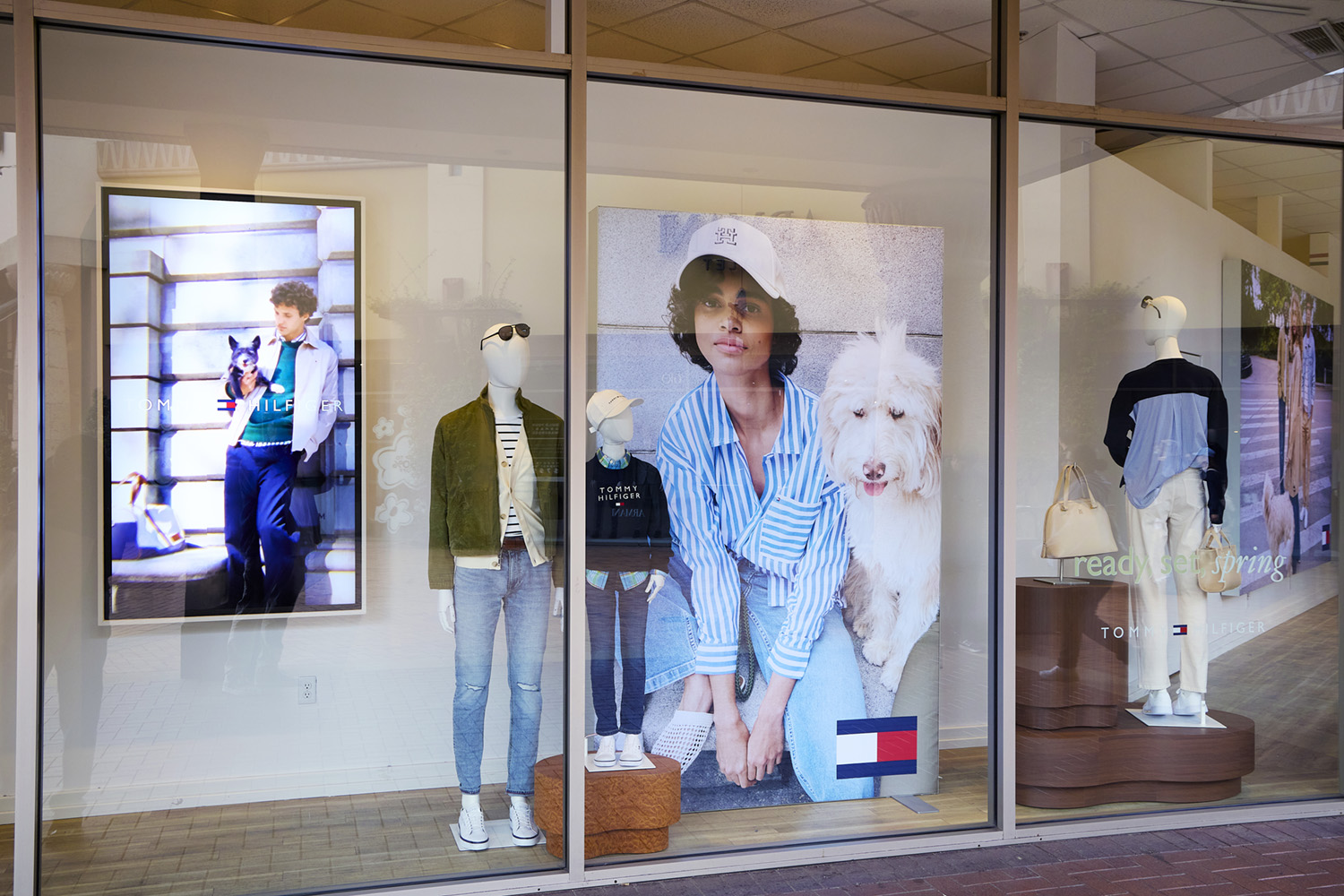
The wood in a shop window has a job. It must suggest a certain kind of life: considered, comfortable, perhaps slightly better organized than your own. Whether it needs to have grown on a tree is a separate question. For one Tommy Hilfiger campaign, Image Options answered that question two different ways.
The flagship treatment used wood veneer. For the wider rollout, the production team photographed the actual finish and reproduced it in print. A visual idea could travel without taking the same materials everywhere. That small distinction is a useful introduction to Image Options, a California company whose work begins where a handsome design starts making demands on the physical world.
Think of the distance between approving a picture and opening a store. Someone must choose the substrate, build the fixture, check the color, pack the pieces, and get them installed. Image Options sells work across that distance. Its customers include retail brands, exhibition teams, architects, and businesses commissioning interiors. They are buying something that has to exist at a particular place and time.
One look, two ways to build it
The company’s account of Tommy Hilfiger’s Spring 2025 campaign describes hand-finished plaster walls, curved details, lighting, and mannequin plinths. A printed-styrene prototype gave way to wood veneer for the premium version. Image Options produced 98 plinths for nine flagship stores in the United States and Canada. For 164 additional locations, it made 940 lighter Kemi e-flute podiums carrying the reproduced wood finish.
The interesting choice was to preserve the appearance while changing the construction. In a rollout, identical specifications and consistent presentation are different goals. Treating them as interchangeable can make the production brief needlessly expensive.
Same campaign. Different construction. Counts describe different display types, not equivalent units or a savings calculation.
This is also a better way to think about cost. Start with the complete journey: material, fabrication, packing, shipping, handling, and installation. A material decision changes more than the invoice from a supplier. Lighter components can change the work required downstream. Image Options explicitly offers retail packouts as well as fabrication, making delivery part of the service rather than a problem left at the factory door.
There is a condition attached to the lesson. A printed surface must still suit its viewing distance, handling, and intended life. A technique that serves a seasonal window may be wrong for a permanent fixture that customers touch all day. The useful question is what the object must do once it leaves the photograph.
The mirror that changed the material
Another project began with an awkward request: an oversized, custom-shaped infinity mirror. The client wanted an uninterrupted surface. Image Options initially ran into material-size limits and proposed alternatives, including a sectional construction. The client preferred the continuous mirror.
Engineers Jeff Veta and Dan Fandel explored oversized acrylic and films. Availability, shipping, and budget complicated the options. Testing eventually made glass the practical choice over cast acrylic. The first thing to fail was the original material assumption, not a mirror dramatically shattering on the shop floor.
The finished installation weighed approximately 400 pounds. Its assembly combined mirrors, one-way film, and lighting, with supporting infrastructure designed around that weight. The team used a printed stencil and laser levels during mounting. These are wonderfully unglamorous details for an object intended to suggest infinity.
Infinity, meet the wall bracket.
THE EDITOR’S NOTEBOOK
Image Options’ account makes a distinction that anyone commissioning an object should remember: a digital model can reveal problems, but physical engineering introduces its own. The practical takeaway is to give testing permission to change the specification. If the material is fixed before its availability, optical performance, and installation have been examined, the team has fewer useful moves left.
A hospital runs on a different clock
At Baylor Scott & White Health’s Frisco campus, Image Options worked with architecture firm Corgan for more than two years. The scope included dichroic plexiglass chandeliers inspired by the health system’s cross logo, a 20-foot lenticular wall, privacy graphics, and graphics across walls and ceilings. The wall reveals the message “We Are One.”
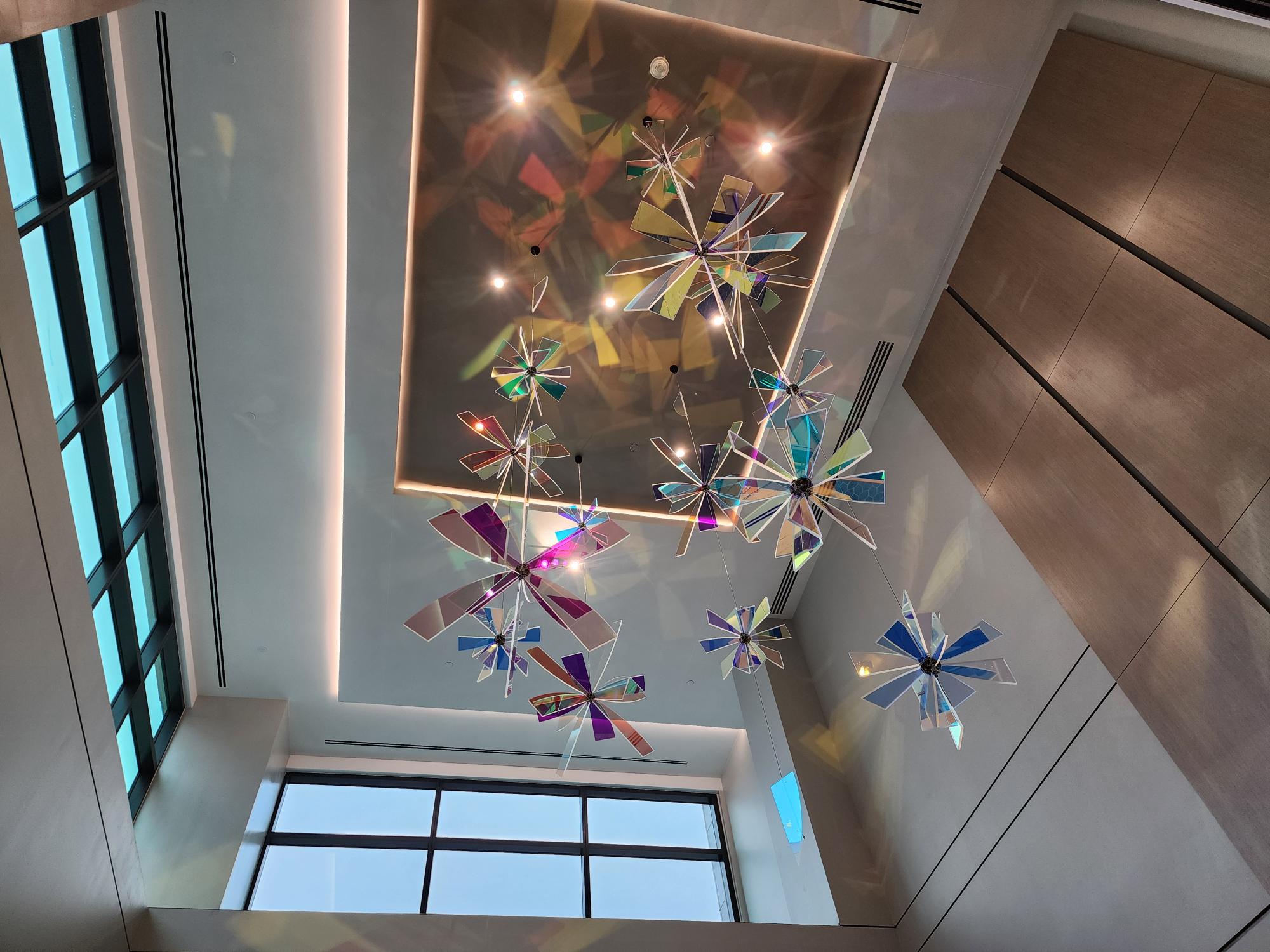
Here, the company describes phased installation around construction and hospital operations, alongside prototyping and material testing. Coordination included the architects, hospital stakeholders, and contractors. A healthcare interior asks for more than an appealing finish; the finish has to belong to a building with ongoing operational demands.
That helps explain the company’s place in the market. A customer can separately hire a printer, a fixture maker, and an installer. Image Options combines those capabilities with engineering and design support. The potential advantage is fewer gaps between the people deciding how something should look and those responsible for making it stand up. It is especially relevant when the job crosses several trades.
For simpler work, that breadth may be unnecessary. A straightforward graphic with a settled specification presents a different purchasing problem from an architectural installation. The sensible fit depends on how many unresolved production questions come with the brief.
Buying the people who draw the first line
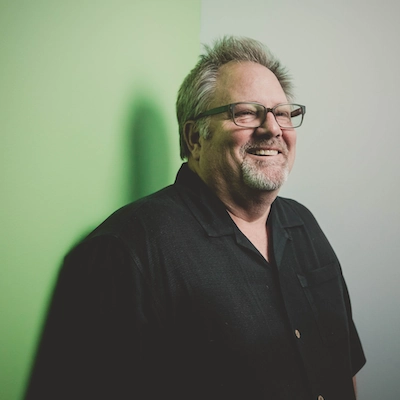
Tim Bennett and Brian Hite founded Image Options in 1999. Its current leadership page lists Bennett as chairman and chief client advocate, Hite as principal and cofounder, and Barry Polan as CEO. Polan took the chief executive role in May 2024 after joining the business in 2020.

Cofounder
Cofounder
In April 2025, Image Options acquired SPMD, a Los Angeles design and fabrication studio. The announcement said SPMD would continue as a division, leading creative, design, and experiential work. The logic is easy to follow: bring more of the initial creative work into a business already equipped to produce it.
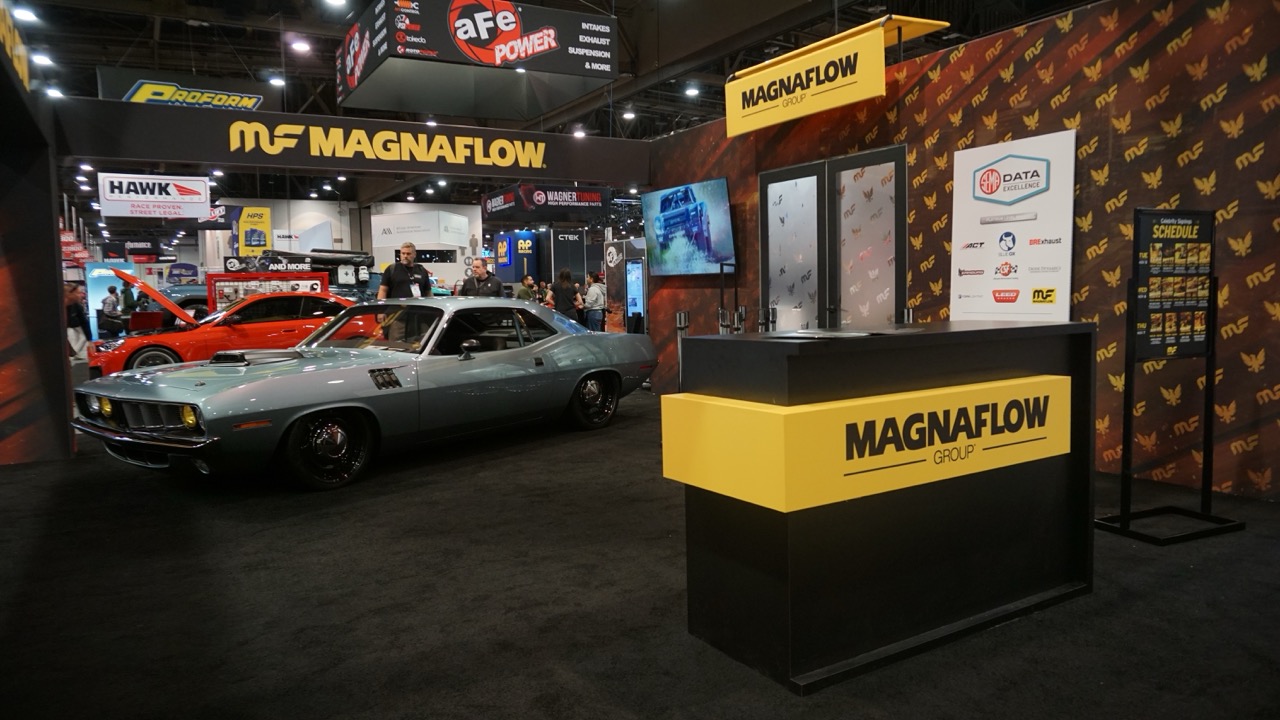
The business model remains concrete. Customers commission projects and campaigns, obtaining quotes for the work involved. Repeat seasonal programs can extend a relationship beyond one installation. This is a service and manufacturing business, with expertise expressed in finished objects rather than access to a software subscription.
The company’s culture statements are unusually direct about economics. Alongside promises about respect, community, and environmental responsibility sits “Profit Is A Good Thing.” In July 2024, it announced senior promotions for Catina Talamantes and Marisa Sedlak, each with more than a decade at the business. That is a specific glimpse of internal continuity in a company selling experienced coordination.
The useful part to steal
Image Options’ published sustainability program includes small test batches before large jobs, reducing rework, improving departmental communication, and getting more use from materials. These are production habits a reader can recognize and borrow. The company reports Sustainable Green Printing Partnership certification, framing improvement as an ongoing process.
- 01 / QuestionIdentify the appearance and function that must survive.
- 02 / TestCheck materials before committing to volume.
- 03 / CoordinateResolve transport, mounting, and site conditions.
- 04 / ProduceBuild and deliver the approved solution.
A buyer can make those habits easier to apply. Bring the budget into the first conversation. Describe where the object goes, who handles it, and how long it must last. Distinguish the parts of the design that are essential from the parts open to another material or method. Ask to see a sample before asking for hundreds.
The Tommy Hilfiger windows offer a memorable way to hold those questions together. Sometimes the wood should be real. Sometimes its photograph will do the work. The expertise lies in making that decision before the trucks are loaded.
Step onto the shop floor
Explore Image Options, its services, and Behind the Build project journal. Follow the company on LinkedIn, Instagram, or Facebook.
More to explore: the SPMD acquisition announcement and trade coverage linking to Barry Polan’s two-part video interview.