At a Formula 1 hospitality suite, the buffet had a bigger share of the build budget than the bar. Add the storage room and the two accounted for 28 percent. For a business that sells the appearance of a brand, Artsolute Media Group offers a useful reminder: someone has to make room for the things guests never came to see.
The figures come from AMG’s published account of its work for Niche Exhibit International on Aramco’s suite at the 2021 United States Grand Prix. A specified brushed-metal laminate had a seven-working-day order lead time the schedule could not accommodate. The design team documented the need for faster alternatives. Four scope items were still unresolved when the quote was prepared.
This is the interesting territory for the Southern California exhibit company: the point where an approved-looking picture meets a delivery date. Its retrospective qualifies its own ideal of exhaustive documentation. When every answer cannot arrive before production starts, list the unresolved decisions explicitly and let the confirmed work proceed. That is a practical lesson for anyone buying a temporary space with a very permanent opening time.
Buffet + storage. The room has to work.
02A pet toy needs a different stage from an airline
AMG designs and builds custom exhibits, supplies rental booths, and produces brand activations and permanent showrooms. Its customers need physical places to demonstrate products, meet buyers, entertain guests, or explain complicated services. The work sits between an advertising assignment and a construction job: deciding what an audience should understand, then making the place where that understanding might happen.
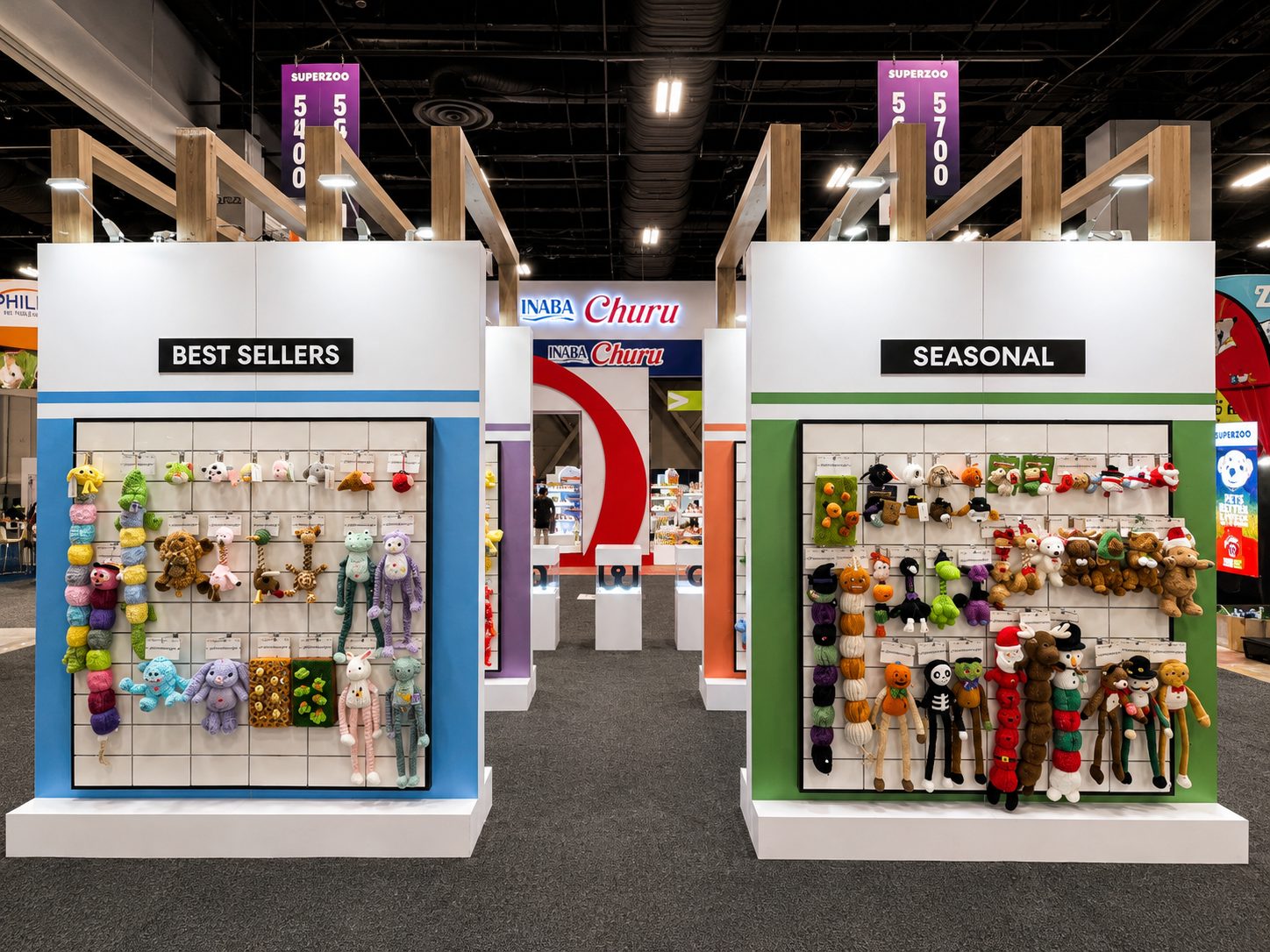
Consider Patchwork at SuperZoo 2026 in Las Vegas. AMG’s project record describes a 20-by-50-foot island, an exhibit accessible from all four sides. The assignment included design, fabrication, graphics, freight, installation, and show management. Display walls gave the pet products a readable home; integrated storage helped keep the working booth orderly. Move-in began August 9, ahead of the August 12 opening.
For footwear brand Yellow Box at MAGIC 2026, the problem was more intimate: put shoes where wholesale buyers could see and handle them. AMG built a 20-by-30-foot island with product presentation directing the layout. A buyer inspecting a sandal needs a different arrangement from a crowd watching a screen. The product gives the architecture its instructions.
EVA Air’s 30-by-30-foot GBTA 2026 exhibit in Chicago had another job. A fuselage-inspired structure and green tail fin provided recognition; reception, interactive counters, and a presentation lounge divided the business-travel conversation into manageable parts. There was also a claw machine. Even corporate hospitality can leave room for a small, undignified contest with a mechanical hand.
03The workshop is part of the pitch
Founded in 2009, AMG identifies Wayne Lu as its co-founder and chief executive, and Calvin Yee as its chief operating officer. Its education material also identifies Yee as a founder. The company describes an evolution from a small Southern California fabrication shop to an exhibit business with more than 500 builds. That count is AMG’s own, and the workshop remains central to how it presents itself.
The service model joins spatial design, three-dimensional visualization, fabrication, graphics, storage, freight coordination, installation, and dismantling. The promise is understandable to a marketing manager: fewer separate people to brief, and a clearer place to take a problem. A client is buying the management of a physical project as well as the finished structure.
AMG occupies the custom exhibit-house end of the market. Alternatives include portable display sellers, rental exhibit suppliers, and agencies that assemble specialist vendors. The relevant comparison is scope: who designs, who manufactures, who installs, and who takes responsibility for the next move? A tabletop display and a room with lighting, screens, product fixtures, and guest seating solve different purchasing problems.
Its international work adds a qualification to the in-house pitch. For Durofix’s 2026 Shanghai and Bangkok exhibits, AMG’s case book describes Los Angeles design and fabrication by AMG-managed partners in Asia. Drawings and supervision carried the standard across the ocean. Local manufacture avoided the burden of sending the entire structure from California. For buyers, that makes the agreed delivery arrangement more informative than a blanket promise about doing everything under one roof.
“The booth is a tool. The experience is what we sell.”Artsolute Media Group / company website
04What the floor plan costs
AMG publishes rental package ranges, giving prospective exhibitors something more useful than a request to call sales. A 10-by-10-foot rental is listed at $10,000-$14,000; a 10-by-20 at $16,000-$24,000; a 10-by-30 at $24,000-$34,000; and a 20-by-20 island at $30,000-$45,000. The advertised package includes design, graphics, installation and dismantling, shipping, and show support.
Those figures describe packages, not the total cost of attending a trade show. An exhibitor comparing proposals should ask what the quoted scope covers at the chosen venue and what remains on its own purchasing list. Floor space, staffing, and the activity inside the booth belong in the wider event plan. A price is only comparable when the deliverables are comparable.
Custom work follows a different pricing logic. AMG’s website gives a starting point of $15,000 for a 10-by-10-foot custom exhibit and a broad $40,000-$150,000-plus range for islands of 20-by-20 and above, depending on materials, audiovisual equipment, and complexity. Its business model is project work and rentals, with production and delivery services wrapped around the space. The sensible first question is what the booth must accomplish at this particular event.
05The calendar is a design material
AMG advises allowing at least eight to twelve weeks for a custom build and four to six for a rental. Its longer planning guide starts six months before a show, with goals, budget, and floor-space decisions. These are different clocks: one is a production window; the other is the time a client gives itself to make decisions before production becomes urgent.
The guide places design approval four months out, graphics production three months out, and logistics arrangements two months out. Crew confirmation follows. A mock build gives the team a chance to catch problems before shipping. Late approvals, the company warns, put pressure on freight and introduce rush costs. An expensive booth can begin with an inexpensive habit: leaving an email unanswered.
There is a useful operational detail in AMG’s May 2026 shipping-specialist vacancy. The company said its operations manager was handling shipping alongside the warehouse floor and wanted a dedicated person to take over that workload. The duties included booking carriers, calling drivers, checking invoices, and collecting signed delivery paperwork. That is what the polished phrase “full service” looks like at desk level.
The role advertised $23-$24 an hour. It also asked for someone who would flag trouble early. The posting gives a concrete glimpse of the company’s working culture: physical production, direct communication, and responsibilities that continue after a crate leaves the building. The show floor is downstream of a lot of telephone calls.
06Sometimes the exhibit stays put
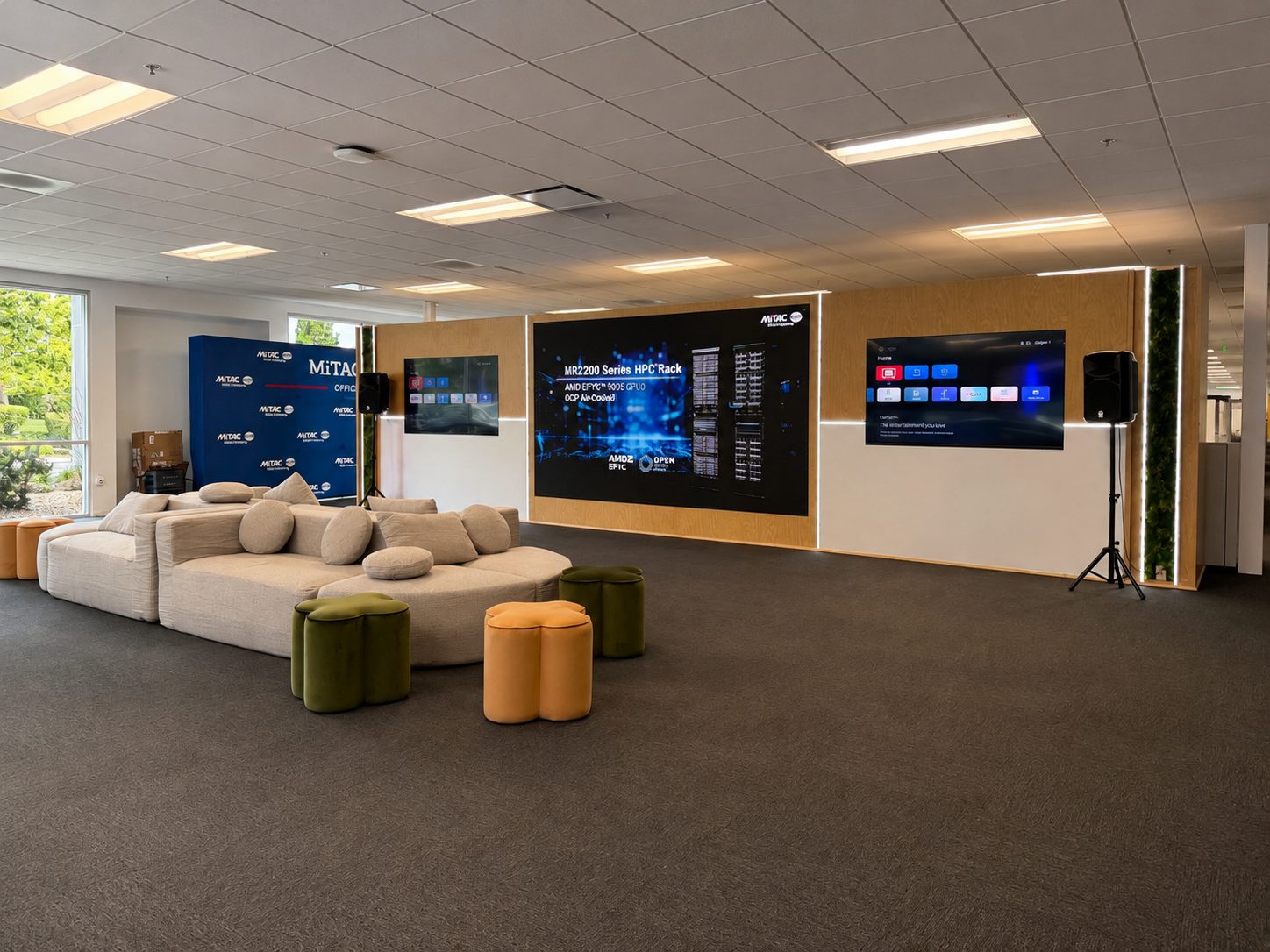
Temporary construction is only part of the portfolio. AMG designed and built MiTAC Computing’s Customer Experience Center in Newark, California, a permanent showroom for server, high-performance computing, and AI infrastructure. The installation combines rack displays, screens, a central product island, a world-map wall, and a lounge demonstration area.
The commercial problem is familiar even when the hardware is specialized. A visitor needs to see the equipment and understand how it fits together. Engineers need room to explain it. AMG’s account calls the center its fourth showroom, for its third showroom customer. It is a small, specific indication of a business applying exhibition skills to spaces with a longer working life.
Other assignments move outside altogether. For Youngs Communication and Marketing, AMG produced the YOSTAR Azur Lane activation at Santa Monica Pier on August 15, 2026. Character standees, wrapped cars, flags, merchandise displays, and booths brought the game into a public setting. The project required design, fabrication, delivery, and installation for a single day.
A pier changes the brief: the background is wood and sky, visitors arrive from several directions, and the installation shares space with a working tourist destination. The lesson for a brand considering an activation is to commission for the actual site. A layout that makes sense inside a convention hall still has to earn its place outdoors.
07You can borrow the homework
AMG has made its design-training material public through the Artsolute Exhibition Design Method, or AEDM. Yee wrote the introductory manual to train junior designers. The academy now offers that manual, a strategy volume, case studies, and an applied workbook. The three core books are offered in five languages, with free PDF downloads that require no email address.
The curriculum gives a buyer a way to ask better questions before commissioning a build. Its workbook moves from a client brief and objectives into a space plan, visitor journey, drawings, materials, and a review of buildability and budget. Each stage produces something the next stage needs. This is unusually tangible marketing: the company is showing potential clients the homework behind the renderings.
The most portable idea also appears in AMG’s booth-selection guide. Choose the job before choosing the size. An inline booth gives one aisle-facing approach; an island has four exposed sides. Product demonstrations, private meetings, and fast introductions make different demands on the same square footage. Write those demands down before buying a larger rectangle.
That approach works best when the exhibitor can name its audience, decide what visitors should do, and supply the people and products to support that interaction. An elaborate structure has limited value when those decisions remain unsettled. For a modest product line and a straightforward conversation, a simpler footprint may fit perfectly. AMG’s most persuasive work makes room for the activity that matters, including the unphotogenic activity behind a closed storage door.
Beyond the show floor
Explore the work, plan an exhibit, or borrow the design curriculum.