A shopping bag with wheels sounds like a retail executive’s fever dream. Starch Creative built one. For Shopify, the studio turned a Piaggio Ape into a mobile storefront, wrapping the little vehicle in the commerce company’s familiar green bag. At The Lighthouse Campus in Venice Beach, a symbol usually encountered on a screen became somewhere merchants could show and sell their goods.
The joke works because the shop works. Modular casework accommodates different products. Custom cubes fit into displays and double as lounge seating. The exterior earns the second look; the interior gives that attention somewhere to go. It is a useful introduction to Starch, an agency whose creative work extends into the stubbornly physical business of making things fit.
The idea has to survive the workshop
Based in Irvine, California, with a studio in Portland, Starch sells retail design, brand activations and campaign creative. Its current company description puts the team at more than 60 strategists, designers, producers and builders. The roster includes work for adidas, Vans, Coca-Cola, Oakley and Arc’teryx. These are business clients buying design and delivery; shoppers and fans encounter the finished work.
The company’s position sits between a creative agency, a retail design studio and a fabrication business. Starch Fabrication is its production partner within that integrated model. Earlier project accounts refer to the sister build company as Purpose Supply Co. Across those accounts, the proposition stays consistent: keep the people drawing the space close to the people responsible for producing it.
Founder and CEO Brandon Ball arrived at that proposition from the client’s side. He left Vans in 2015 after 13 years there, having worked across retail, consumer experience and events. His test for a store is disarmingly plain: could you recognize the brand after removing its logos? It puts pressure on the materials, layout and objects to do more than provide a handsome background.
“If you took every logo out of a store, would you know who it belonged to?”
Brandon Ball, speaking to ICSC in 2023
That test is easy for a reader to borrow. Cover the wordmark in a rendering. Then ask what remains specific to the business. A room that could sell any label has probably left too much work to the sign above the door. Starch’s better project details give the question a physical answer.
A store with dirt under its fingernails
For Fox in Bentonville, Arkansas, Starch converted a 1990s office building into a showroom and gathering place for the mountain biking community. Modularity shaped the design. Its sister fabrication company produced many fixtures in Huntington Beach and shipped them to Arkansas for installation. The project connects a local audience with a production operation thousands of miles away.
Fox’s Irvine environment takes another route into the same brand: an R&D lab concept, with concrete, black metal, warm wood and greenery. The point is to make product development visible. In Ball’s account, displays of track sand and mud-marked jerseys supplied something a generic sports shop could not: physical evidence of where the brand had been.
Other clients call for a different material vocabulary. For Outerknown’s SoHo, Malibu and El Segundo stores, Starch describes locally sourced wood, soy-based ink on recycled fabric, recycled denim hangers and recycled mannequins. Those are identifiable choices a buyer can examine. They also show how a brand’s stated values can shape purchasing decisions during construction, long before anyone writes a caption about the finished room.
At MUNICIPAL’s headquarters in Oceanside, the brief was to design, build and install a flagship store. The result combines an industrial interior with custom fixtures, a customization area and a central feature. Navigation matters alongside appearance. A shop can photograph beautifully and still make the customer work too hard to find a product.
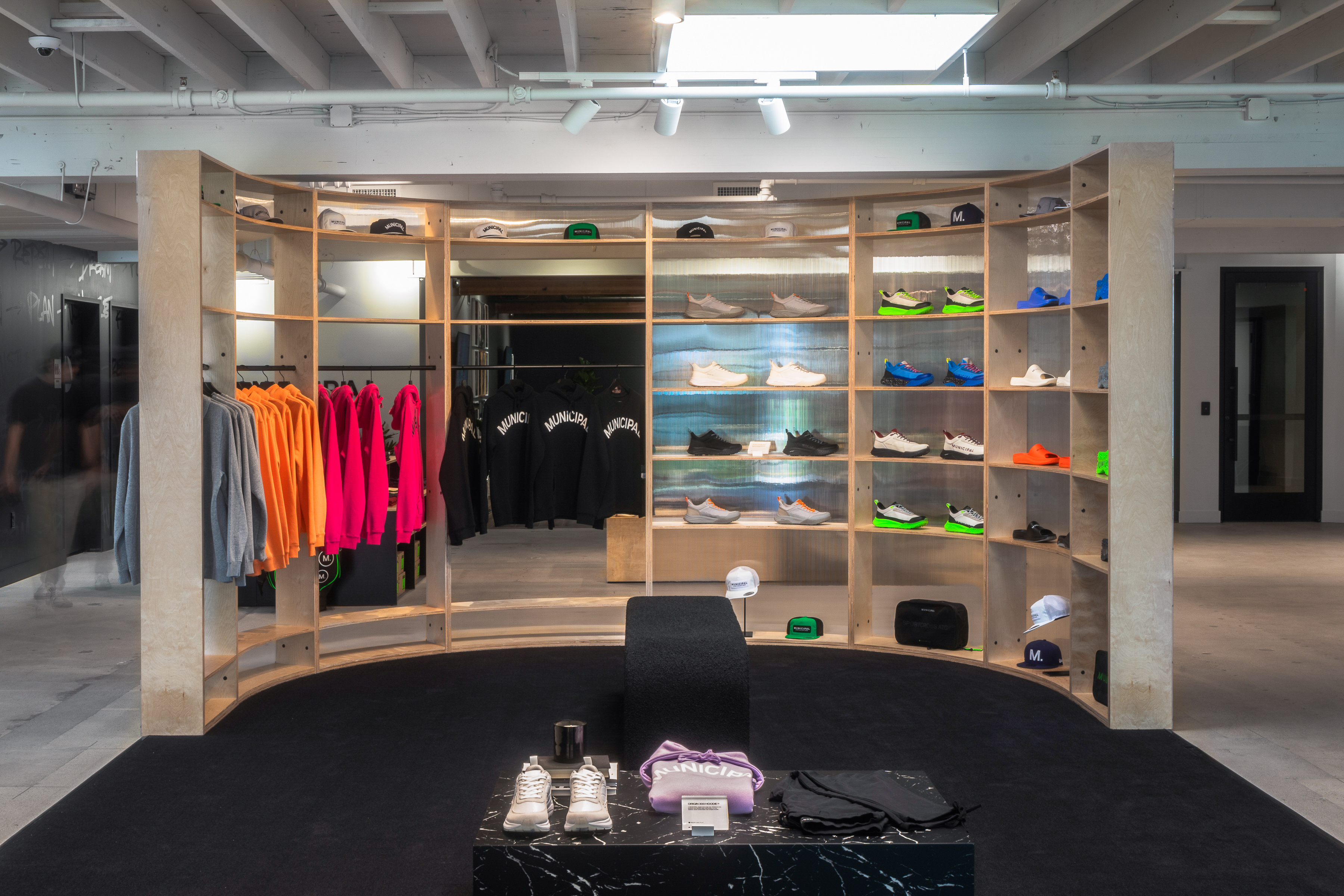
Build the second use into the first brief
Modularity appears so often in Starch’s portfolio that it deserves more attention than the spectacular props. Generation Tux wanted to move from digital commerce into physical showrooms. Starch designed custom fixtures and a retail system that could adapt to different footprints, then described its rollout across multiple locations. The useful deliverable was a repeatable set of decisions.
For Beyond The Streets in Los Angeles, shipping crates became display platforms in a gift shop intended to accommodate changing artists and merchandise. For Smith Optics, a 20-by-40-foot trade show booth used lightweight materials and a flexible layout for helmets, goggles and eyewear. In each case, change was part of the brief, rather than an inconvenience discovered after installation.
That is also a practical way to think about cost. A brand commissioning physical work should evaluate what it can reuse, how much it must ship and how quickly a crew can reset it. A spectacular object that needs rebuilding for every outing creates a different purchasing decision from a display system that accepts new merchandise. These are questions to put into the scope, alongside the visual direction.
An editorial map of Starch’s published capabilities. The workshop belongs in the conversation early.
Starch’s homepage emphasizes 3D visualization, including virtual walkthroughs before construction. That gives clients a way to examine a proposed store or activation while changes are still changes to a model. The studio also offers brand identity, art direction and campaign work. Its Crocs Monster Cereal campaign, for instance, combined photography, in-house art direction and a toolkit for online and retail partners.
The pop-up that earned an extension
One of the clearest examples of a changed decision concerns adidas TERREX. Starch designed and built what it identifies as the outdoor brand’s first North American retail store, in Portland. The studio says the temporary pop-up was received well enough by the community to become semi-permanent.
The interesting part is the sequence: open, observe the response, extend. A temporary format can help a brand learn about a place before treating its original assumptions as permanent. The lesson is conditional. A short run has to produce information the business can use, and the design has to remain serviceable if the planned closing date moves.
Starch has also worked beyond the United States. Its Vans Gangnam project turned a two-story, 3,000-square-foot building in South Korea into a store with a shoppable history, a cultural library and an adaptable upstairs area for art and music. Here, flexibility supports programming as well as merchandise. The same room needs to behave differently when an event replaces an ordinary shopping day.
Twenty-one activations, one football summer
The agency’s 2026 adidas World Cup work shows how the model operates across a larger program. Starch reports 21 activations in the United States and more than 10,000 attendees. Its account describes a connected system spanning adidas stores and wholesale partners, with customization, giveaways, photo booths and content from local creators.
Program attendance, not a measure of incremental sales.
Production partner Family Industries supplies another view of the work. Its tour account describes heat-pressed patches, equipment moved by Sprinter vans and customization stops in 17 cities. It reports more than 1,500 customized pieces. That detail makes the operational challenge tangible: a national concept still depends on a person, a machine and the next customer in line.
These figures describe activity and participation. They should not be read as proof that every attendee became a new customer. Starch’s Oakley Sphaera launch at the Waste Management Phoenix Open offers another example: the agency reports more than 6,000 Innovation Center visitors and 3,200 QR scans. A marketer still needs to decide what those actions mean for the product and the next campaign.
The bill starts before the doors open
Starch’s business model becomes particularly visible in an unlikely document: its controller job listing. The role covers accounting across creative and fabrication, including job costs, project profitability, deposits and progress billing. An account director listing describes defining scopes with creative and project management leads and developing existing client relationships. This is a service business organized around commissioned work and continuing accounts.
Those details matter to a prospective customer. Commissioning a physical experience involves the idea, production and a delivery schedule, with money moving before the public sees anything. Buyers can use Starch for that connected assignment, or discuss a specific capability within it. The fit is strongest when brand meaning and physical execution need sustained coordination.
The agency has encountered the less photogenic side of creative commerce. In 2022, Starch alleged that Laird Superfood used ideas resembling an unpaid activation pitch. Laird denied the allegation. The dispute became a trade-press discussion about speculative work and compensation. It illustrates a point at which a relationship can fracture before a build begins: the parties’ understanding of what the pitch buys, if anything.
The pandemic also disrupted the business. In an April 2022 announcement, Starch described rebuilding and repositioning after that period, and said it had posted record fourth-quarter earnings in 2021. The announcement accompanied Anthony Taylor’s return as associate creative director. The company presented recruiting as part of its recovery.
Give people something to do
Starch’s work is most persuasive when participation has a clear purpose. At its Oakley Super Bowl experience in 2024, visitors jumped to grab flags for prizes, then added messages to a growing wall installation. At an adidas Golf Tour360 vehicle, the purpose was product display and shoe trials at tour stops, clubs and retailers. Each format gives the visitor an action connected to the merchandise.
A business needing only a campaign image may reasonably choose a smaller specialist assignment. A shop without a defined audience will not discover one merely by ordering custom furniture. Starch’s approach asks for a recognizable brand, a reason to gather and an operating plan that can support the physical promise. The green Shopify bag succeeds as an introduction because it contains all three. Someone notices it, walks over and finds a shop.
Visit the work. Hear the thinking.
Starch Creative · Project portfolio · Instagram · LinkedIn
Brandon Ball on retail and customer experience
The Brand Called You: founder interview
Watch: Brixton retail project
Starch’s video portfolio
Inside the adidas World Cup customization tour