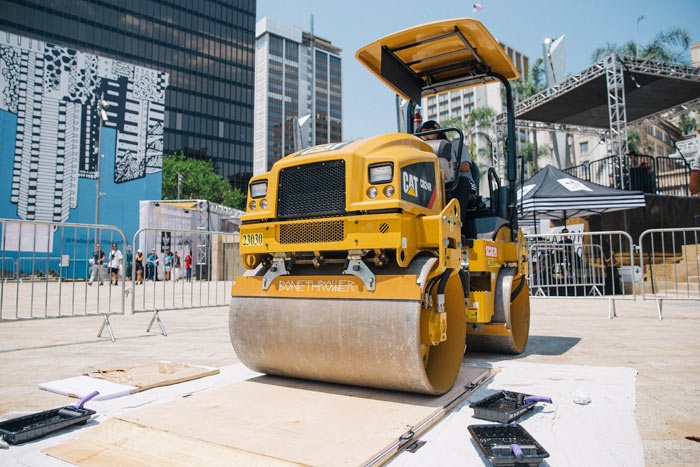
A steamroller is an extravagant way to make a print. For Brandon Ball’s team, that was part of the attraction. At Destination San Diego, a free festival for Adidas Skateboarding and Journeys, visitors could ink a linocut and watch construction machinery do the pressing. Elsewhere, buttons sent fresh stripes of paint down a 40-foot mural. The audience had been given something better to do than stand around admiring the branding.
Ball’s explanation was pleasingly direct: “We wanted to over-dramatize the lino print process.” The line could double as a working instruction for a certain kind of creative business. Find something people can take part in. Make the experience worth the trip. Then solve the rather less glamorous problem of getting a steamroller into the plan.
As founder and CEO of Starch Creative, Ball works in the space between a brand’s intentions and a customer’s actual afternoon. That space might be a shop, a parking lot, a festival or a mobile storefront. His career has involved giving ideas physical dimensions, with all the possibilities and inconveniences that follow.
Thirteen years on the shop floor’s side of the argument
Before he was commissioning environments for other companies, Ball worked inside Vans. He spent 13 years there, moving from a retail associate into responsibility for global environmental design and retail marketing. His work extended across retail, consumer experiences, events and activations. It was an education in how a company meets people outside its own offices.
The progression matters. A retail associate encounters the small, immediate facts of a shop: where people stop, what they ask, what they walk past. A global role brings a different scale of decisions. Ball’s route took him through both. His subsequent business would join the planning of a brand experience to the practical work of producing it.
In 2015, he left Vans and founded Starch. The agency’s early promise was to bring that experience to other brands. His professional story has a clear hinge here: after years working within one company’s culture, he began building a business that had to understand many.
A place for people who make things
Ball’s account of the founding starts with the people doing the work. He wanted a home where creatives could use the skills they had spent years developing. By 2022, a business that began with two people and one office had grown to two offices and earned a place among Adweek’s fastest-growing agencies.
His advice about brands was less ornamental than the agency’s more theatrical projects might suggest. The product has to offer value to the person using it. There also has to be continuing attention to what the next generation of customers wants. A lively activation cannot permanently compensate for a disappointing thing in the shopping bag.
That emphasis keeps the story anchored. Ball sells creative work, but the purpose he describes begins with usefulness. An agency can make a handsome room and still leave a customer wondering why they came. His stated ambition asks the team to begin earlier, with the reason the business deserves anyone’s time.
Take the logo off the wall
Ball has a useful test for the stores his industry produces. Remove the logos. Could someone still tell whose shop they had entered? He thinks many would struggle. For Starch, the exercise means working through a brand’s values before choosing how a room should look.
The question is harder than it sounds. Signage is wonderfully efficient at naming the proprietor. Without it, the materials, displays, objects and arrangement have to earn their keep. They must tell a coherent story while allowing someone to find a jacket in the right size. Retail has an unromantic way of interrupting a design thesis.
“If you took every logo out of a store, would you know who it belonged to?”
Brandon Ball
The test is also a way of understanding Ball’s career. His subject is the accumulated evidence of a brand: the decisions a visitor can touch, use and remember. A logo may identify the business immediately. The rest of the room explains what the identification is supposed to mean.
The answer came on the flight home
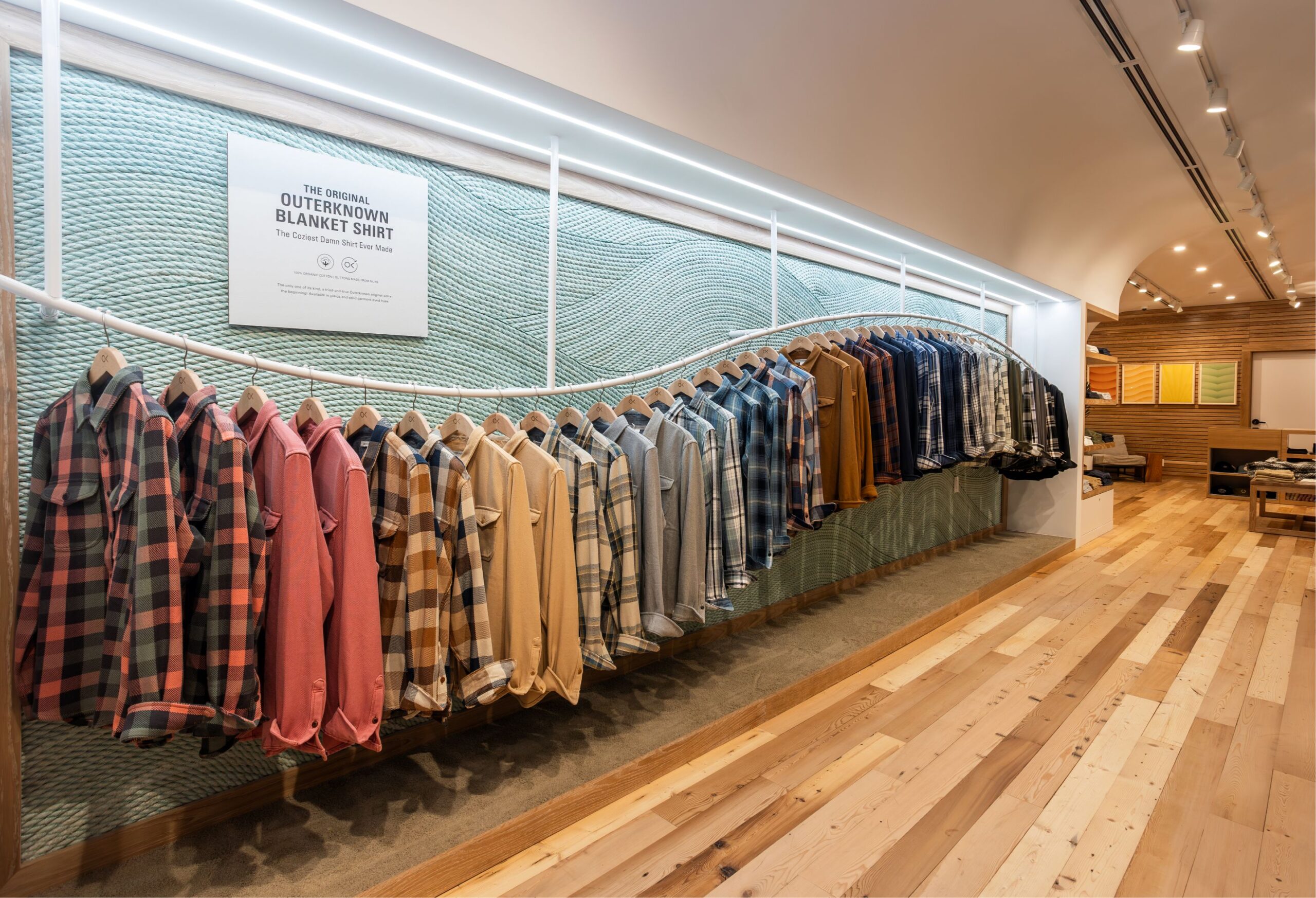
With Outerknown, the work included a research trip through New York, Massachusetts and Vermont. Ball and the clothing company were thinking about how to scale its stores. On the flight back, the direction came together: smaller spaces, a tighter merchandise selection and fixtures, floors and other components made with reclaimed or scrap materials.
It is an unusually concrete glimpse of a creative decision becoming a business decision. Choosing a smaller shop changes the rent, the assortment and the number of things a customer has to consider. Choosing reclaimed materials makes the fit-out part of the same conversation as the clothing. Each choice places limits on the next, which is often where design starts becoming interesting.
The finished retail system used locally sourced wood, soy-based ink on recycled fabric, recycled denim hangers and recycled mannequins. Starch identifies the SoHo, Malibu and El Segundo locations as reference points for later stores. The details offer a physical account of Outerknown’s priorities, down to objects that could otherwise disappear into the background.
A mountain-bike shop starts with the town
Fox Racing presented another version of the problem. In Bentonville, Arkansas, Starch transformed a 1990s office building into a retail showroom and a gathering point for the local mountain-biking community. The location gave the assignment a particular audience before the design team had selected a single fixture.
Modularity helped shape the store. Many fixtures were made by sister company Purpose Supply Co. in Huntington Beach, then shipped to Arkansas for installation. The account brings Ball’s kind of work back down to earth: an idea has to survive manufacturing, transport and assembly before anyone can browse it.
For MUNICIPAL’s flagship inside its Oceanside headquarters, Starch handled design, construction and installation. Custom fixtures and an area for in-store customization sat within an industrial design. Both projects give the visitor a role beyond looking. A store can be somewhere to meet, make a choice or personalize something, while still performing the ordinary duties of a store.
Back to the steamroller
Destination San Diego made participation the main attraction. The 2018 festival at Horton Plaza Park was free to its 3,000 attendees. Music shared the programme with things visitors could make. The scale of the paint wall and the weight of the printing machinery gave familiar creative activities an entertaining sense of occasion.
There was a producer’s problem tucked inside every flourish. A wall that changes colour all day requires thought about the paint, how it flows and what happens after it lands. A steamroller print requires testing before a guest gets near it. Starch worked with Purpose Supply Co. on those tests.
This is the amusing tension in Ball’s profession. The visitor gets the surprise. The team gets the logistics. Somebody has to be sufficiently interested in both for the afternoon to work.
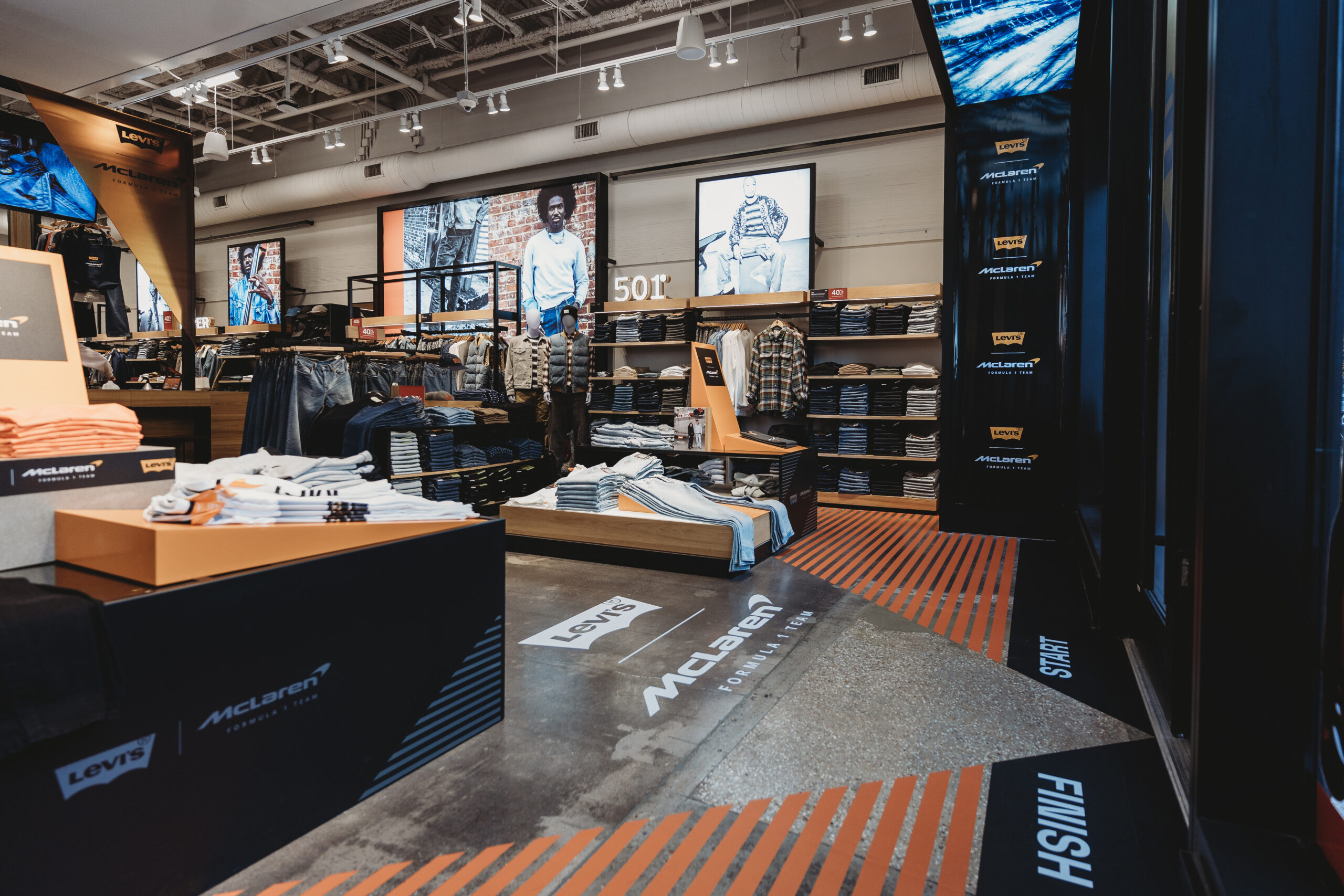
The Levi’s x McLaren project applied a different vocabulary: pit-lane graphics, apparel customization and an exterior activation around the United States Grand Prix. The setting changed from festival to shop, while the invitation to participate remained. The racing references had to coexist with merchandise and the movement of customers through the space.
The people behind the finished room
Ball’s company has also grown through the people it brings back. In 2022, Anthony Taylor returned as associate creative director, reporting to executive creative director Steve Zeitzoff. Taylor arrived with experience across sports brands and a network of photographers, animators, illustrators, builders and other collaborators. Ball emphasized the perspective and strategic thinking he would contribute.
Expansion brought another kind of appointment in 2023. Starch opened a SoHo outpost led by Jason Newman, whose background included agency work and roles on the brand side. At a time when some businesses were reducing their New York office presence, Ball saw a reason to put the company closer to experiential retail there.
His own account of leadership includes a place for advice. Through YPO, he described exchanging experiences with other business owners facing comparable decisions. The image of the solitary founder does not do much explanatory work here. Ball has talked about both creating a home for skilled people and finding peers he can learn from.
An idea still has to fit through the door
Starch now brings strategy, design, engineering and fabrication together in a 45,000-square-foot creative and production facility in Irvine, with another office in Portland. The arrangement gives physical form to the business Ball has been building: people deciding what something should be alongside people working out how to make it.
His work has room for theatre, from a print made under a steamroller to a shop dressed for race weekend. Its recurring concern is more intimate: what someone will do when they arrive. Will they make something, understand something, recognize a place as theirs? Ball’s logo test asks a room to answer without prompting. The customer gets to decide whether it has.