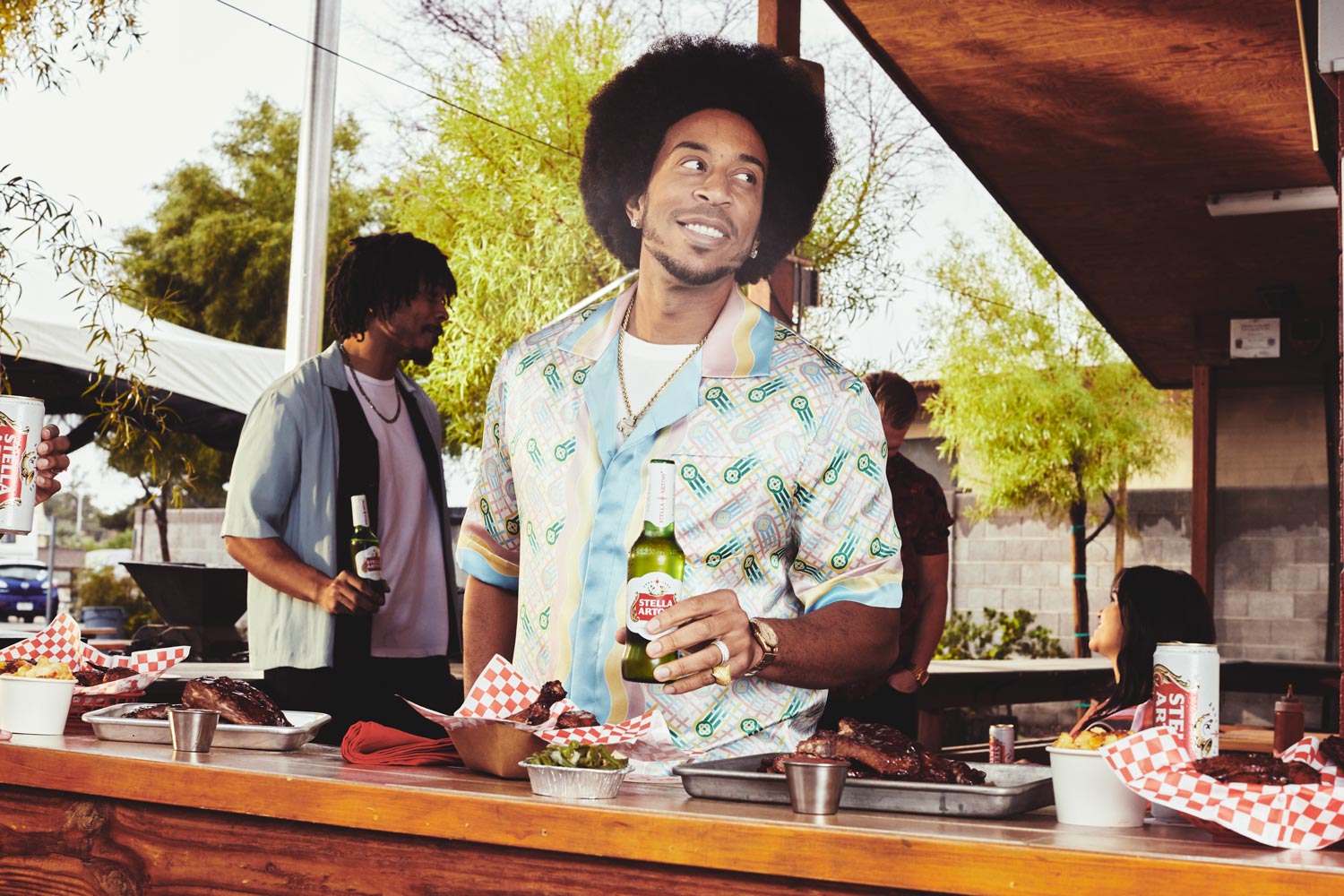
There is a photograph in The Creative Bar's portfolio of Ludacris holding a bottle of Stella Artois at a Las Vegas barbecue joint. The sun appears cooperative. The shirt is perfect. The food glistens. Nothing in the frame tells you that the agency had only two weeks to arrange the shoot, that the performer had a crowded calendar, or that Las Vegas was in its rainy season. Advertising has always depended on this little deception: the finished image should look inevitable, even when its production was anything but.
The campaign is a neat introduction to a company whose work often begins in a conference room and ends somewhere much less tidy - on a grocery-store floor, across a municipal website, inside an augmented-reality animation, or beside a stadium crowd. The Creative Bar is an independent agency founded in 2007 and based in Murrieta, California. LinkedIn lists 14 employees. The agency also maintains a New York presence. Its own preferred description is “Strategists. Artists. Entertainers.” The more revealing description is this: it is a small shop designed to carry an idea a surprisingly long distance.
The idea does not leave the building
Full-service is one of those agency phrases that has been polished smooth by overuse. Here it has a practical meaning. The same company sells positioning, identity and messaging; graphic and 3D design; web design and development; photography and video; shopper marketing, media and live activation. A beverage campaign can move from an audience insight to custom barware, a store display, event décor and a phone experience without being translated among a strategy consultancy, a digital shop, a fabricator and a production company.
That continuity is the product. It is also the answer to the problem The Creative Bar solves. Brand teams rarely suffer from a shortage of vendors. They suffer from the space between vendors: the revised headline that never reaches the display team, the beautiful identity that becomes generic on a product page, the campaign idea that cannot be manufactured on time. Every handoff adds interpretation. A compact multidisciplinary team reduces the number of translations.
The agency packages this as “discover, design, deliver.” It sounds almost comically simple. That is why it is memorable. Another studio can copy the sequence tomorrow: insist on a written understanding of the audience, present a limited number of coherent directions, refine one, then assign a named owner to the final implementation. The harder part is building a team whose skills reach the last step.
What a nationwide shelf can hold
For Estrella Jalisco, the assignment was not a single advertisement. The agency says it has worked with the beer for six years, including three as agency of record. Its Cinco de Jalisco program combined cultural cues, custom barware, event pieces and bold retail displays. Another campaign, Tattoo of a Lifetime, enlisted tattoo artist Nikko Hurtado. For Día de los Muertos, the team drew a Katrina, placed her beside a QR code, storyboarded an animation, worked with an AR developer and built the landing page that opened on a shopper's phone. The resulting displays appeared in grocery and liquor stores across the country.
This is where the company fits in the market. A digital studio might have built the landing page. An experiential firm might have fabricated the display. A brand consultancy might have supplied the cultural framework. The Creative Bar sells the join between them. For a marketing director, fewer seams can mean faster revisions and clearer accountability. For a smaller business, it can provide capabilities that would be expensive to hire one role at a time.
“The Creative Bar feels like an extension of our team.”
- Emily Velez, senior brand manager, Estrella Jalisco
The client list makes the point in an oddly pleasing way. Hilton, Disney, Marvel, Humana, GT's Living Foods, Bud Light, Haro Bikes, Pechanga Resort & Casino and the City of Murrieta occupy the same page. They do not share a sector. They share a recurring problem: a brand promise must remain recognizable while changing shape.
Research before decorationThe first thing to fail was consistency
In 2018, Murrieta had accumulated a mix of logos, taglines and communications. The city did not primarily have a drawing problem. It had a consensus problem. Residents, businesses, visitors and public employees were encountering different versions of the same place. After a competitive RFP, The Creative Bar interviewed residents, city officials, business owners, educators and public-safety personnel. Workshops and surveys surfaced four useful themes: safety, opportunity, community support and location.
That discovery changed the shape of the answer. The agency built archetypes, a positioning statement, a visual system, a tagline and a marketing plan. The lesson is portable: when many stakeholders disagree about the look, do not begin with the look. Begin by finding the few ideas that each audience needs the identity to carry. A mood board cannot repair an unresolved argument about meaning.
A rare public price marker: in 2017, a regional government body recommended a contract capped at $100,000 for a different community-energy launch. The scope covered naming, identity, an interactive multilingual website, workshops, outreach, advertising, enrollment materials and even a call-center script. It is a historical contract ceiling, not the agency's current rate card.
That document explains the business model better than a menu of services. The agency earns project and ongoing account revenue by acting as an outsourced creative department. A client is not buying a logo for the quoted ceiling. It is buying coordination across public research, creative production and operational rollout. The supplied company data estimates annual revenue at about $3.84 million, though the figure is not publicly confirmed and the company has announced no outside funding.
Recognition, countedAwards are the garnish, not the meal
The Creative Bar reports more than 150 national and international awards. Its awards page is unusually specific, breaking out 27 platinum, 51 gold, 28 silver, 13 bronze and 14 notable honors across ADDYs, MarCom, Hermes, Communicator, MUSE, AVA Digital and other programs. Awards establish craft. They do not prove that a store display sold more beer or that a city became easier to understand. The more persuasive evidence is the repeated work and the movement from one format to another.
How the reported awards stack up
GT's Living Foods offers a quieter example. The kombucha maker needed a site with cleaner navigation, a better store locator and product pages that made flavors easier to explore. The agency combined those utilities with photography, video and animation. It also made a temporary “Feel the Synergy” experience: answer a quiz, receive a flavor and a playlist. The work is not memorable because a website had motion. It is memorable because discovery, purchase and brand personality were treated as the same job.
The tradeoffSmall teams win on seams and lose on simultaneous scale
The model is best suited to clients who want a close senior relationship, need several connected outputs and are willing to collaborate. It is less convincing when a global account requires hundreds of specialists working at once, when media buying volume matters more than craft continuity, or when a company wants an isolated commodity task at the lowest unit cost. An integrated studio only creates an advantage when the work benefits from integration.
There is also a useful warning in the barroom branding. “Patrons,” “top shelf” and “serving up ideas” make a complicated service company easy to remember. The metaphor works because the agency keeps earning it in the copy. Borrow the principle, not the props: choose one verbal world, make sure it fits the actual culture, and carry it lightly across the experience. A forced metaphor becomes a costume.
Back in Las Vegas, the rain and the schedule disappeared from the finished photograph. But they are exactly what make the picture instructive. Clients do not hire an agency because reality will cooperate. They hire one because it will not. The Creative Bar's compact proposition is that the strategist, designer, producer and account lead will be close enough to solve the problem before the bottle reaches the table.