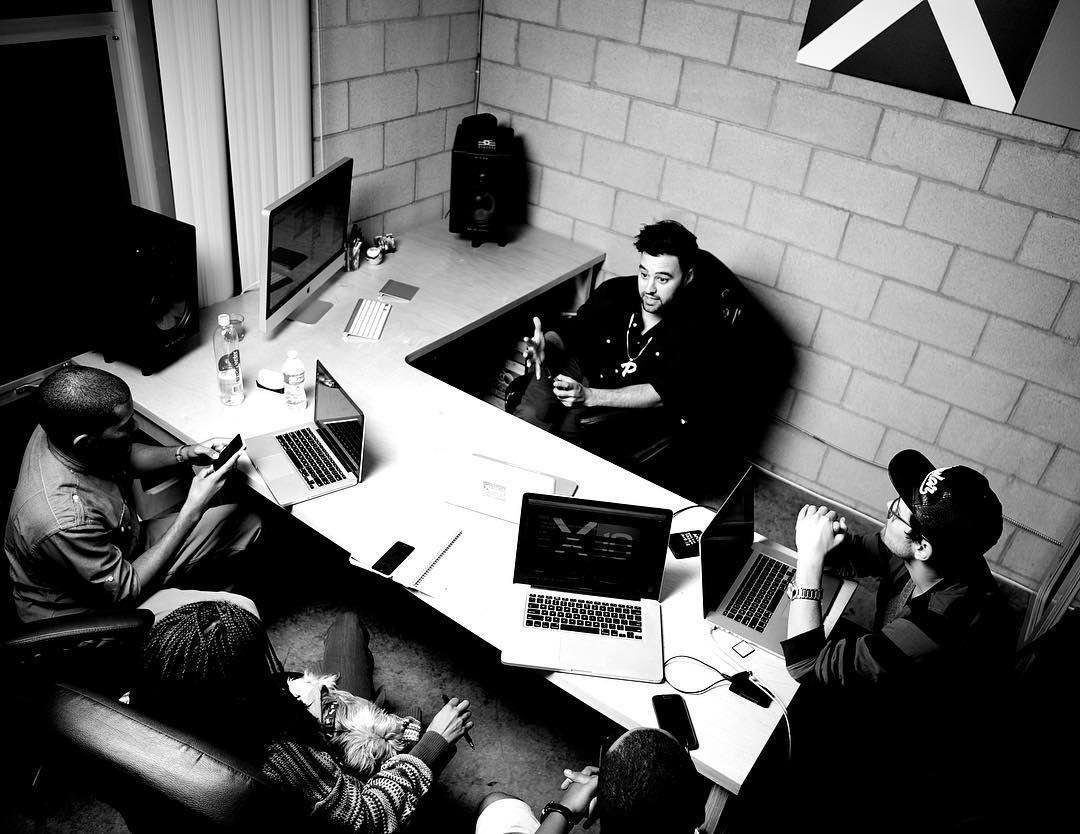
Ben Ricciardi remembers the dimensions: eight feet by ten. An early office sat in his brother’s basement at the old Popular Demand headquarters, with neither air conditioning nor heat. In the photograph he later shared, people and laptops crowd a desk that appears to have negotiated a generous share of the available floor. There are concrete-block walls, computer screens and very little room for an executive entrance.
He had barely enough money to work out what he was doing. A month into hiring his first employees, the founder of Times10 was still making the business up close, one decision at a time. Michael, the colleague pictured on the right, left two jobs to join him and eventually became his business partner. The gamble was personal before it became a company story.
By the time Ricciardi posted the memory in 2019, he could describe 25 team members and an 11,000-square-foot Los Angeles office. Those were the numbers he chose to put beside the basement. But the photograph holds the more interesting part: people agreeing to work together before the surroundings supplied much encouragement. The furniture could hardly have been the attraction.
A family business, before the business
Ricciardi’s route into advertising had both a formal education and a family backdrop. He graduated from Towson University in 2003, studying mass communications with a focus on public relations and advertising. His father was an entrepreneur, his mother an author and professional theater actress. His brother Blake created the streetwear company Popular Demand, whose premises provided that early office.
It is a background in which making something and finding its audience belong in the same conversation. Theater needs people in seats. A clothing brand needs people willing to wear its name. An agency has to persuade a client that it can help create such a relationship. Ricciardi’s eventual business would operate around the meeting point of those problems.
Times10 was founded in 2011. Today its work spans creative production, social media and physical experiences, with a base in Burbank. The range matters because Ricciardi’s career repeatedly crosses the boundary between an idea and the arrangements required to put it in front of somebody. The joke, the photograph, the invitation and the room all need to agree.
Towson graduate
Times10 founded
Directing Kevin Hart
The Mid-Am pursuit
The audience on the other side of the phone
Ricciardi also built an audience under his own name. By June 2020, his Instagram following had reached one million, and his recurring Morning Motivation stories were a recognizable part of his public identity. That is a useful distinction for an agency founder: he has had to give people a reason to return to his own account, alongside finding reasons for them to notice a client.
The recurring format gives the relationship some continuity. A viewer knows roughly what kind of encounter to expect, even when the particular message changes. For a strategist working in social media, maintaining that expectation is part of the craft. Attention arrives in small installments; an audience can leave without needing to cancel anything.
He is more exacting about measurement than a follower count alone might suggest. In 2019, Ricciardi argued that each campaign needs its own objectives and measures. A sales assignment calls for a financial assessment; an awareness assignment calls for measures of exposure and audience. The distinction sounds elementary until an attractive number appears on a slide and everyone politely forgets the question.
“You have to tailor your objectives, goals, and KPIs for each individual campaign.”
Ben Ricciardi
It is a practical streak beneath the motivational material. A large audience can be useful, but usefulness depends on the job. For someone who makes his living around public attention, being clear about what that attention is meant to accomplish helps keep the conversation attached to the business paying for it.
Two hours with Kevin Hart
In 2022, a C4 Smart Energy commercial presented Ricciardi with an unusually literal version of time management. Kevin Hart had two hours available on set. The finished spot needed to show him moving through several roles, ending with stand-up. Ricciardi directed; Times10 used two crews, allowing one scene to be prepared while another was filmed.
The team also captured horizontal and vertical footage simultaneously, anticipating conventional video placements as well as TikTok and Instagram Reels. The screen shapes were part of the production plan. With a limited window to film the central performer, discovering later that a shot would not fit somebody’s phone would have been an expensive little revelation.
There is a revealing division of labor here. Hart changes characters; Ricciardi helps him make the transitions; the crews keep the next setup ready. The apparent speed of the finished commercial depends on a structure outside the frame. Its movement has been organized before the viewer encounters it.
two orientations
2022 C4 Smart Energy production setup. The diagram shows the workflow, not a calculated productivity gain.
Ricciardi was also credited as executive producer and director on C4’s Ignite Your Fire campaign. The title captures a second part of his working identity: the founder remains involved in making the material. His public career includes the managerial role and the person responsible for what happens when the camera starts.
A famous face still needs a reason
Celebrity access has not made Ricciardi indifferent to whether an endorsement feels believable. In a 2023 discussion of beverage marketing, he warned that audiences can recognize when someone appears to be collecting a check. A partnership needs a credible connection between the person and the product. Otherwise, expensive visibility can advertise the awkwardness of the arrangement.
He was similarly direct about the money required to compete in a crowded market. Content, social distribution and talent require investment, and a brand needs a point of view strong enough to earn attention among well-funded competitors. His advice leaves little room for the comforting idea that one famous photograph will take care of the rest.
That combination explains something about his public persona. He likes a conspicuous idea, but he keeps returning to the work around it: the choice of talent, the audience, the format, the objective. The playful part needs a plan. A marketing budget is an unforgiving place to discover that the joke required more explanation.
The room becomes part of the story
Times10’s physical projects extend that thinking into places people can enter. In March 2025, its Harden Vol. 9 launch at adidas Melrose carried a chrome theme through displays, basketballs and even burger wrappers. The agency coordinated James Harden’s arrival, invitations, check-in and content capture. A visual concept had become a series of practical decisions, right down to lunch.
The point of those details is their relationship. A guest can photograph the shoe, the setting or the food and still carry away something recognizable from the same event. The experience supplies several possible entry points for a person’s attention. Somewhere behind the shiny surfaces, somebody also has to make the queue work.
A different assignment, Derrick Rose’s Forever Yours celebration in Chicago, called for a different setting. Times10 worked with Rose’s team on Roses Flower Shop and Homegrown at Simeon, handling creative, production and logistics. Flowers, a school hallway timeline and a local pizza partnership gave the celebration specific places and familiar associations.
The Simeon work included banners, seating and a scorer’s table upgrade that could remain after the event. That is a satisfying detail in an industry devoted to the launch date. Some of the work gets packed away. Some stays available for the next game. The agency’s responsibilities extend into both kinds of object.
The next number goes on a scorecard
By March 2026, Ricciardi’s own public story had acquired another recurring subject: golf. His appearance on Pin High: The Philadelphia Golf Show centered on his attempt to qualify for the U.S. Mid-Amateur Championship. He was sharing swing progress, short-game practice and golf experiences across Instagram, TikTok and YouTube. The strategist had become the subject of an unfolding sporting project.
There is a different rhythm to that kind of account. A campaign can be planned around a release. A qualification attempt asks viewers to stay with the preparation, including the stretches when preparation does not produce the desired result. The appeal lies partly in watching someone pursue a clearly stated ambition before he can supply a tidy ending.
For Ricciardi, the ambition is explicit: earn a place in the championship. It gives his golf content a direction beyond collecting pleasant views of courses. Viewers can follow a person working toward a test, and the test gives the practice its meaning. An amateur scorecard is impressively resistant to flattering copy.
The basement photograph makes a good companion to that pursuit. It preserves the company before the spacious office, when the people at the desk had committed themselves without knowing how the picture would look years later. Ricciardi kept that imperfect beginning in public view. His golf content lets viewers see another project while it is being worked out. There is room in his story for the work before the result.