A banner arrived. Josh Feller looked at it and decided he could not sell it. For a company paid to make other people look good, this was a fairly fundamental problem. The order had gone to an outside supplier. The disappointment had come back to COLORZONE.
Feller had bought the troubled business in 2005. As he later told an interviewer, that early encounter with outsourcing helped persuade him to buy equipment and control production himself. His verdict on the banner was wonderfully brief.
“I couldn’t sell it. It was terrible.”
Joshua Feller, recalling the outsourced banner in 2016
There is a familiar purchasing question here: can somebody else make this for less? COLORZONE’s story suggests a second one. What happens when the object arrives and you are the person who has to hand it to the customer?
Control came with a machinery bill
The answer eventually occupied a substantial amount of factory floor. A January 2020 interview with Feller described equipment investment of as much as $8 million. That is a historical investment figure, not a valuation. It puts a useful price tag on a word businesses like to use rather casually: control.
As much as this in equipment investment, described in a January 2020 owner interview.
COLORZONE began in 1997 with two printers and a laminator, initially making color copies. Its present menu stretches from labels to large-format graphics, with vehicle wraps, retail signs, wall coverings, and trade show displays in between. The growth is visible in the variety of things it can make.
Its current equipment roster also makes a less photogenic point. There are cutters, a welder, a grommet machine, and label-finishing equipment alongside the printers. A banner must hang. A display must have an edge. A roll of labels must become something a customer can use. Printing is one stage in the manufacture of an object.
The surprisingly important color was white
Near Napa Valley, customers kept asking for labels. COLORZONE purchased an EFI Jetrion 4950LX in December 2014. Feller’s interest included its opaque white ink for transparent and metallic materials, along with laser cutting that removed the need for physical cutting dies. The equipment answered a particular kind of demand.
By 2015, Feller was describing orders of 400,000 to 600,000 labels spread across 20 to 50 product variants. A large total could conceal many smaller jobs. The setup costs for all those versions mattered. Digital production made the mix more manageable.
Today, the company advertises label runs from 50 to 2 million, covering food, wine, product, and specialty applications. It offers help choosing materials and finishes, and its label service explicitly eliminates plate and die costs. The buyer still needs a quote. Fifty labels and two million labels are very different conversations, even when they begin at the same phone number.

The useful lesson for another business is to follow the request that keeps returning. In this case, a neighboring market helped shape the equipment decision. Buying a machine because customers need a specific output is a more testable proposition than buying one and hoping to discover a market afterward.
A booth, a bottle, a very conspicuous car
COLORZONE sits where graphic design meets physical production. Its customers include companies with something to launch, agencies with something to present, artists with something to reproduce, and retailers with something to explain. The business earns its money through custom jobs: an object, a quantity, a material, a deadline.
That variety has practical uses. A trade show team can order a booth system with backdrops, floor graphics, banners, and modular components. A team that already owns a booth can commission replacement graphics. COLORZONE explicitly offers to refresh existing structures, including older ones. A campaign can change without automatically requiring a new piece of furniture.
A retailer has a different set of surfaces: a window, a wall, the spot beside the register. The company makes point-of-purchase displays for one-time promotions, seasonal campaigns, and ongoing use. It also produces indoor wayfinding and decorative graphics. The job starts with where a person will encounter the message.
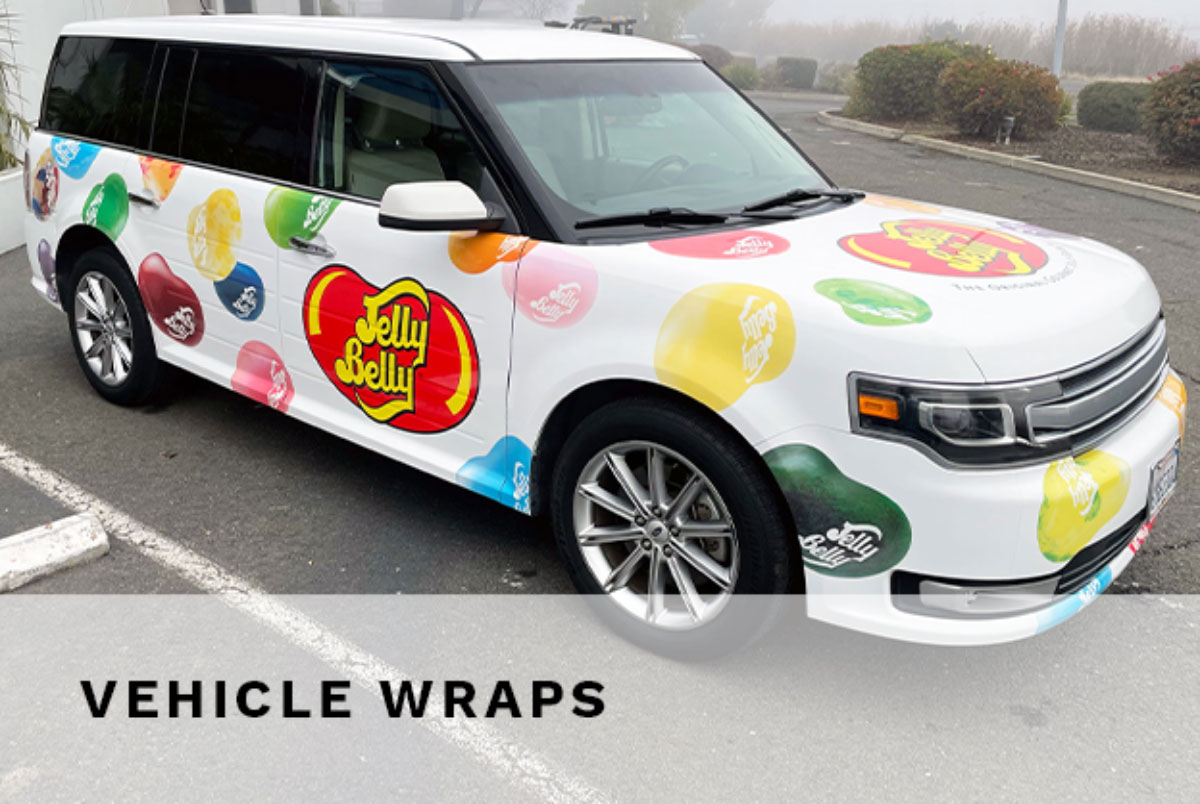
Vehicle wraps add another complication: the surface has doors, windows, and curves. COLORZONE prints and installs custom vinyl vehicle graphics, including fleet signage. The resulting advertisement moves with the vehicle and remains visible when it is parked. It is an unusually literal way to take a brand somewhere.
The customer is often buying relief
The company’s published testimonials are instructive about the work behind the pictures. Levi’s production manager describes unusual graphics and tight presentation deadlines. Julie Coyle recalls needing wall coverings for approximately 475 rooms in a Las Vegas hotel. An agency describes urgent signage for a healthcare client during the pandemic.
These are customer accounts selected by COLORZONE, but the recurring demand is clear: help turn an awkward requirement into a finished job. The company promises a human contact through the project and direct access to its owner. For a buyer juggling artwork, approvals, and a delivery date, that is a concrete service proposition.
The alternatives depend on the assignment. A local sign shop, an online print vendor, a label converter, and an exhibit fabricator can each solve parts of this problem. COLORZONE’s appeal is the combination of applications and hands-on coordination. Whether that combination is worth paying for depends on how much coordination the buyer actually needs.
The deadline starts in the file
COLORZONE says most projects take three to five days. Its FAQ also warns that rush work may carry a surcharge of 50 to 100 percent. These are planning signals, not a guaranteed completion date or a universal price. A complex exhibit needs its own schedule.
The FAQ asks customers to provide linked graphics and fonts, specify final dimensions and finishing, and supply a proof and color references. It also warns that file preparation can add charges or delay a job. The practical thing to copy is a better brief: explain the surface, the viewing distance, the intended lifespan, and the delivery requirement before asking someone to press Print.
Materials deserve the same attention. COLORZONE offers different mounting and media options for wall coverings, and lists environmentally preferable choices for some interior signs. Those are choices to discuss for the actual application. An indoor decorative print and an outdoor building sign face different conditions; the attractive sample alone cannot settle the specification.
Nor does owning more equipment automatically make every order economical. The investment needs useful work, and a customer with a simple, repeatable job may prefer a narrower supplier. COLORZONE’s strongest case appears when the job crosses materials, formats, or production steps and someone needs to take responsibility for the whole object.
The bad banner is memorable because the failure was so easy to understand. The customer would see the finished surface. COLORZONE would answer for it. Everything between those two facts became worth a closer look.