Suman Siva and his twin brother decided to change where they ate lunch. In their junior year of high school in North Carolina, they left the cafeteria, where they had been sitting by themselves, and joined the more social students in the quad. The experiment took months. There was awkwardness. There were attempts at making friends. Eventually, it worked.
He remembers the move as a lesson in taking the first step. It is an unusually modest origin story for a technology founder: two brothers, a school courtyard, and the uncomfortable business of introducing yourself. Nobody needed a platform. Somebody did need to cross the space between the groups.
Today, Siva is the co-founder and CEO of Marco Experiences, a business that helps companies arrange group travel and gatherings. The distances have grown. So have the budgets. Yet the old question remains recognizable. How do you make it easier for people to get together?
The distance to the quad
Siva grew up in Charlotte, the son of parents who had immigrated from India. He has written about negotiating an American upbringing and an Indian family identity, and about watching his parents build a circle of friends who became something like extended family. The adults he calls aunties and uncles are part of his account of learning what community means.
This gives his later interest a personal shape. Belonging has a history before it becomes a business proposition. It has invitations, familiar faces and people you expect to see when you go home. In Siva’s telling, the work of finding those people was visible from childhood.
He and his brother went to Vanderbilt in Nashville. Siva studied economics from 2009 to 2013, with minors in financial economics and philosophy, and received the full merit-based Cornelius Vanderbilt Scholarship. It is a combination that leaves room for both the arithmetic of a decision and the question of whether the decision is worth making.
His career would supply plenty of opportunities to use the arithmetic. Bain & Company came first, followed by experience at the startup Scoop and investment roles at Castanea Partners and SoftBank’s Vision Fund. He had seen businesses from several chairs before deciding to build one.
A career that looked good on paper
At Castanea, Siva worked around consumer brands. At SoftBank, he joined the consumer internet team and spent part of his time looking at travel. Experiences interested him because they involved two things people choose carefully: their discretionary money and their time. He wanted to bring brand and product together in that market.
The thinking produced a pitch deck. Then a larger pitch deck. Siva has described the familiar founder’s predicament of having done substantial research without having a product or a clear way forward. A presentation can accommodate an extraordinary number of ideas. A customer is a less accommodating audience.
His test for leaving a secure career was personal. He borrowed the idea of considering the decision from old age and asked himself:
“When I’m 80 years old, will I regret not doing this?”
Suman Siva, on starting Marco
He left SoftBank in October 2019. In his retrospective on the following years, he jokes about the appearance of that early deck. The joke helps put the decision in proportion. The future company was still an uncertain proposition, however respectable the jobs on its founder’s résumé.
The partnership began with a message to Nick Freeman before Siva headed to a Rüfüs Du Sol concert. A San Francisco coffee meeting followed. Siva tried to persuade Freeman to leave his job and build with him. It took time. The side project acquired more of their attention, then became a company. Even a business devoted to gathering people began with an invitation that required a follow-up.
A business finds its guests
Marco’s early idea was consumer-facing. The company’s eventual customers helped redirect it toward teams. In 2020, virtual events became the practical format for the business, and Siva and Freeman began asking people in their networks to let them organize something for their colleagues.
By December, Marco had run a virtual holiday party for 500 people across Bain’s three Texas offices. For Siva, serving the place where he had started his career gave the booking a particular significance. His former employer was now a customer. The relationship had acquired a new seating arrangement.
3 offices.
One virtual party.
Marco’s Bain Texas holiday event brought Siva’s early career and new company together.
His year-end account of 2021 describes a company moving beyond its original format. Marco introduced in-person experiences in New York and San Francisco and retreats across the United States. The team held its own first retreat in Alpuyeca, Mexico. A seed round co-led by Slow Ventures and Flybridge had helped turn the early work into an organization.
Looking back in May 2025, Siva recalled delivering paint kits by bicycle across San Francisco for virtual events. He also described a magician who booked more than $500,000 in events through Marco. The details expose the two sides of a marketplace: someone needs an experience, and someone else needs a way to earn a living providing it.
That is a more physical picture of company building than the pitch deck suggests. There are supplies to deliver, hosts to prepare and customers willing to try something unfamiliar. The useful information arrives while doing the job.
The host has homework, too
Marco’s team has gathered for the same kinds of experiences it sells. Siva’s public record includes team dinners, retreats and virtual activities. In one gingerbread-house session, he admits that his construction effort failed. There are worse demonstrations of a shared experience than discovering that the CEO cannot keep the walls up.
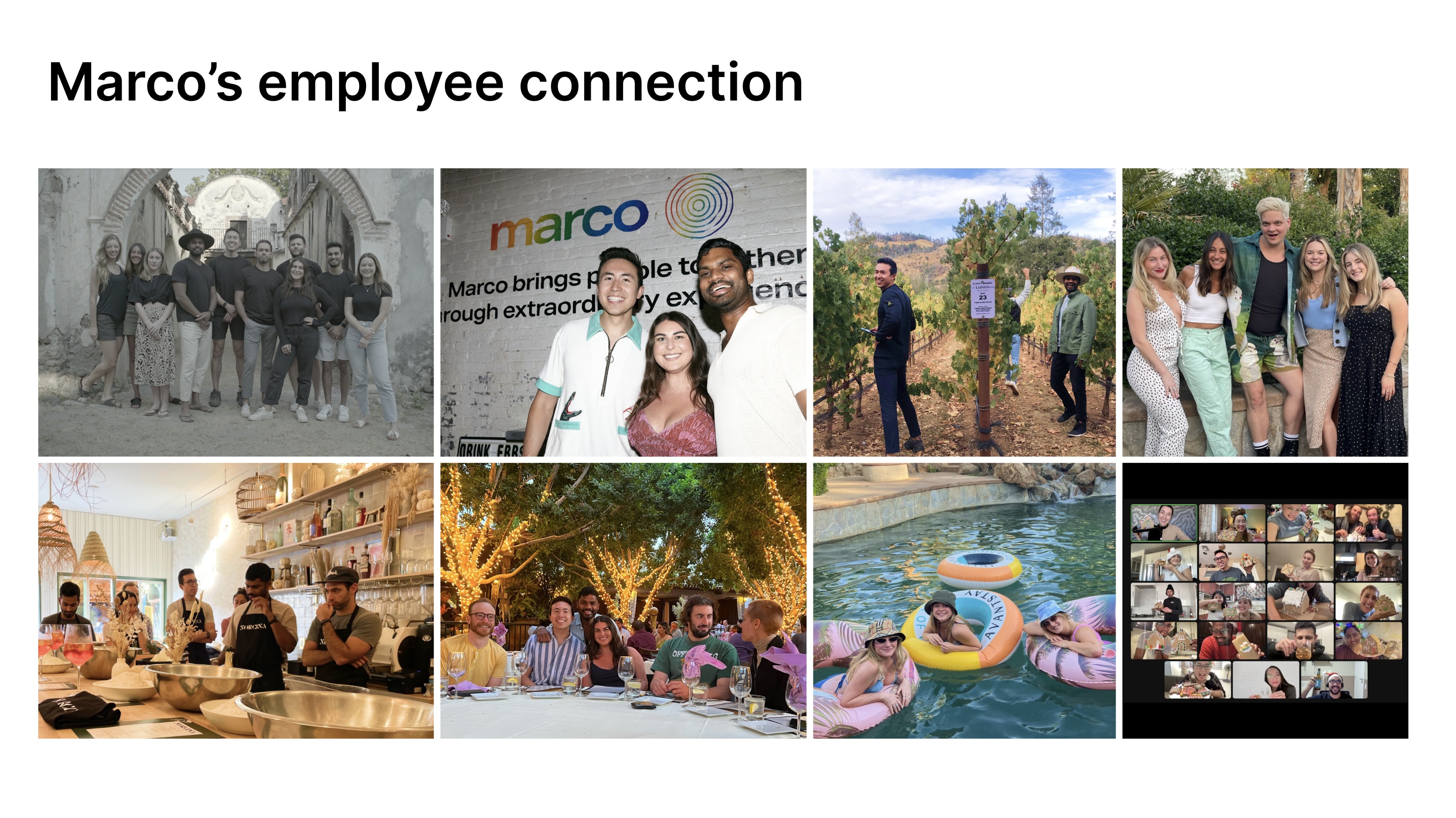
The company has also hosted gatherings for people who build communities professionally. At Mr. Tipple’s Jazz Studio in San Francisco, Marco brought people leaders and community builders together with workshop host Chris Schembra. Guests were asked to turn toward a partner and explain a word that described how they felt.
The exercise asked something specific of the room. Attending an event and participating in it are separate actions; an invitation to speak can help bridge them. It also puts responsibility on the organizer to offer a reason for being there beyond exchanging job titles.
Siva has pursued related questions through interviews. His Turning Companies into Communities conversations have included his co-founder, as well as people working on culture and community elsewhere. There is a practical advantage to asking another builder how they do it. Their answer may reveal a decision that your own polished agenda has overlooked.
The hotel quote enters the conversation
As Marco’s business moved toward offsites, the work became more elaborate. Siva’s 2024 explanation of the company’s direction emphasized saving customers time and money. He cited Ramp’s focus on those two benefits as an influence. A gathering could be meaningful and still be unnecessarily expensive to arrange.
The product work followed the administrative burden. Marco introduced guest tools for invitations, RSVPs, itineraries and preparation details. Collaborative playlists and Slack integration sat alongside maps and travel guidance. An organizer needs somewhere to put the practical information. Guests need a fighting chance of finding it before asking the organizer again.
- 01Choose
a property - 02Compare
group terms - 03Coordinate
the guests - 04Get
together
In January 2025, Siva described a customer who wanted proof that Marco could secure a better hotel rate. He pulled up a previous rate for a property she had used. The comparison was lower than what she had paid. His explanation of savings centered on negotiated group terms, hotel relationships and the volume of business a specialist brings.
By May, he was laying out the next stage, Instant Offsites. His diagnosis was straightforward: booking a room for yourself and arranging rooms, catering and meeting space for a team create different jobs. Group planners can find themselves comparing incompatible quotes, chasing replies and managing contracts while their ordinary work waits.
Marco’s current offering reflects that concern, with group hotel search, rate comparison and booking alongside full-service planning. The ambition has acquired a set of practical verbs. Search. Compare. Book. Each one is a promise to remove some of the work between deciding to gather and arriving.
An invitation, delivered
Siva’s curiosity has also taken him outside travel. In 2023, he and Will Schreiber co-hosted AI For Dummies, exploring image generation, illustration and media. The series included guests such as artist Boris Rasin and former Clear Channel CEO Mark Mays. Its appeal was the permission to investigate a subject while still learning it.
He continues to make the case for getting close to the physical details. A 2025 visit to Snow King Resort in Jackson Hole involved touring rooms and meeting spaces and getting to know the sales team. A platform listing can describe a property. Walking through it gives the person making a recommendation more to work with.
In 2026, he introduced Bagel Bytes, visiting New York startups with Apollo Bagels after deciding that sales had become impersonal. It is a pleasantly literal response to the problem. The founder of a group travel company leaves his screen, carries breakfast across town and asks to meet the people inside.
There is a line back to the school quad here, though the deliveries have improved. Siva’s work keeps returning to the first few feet of a relationship: the approach, the invitation, the reason to stay and talk. Marco handles an expanding amount of machinery behind those moments. Somebody still has to show up.