BREAKING
// San Francisco, California  •  CEO & Co-Founder

Suman
Kanuganti

"Not your memory, not your AI."

Two-time founder. Patent holder. The person who built AI for people who couldn't see - then turned around to build AI that never forgets. Now running Personal AI, where enterprise workforces get a memory layer.

Forbes 40 Under 40 Smithsonian Innovator 10 Patents $16M Raised TIME Best Invention
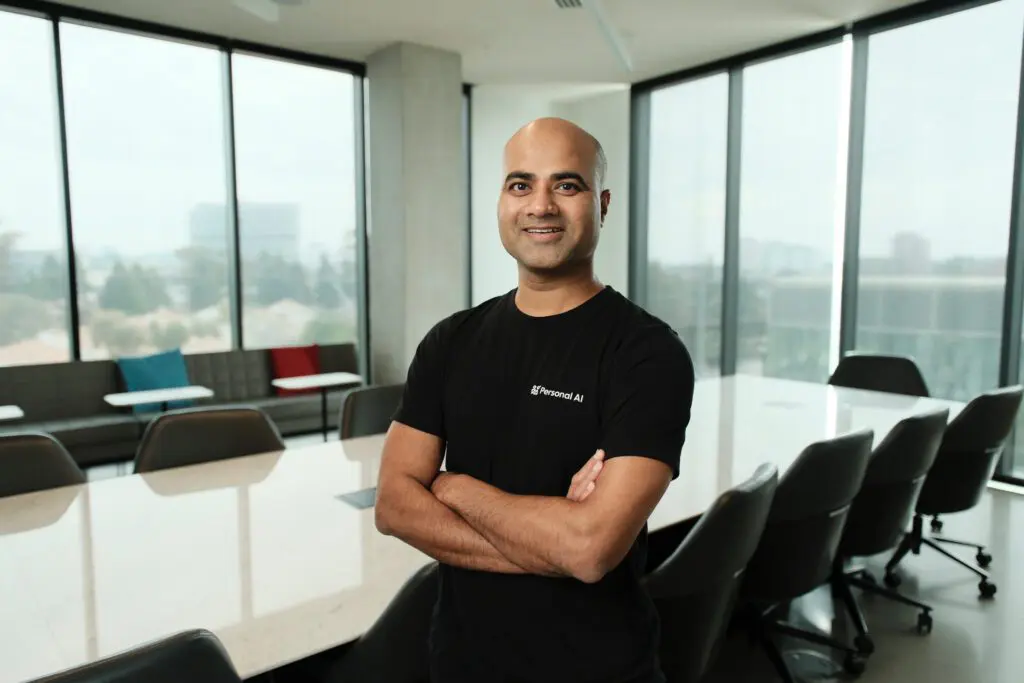
Suman Kanuganti, CEO of Personal AI

Suman Kanuganti // Personal AI // San Francisco

$16M
Raised for Personal AI
10
Patents Held
100+
Podcast Episodes
2x
Venture-Backed Founder

The Memory Builder

There's a company in San Francisco where 53 people are quietly building something that sounds obvious once you hear it: what if your AI remembered everything you knew, forever? That company is Personal AI. The person running it is Suman Kanuganti - and he has been thinking about this longer than most people have been using ChatGPT.

Kanuganti's path to this idea wasn't straight. He came from India, trained as an electrical engineer at Kakatiya University, sharpened his technical edge in robotics at the University of Missouri-Columbia, and then - unusually - added an MBA from UC San Diego's Rady School of Management. At Qualcomm and Intuit, he learned what enterprise-grade systems actually look like under pressure. Both companies. Real scale.

"Every individual should own and build their own AI."

- Suman Kanuganti, CEO, Personal AI

In 2015, he co-founded Aira - long before AI was everyone's favorite word. The premise: use AI and augmented reality glasses to give blind and low-vision people access to visual information, anywhere, anytime. The New York Times called it a "godsend." TIME Magazine put it on their Best Inventions list. Fast Company named it a World Changing Idea. Kanuganti built Aira to $50M in revenue before stepping back.

He would later describe those early years as "physical AI when it was mostly too early." He was a decade early to the wave. He built anyway.

In 2020, while the world was just starting to understand what language models could do, Kanuganti started Personal AI. The initial concept: a digital version of you, built from your own data, facts, and opinions. Not a chatbot. Not a search engine. A memory extension - personal, persistent, and private.

"It's like, Suman, where the hell are you?
This is exactly what we are looking for."

-- Enterprise customer, post-ChatGPT pivot // 2023

When the World Finally Caught Up

When OpenAI launched ChatGPT in late 2022, Suman Kanuganti had a problem that most founders would envy: everyone suddenly wanted what he had been building for two years. The problem was that the market couldn't differentiate - "confusing to investors, confusing to customers," as he put it. His consumer-focused product was getting lost in the noise of every AI startup suddenly claiming the same territory.

So he pivoted. Not the product - the customer. He went enterprise. Specifically, he went after companies with highly sensitive data, the ones that couldn't just send everything to OpenAI's servers and hope for the best. Healthcare. Legal. Finance. Organizations where data sovereignty is existential.

The enterprise response was immediate: "Where have you been?" Personal AI had the private, secure, memory-first architecture that large organizations needed. The pivot worked.

Today, Personal AI's platform is trusted by Microsoft, NVIDIA, HPE, Verizon, AT&T, and T-Mobile. NVIDIA named the company its top independent software vendor for telco. The pitch: Personal Language Models that deliver 10-30x better cost efficiency than general-purpose large language models - because they're trained on specific knowledge, not the entire internet.

10-30x
Cost Efficiency
vs. general LLMs
53
Team Members
Personal AI
$50M
Aira Revenue
Before exit

AI Workforce. On the Balance Sheet.

Kanuganti's stated vision isn't incremental. He thinks public companies will, in the not-so-distant future, report their workforce composition with a line item for AI workers - something like "10% AI workforce powered by personal AI." He's building the platform to make that accounting real and auditable.

The architecture is built on five memory primitives: encoding, stabilizing, storing, retrieving, and updating. It's not retrieval-augmented generation bolted onto a general model. It's a persistent AI identity - one that grows more personal through accumulated experience, transfers across systems, and operates under centralized compliance governance.

The use case that captures the imagination: what happens to institutional knowledge when an expert retires? With Personal AI's memory platform, that knowledge doesn't walk out the door. It stays - searchable, queryable, deployable as an AI that can answer "What would [Name] do?" with real fidelity to how that person actually thought.

From Suman's Medium, Oct 2023: "What Would Larry do?" - Kanuganti wrote about bringing back Larry Bock, a colleague and friend who had passed away, as a personal AI. The piece explored what it means to preserve someone's intellectual legacy in a form others can still access.

That essay - about grief, memory, and technology colliding - reveals something about the founder that the pitch decks don't. Kanuganti thinks about AI as a human problem, not just an engineering one. As an AI developer and father (his words), he wrote an open letter to students about AI in 2023. He tweeted about his 6-year-old's thoughts on the future of AI.

He calls the current AI landscape an "attention economy" problem, and argues for what he calls a "connection economy" - AI that deepens relationships and extends human capability rather than capturing eyeballs for advertisers.

Direct Lines

"

Always keep your cool - handle tasks one-by-one and focus on what is in your control.

"

Everyone gets their own chatgpt model, or we call it chatggt - not pre-trained but model grounded in personal truth.

"

Memory is at the center of authentic AI experiences.

"

Public companies will eventually report workforce composition including what percentage is AI workforce powered by personal AI.

Two Swings. Both Connected.

Aira
2015 - 2020

AI + augmented reality platform giving blind and low-vision people access to visual information. NYT "godsend." TIME Best Invention. Fast Company World Changing Idea. Scaled to $50M revenue.

Raised $35.6M
Personal AI
2020 - Present

Memory-first AI platform for enterprises. Personal Language Models trained on proprietary knowledge. 10-30x cost efficiency vs. general LLMs. Trusted by Microsoft, NVIDIA, Verizon, AT&T, T-Mobile.

Raised $16M

A Decade Early, On Purpose

There's a pattern in how Kanuganti operates. At Qualcomm in 2007, he was a systems engineer learning what enterprise-grade looks like. At Intuit from 2008 to 2015, he spent seven years as an engineering manager - patient, methodical, watching product development at scale. Then he left to found Aira when "physical AI" was mostly a research project.

He's been accused - approvingly - of being perpetually early. The accessibility wave. The personal AI wave. The enterprise AI memory wave. Each time, the market catches up and finds him already there, with infrastructure built.

His mistake, he says candidly, was staying in San Diego too long. "You need to be part of the conversation," he told a podcast host about relocating to San Francisco for fundraising. He moved. The conversations changed. The capital followed.

He's spoken at TechCrunch Disrupt, CES, SXSW, and the Qualcomm Snapdragon Summit. He's logged 100 podcast appearances - a running tally he hasn't slowed down on. The through-line isn't self-promotion. It's a belief that the idea won't spread unless he personally carries it room to room.

"We need AI for connection economy, not attention economy."

- Suman Kanuganti, Medium, Nov 2023

He has 10 patents. He holds an MBA and two graduate degrees, one in robotics, one in business. His written voice on Medium is direct, personal, occasionally philosophical - a CEO who writes about his kids' questions and about deceased colleagues he wishes could still answer Slack messages. Someone who takes seriously the gap between AI as marketed and AI as actually experienced by people.

That gap is what he built his career trying to close.

Receipts

Forbes 40 Under 40
Artificial Intelligence category
Smithsonian Top Innovator
Top Innovator to Watch list
TIME Best Inventions
Aira recognized by TIME Magazine
Fast Company World Changing
World Changing Ideas Award - Aira
NVIDIA Top ISV for Telco
Personal AI named top independent software vendor
NY Times "Godsend"
Editorial recognition for Aira's accessibility impact

What He Talks About

Memory-First AI Enterprise AI Personal Language Models AI for Healthcare AI for Legal Accessibility Tech Connection Economy Private AI Deployment Robotics AI Data Ownership AI Workforce Immigrant Entrepreneurship Telco AI AI Personas Voice Cloning NLP